
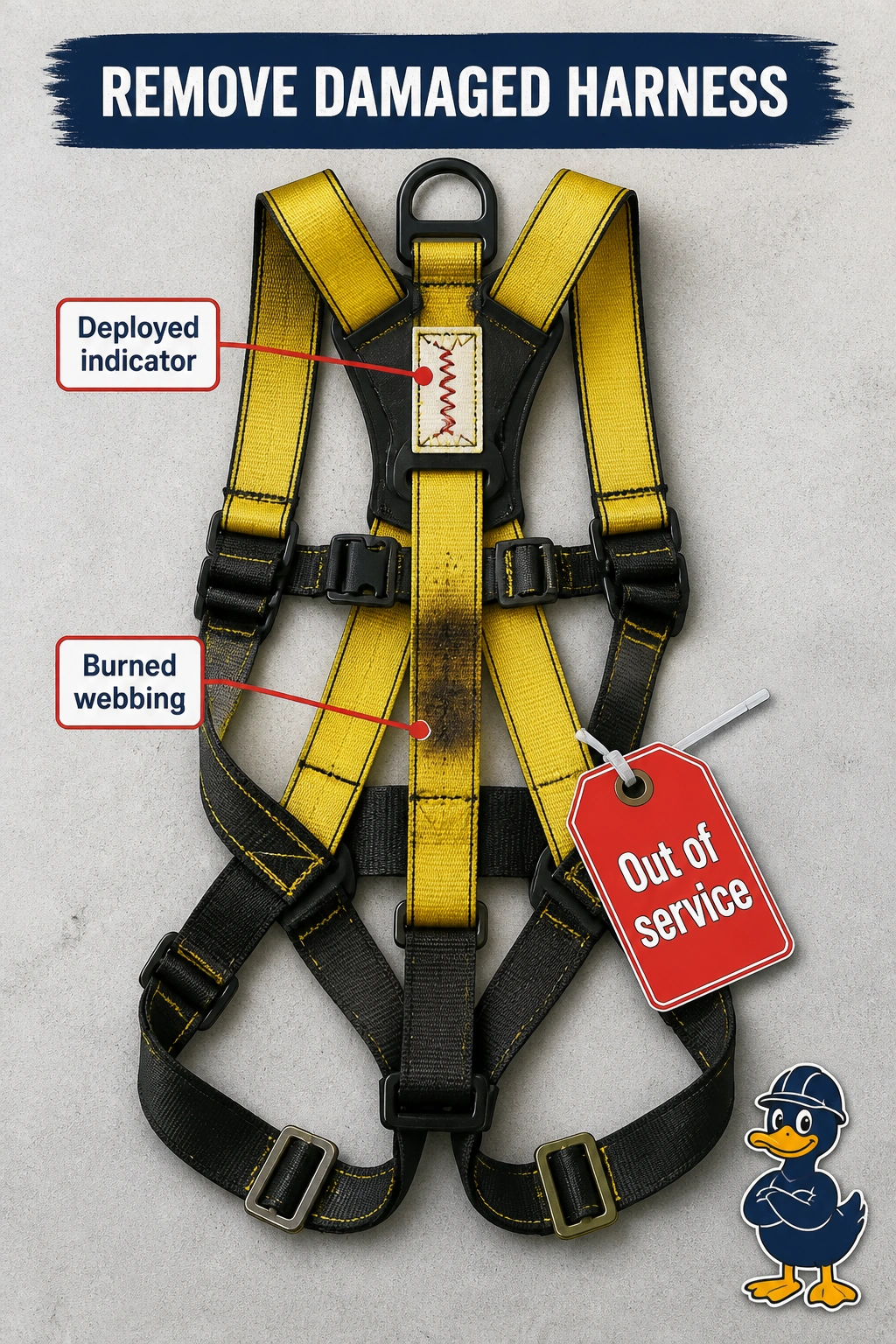
During a pre-shift fall protection inspection on a commercial steel frame, an ironworker foreman notices a worker's full-body harness has a deployed stitched impact indicator and weld-spatter burns on the dorsal webbing. What must the foreman require?
Select an answer to reveal the explanation.
Short Explanation
A harness with a popped impact indicator or weld burns is like a car airbag that already went off—it cannot be trusted to save a life twice. You have to pull it from service on the spot, because the trap is thinking intact metal buckles mean the webbing will hold a fall.
Full Explanation
Under 29 CFR 1926.502, personal fall arrest systems subjected to impact loading or showing defective components must be immediately removed from service, so you must immediately remove the damaged harness from service and tag or destroy it so it is not reused. A deployed impact indicator shows the harness has already absorbed fall forces, and weld-spatter burns weaken synthetic webbing fibers well below their rated strength. Choosing to allow the worker to use the harness if the chest and leg buckles still latch ignores severe structural damage to the load-bearing webbing. Choosing to wrap electrical tape over the burned webbing and re-inspect the harness weekly conceals the defect without restoring any tensile capacity. Choosing to assign the harness only for low-elevation work under ten feet above grade is dangerous because any fall from elevation can be fatal and a compromised harness can fail at any height. As a caveat, a competent person must also inspect any lanyard or self-retracting lifeline connected to that harness before it is cleared for use. For an operational check, cut the damaged webbing or lock the harness in an out-of-service bin, issue a compliant replacement harness, and verify the worker's pre-use inspection.
Prefer to study offline? Printable PDF study book + test engine ($7.50, unofficial). These questions stay free here.