
A masonry foreman is about to start laying a 12-foot-high concrete block wall that is not yet braced, while carpenters are framing an adjacent interior partition nearby. What must the foreman establish before laying block?
Select an answer to reveal the explanation.
Short Explanation
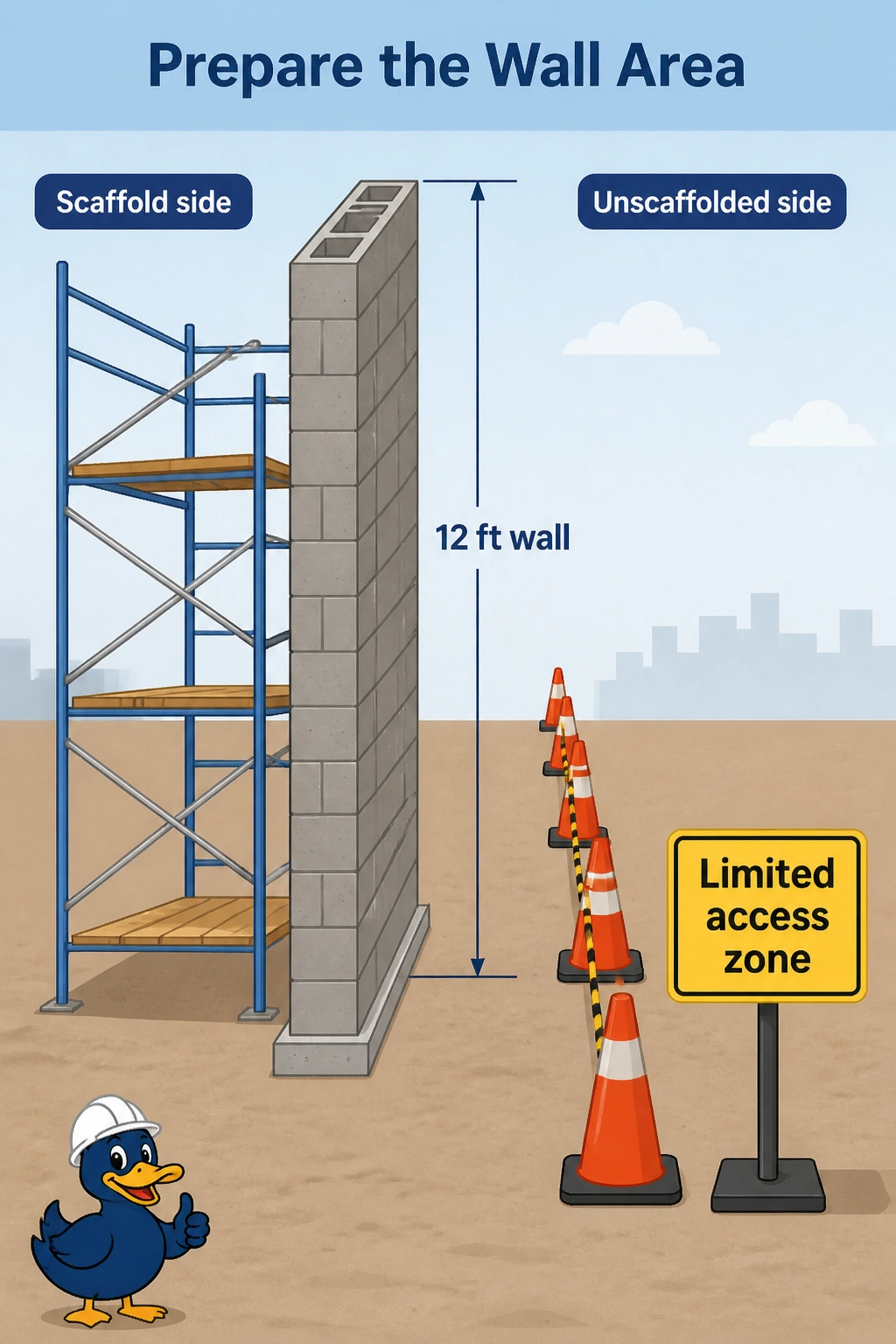
An unbraced concrete block wall acts like a giant domino waiting for a gust of wind or a bump. The trap is thinking you can mark off the danger zone later once the wall gets tall, instead of setting up a limited access zone before the first block is laid.
Full Explanation
Unbraced masonry walls have little lateral strength while mortar is curing and can topple from wind or contact. Under 29 CFR 1926.706, the foreman must Establish a limited access zone on the unscaffolded side before construction begins. The zone must run the entire length of the wall, extend outward a distance equal to the height of the wall to be constructed plus 4 feet on the unscaffolded side, and restrict entry to employees actively constructing the wall until the wall is adequately supported. Walls over 8 feet also need bracing unless the wall is adequately supported to prevent overturning. Choosing to Post a single caution cone at each end of the wall after the mortar sets fails because cones do not create a compliant perimeter and waiting until mortar sets leaves workers exposed during active construction. Choosing to Allow only the mortar mixer operator to walk along the unbraced side of the wall fails because only workers constructing the wall may enter the limited access zone, and mixer operators belong outside the collapse radius. Choosing to Wait until the wall reaches full 12-foot height before marking off any restricted work zone fails because OSHA requires the zone to be established before construction starts, not after the wall is already tall enough to crush nearby trades. Measure and barricade the zone before the first block is laid.
Prefer to study offline? Printable PDF study book + test engine ($7.50, unofficial). These questions stay free here.