
A drywall foreman inspects a 20-foot portable extension ladder leaned against a 16-foot concrete block wall and sees its base sits 8 feet from the wall on smooth concrete. What must the foreman require before anyone climbs?
Select an answer to reveal the explanation.
Short Explanation
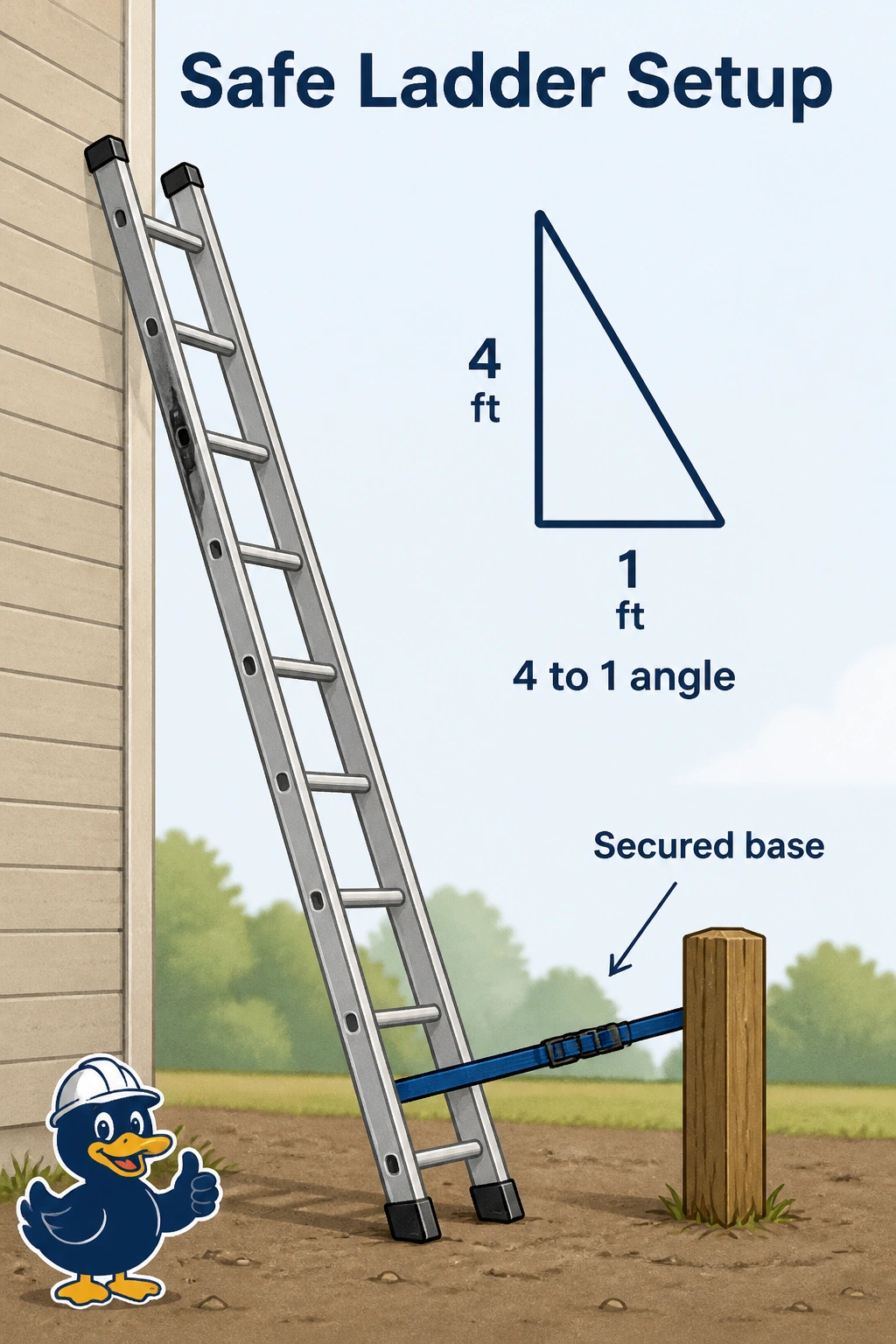
Setting a ladder too flat turns every step into a lever trying to kick the feet out from under you. You need the base set at roughly one-quarter of the working length and secured so the rails cannot slide on smooth concrete. The trap is thinking a steep or overly flat angle is fine as long as a coworker holds the bottom.
Full Explanation
Under OSHA's portable ladder standard, 29 CFR 1926.1053, a non-self-supporting ladder must be set so the horizontal distance from the top support to the foot is about one-quarter of the working length, so the foreman must Reset the ladder to a 4-to-1 angle and secure it against slipping or displacement. With a 16-foot vertical reach, an 8-foot setback is about a 2-to-1 angle, which places excessive outward shear on the feet. Choosing to Have a coworker stand on the bottom rung while the climber carries drywall tools up relies on human weight instead of proper geometry and violates safe carrying practices. Opting to Extend the fly section two more rungs higher while keeping the base at 8 feet leaves the base far too shallow on slick concrete. Choosing to Flip the ladder around so the curved rubber feet face outward against the block wall misaligns the slip-resistant feet and weakens rail stability. Even at a proper 4-to-1 angle, smooth concrete still requires tying off the top or using positive slip-resistant blocking. As an operational check, measure roughly 4 feet out for a 16-foot contact height, tie off the top rails, and inspect the feet before use.
Prefer to study offline? Printable PDF study book + test engine ($7.50, unofficial). These questions stay free here.