
On a two-story brick facade project, a masonry foreman sees a laborer climbing the diagonal X-braces of a supported frame scaffold to reach the second-tier platform instead of walking to the end frame's attached ladder. What should the foreman do?
Select an answer to reveal the explanation.
Short Explanation
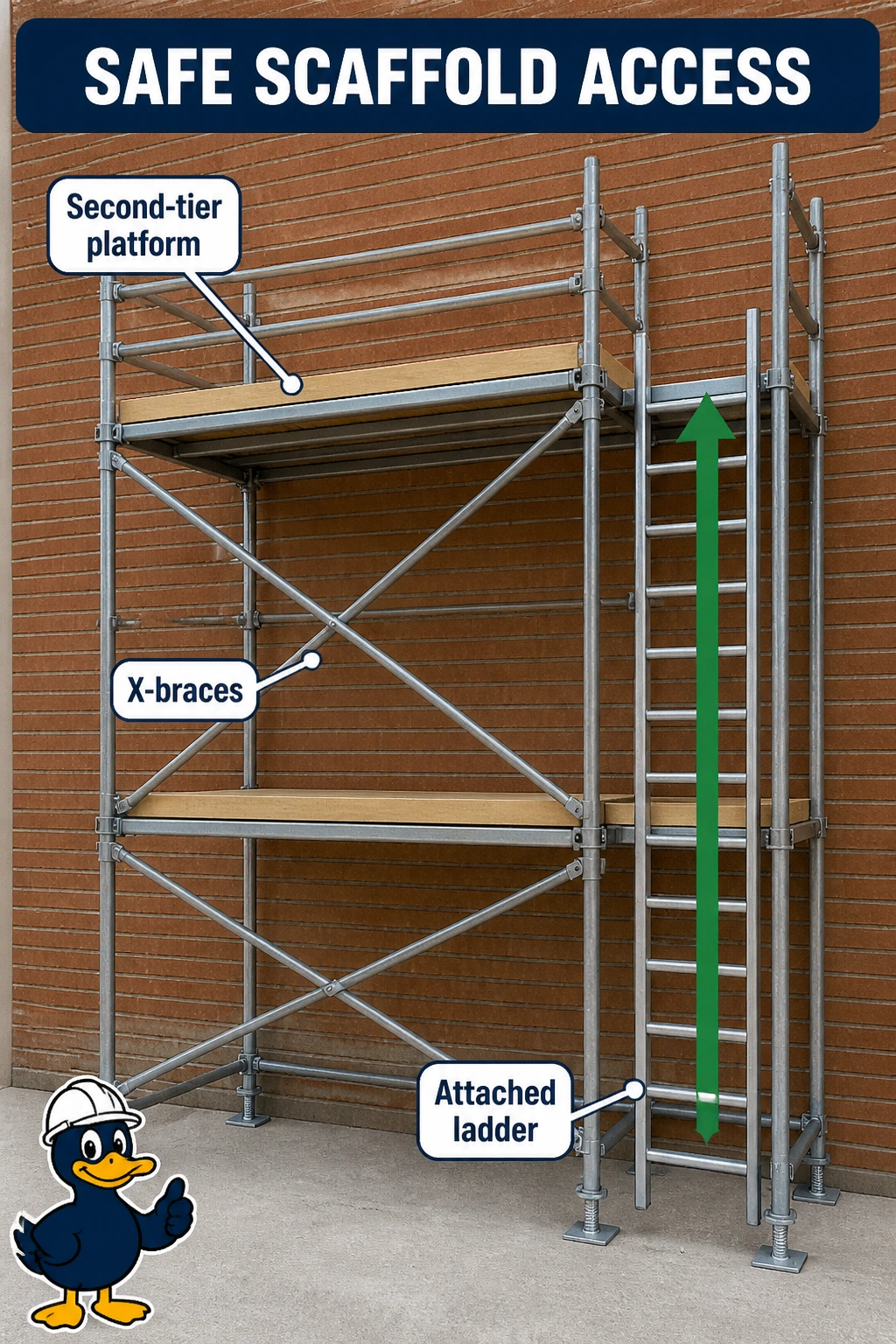
You should stop the worker and require the attached scaffold access ladder; cross-braces stiffen a scaffold, not serve as a staircase. The trap is thinking three-point contact makes brace climbing safe, since the braces can pop loose or snap under foot loads.
Full Explanation
Under 29 CFR 1926.451(e)(1), employers must provide safe access to scaffold platforms, and cross-braces must never be used as a means of access. Stop the worker and require use of the attached scaffold access ladder; this addresses the fall and structural-failure hazard because ladders and integral access frames are engineered to carry vertical climbing loads. Allowing the worker to climb the braces with three points of contact still violates OSHA scaffold access rules: cross-braces are thin-walled members designed for lateral stability, not foot traffic. Inspecting the brace locking pins before allowing the climb does not make it safe; a boot can slip off the angled tubing, and the climb remains unstable. Tying the brace intersections with wire to keep them from flexing is an improvised field modification that adds no rated load capacity to the braces. As an exam caveat, even integral end-frame rungs are compliant for access only when spaced and sized according to scaffold standards. For a practical check, walk the scaffold perimeter before the shift to verify that an unobstructed attached ladder is installed within easy reach of every active work bay.
Prefer to study offline? Printable PDF study book + test engine ($7.50, unofficial). These questions stay free here.