
While inspecting a three-tier supported tube-and-coupler scaffold erected on compacted soil along a commercial exterior wall, a masonry foreman sees the scaffold legs resting directly on hollow concrete blocks. What must the foreman require before workers use the scaffold?
Select an answer to reveal the explanation.
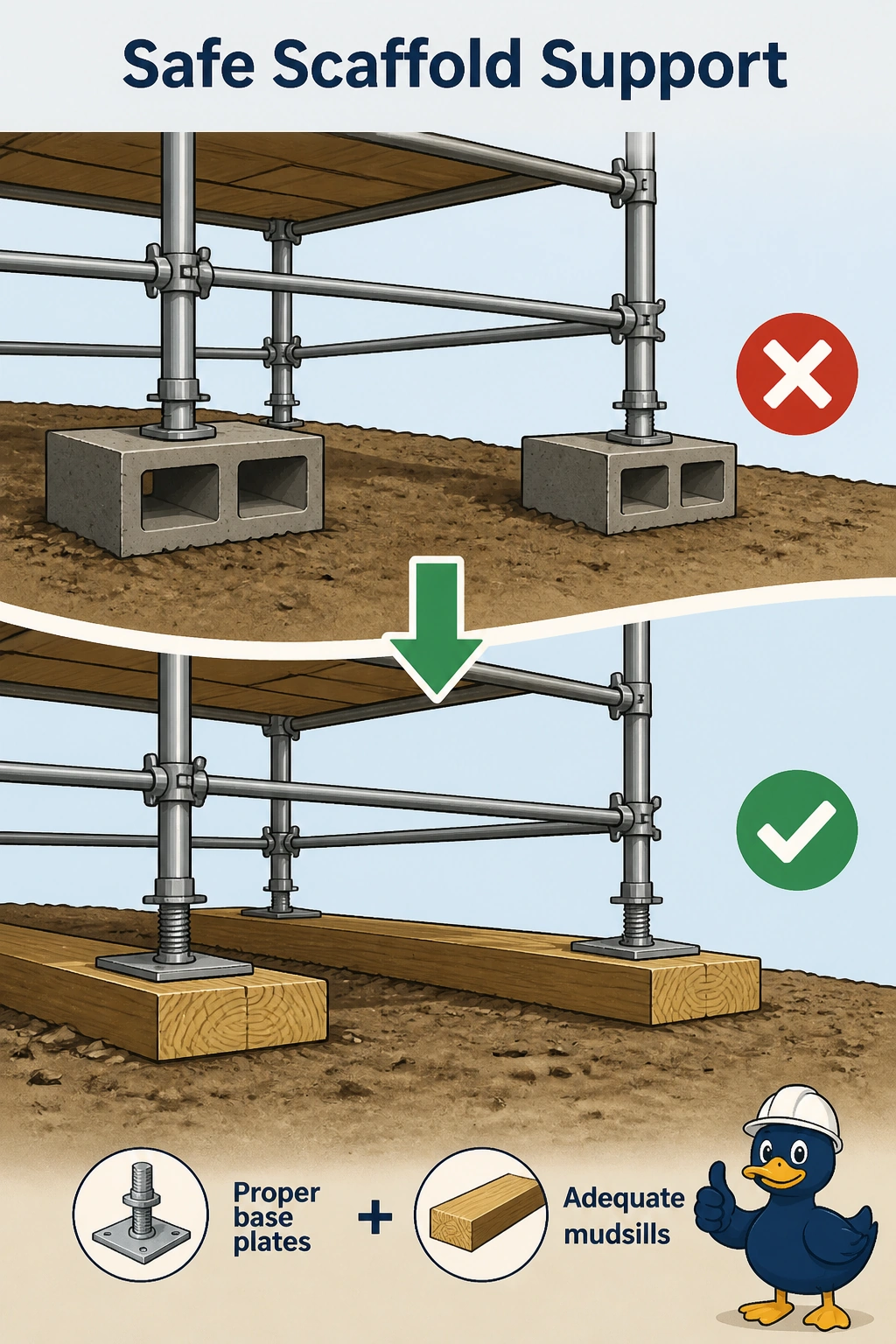
Short Explanation
Hollow concrete blocks under scaffold legs are like building a house on eggshells—one point load and they shatter without warning. Make sure you check what is under every leg before anyone climbs, because reducing the crew weight on top never fixes an unstable foundation.
Full Explanation
Under OSHA's supported scaffold standard in 29 CFR 1926.451, supported scaffold poles, legs, posts, frames, and uprights must bear on base plates and mudsills or other adequate firm foundations, and unstable objects must not be used to support scaffolds. The foreman must Replace the hollow blocks with proper base plates set on adequate mudsills so the vertical load spreads evenly over compacted soil without crushing. Trying to Fill the cores of the hollow concrete blocks with loose sand to distribute the load fails because masonry units are brittle under concentrated point loads and can still crack or shift laterally. Attempting to Tie the top tier to the brick veneer with wire so the legs carry less weight is unsafe because scaffold ties resist tipping, not vertical gravity loads, and masonry veneer is not a structural anchor. Choosing to Limit the platform load to two workers and one mortar tub per bay instead of altering the base leaves an uncompliant, unstable foundation in service where a sudden block failure could collapse the entire frame. As a field caveat, verify that mudsills are sound lumber placed flat across firm, drained ground rather than stacked scrap boards. For an operational check, walk the entire perimeter of the scaffold base before each shift to confirm every leg sits centered on a pinned base plate and solid mudsill.
Prefer to study offline? Printable PDF study book + test engine ($7.50, unofficial). These questions stay free here.