
On a three-story concrete office build, a carpenter foreman finds a 24-inch-square mechanical shaft opening covered by a loose sheet of plywood with no markings. What must the foreman have the crew do to make the cover compliant?
Select an answer to reveal the explanation.
Short Explanation
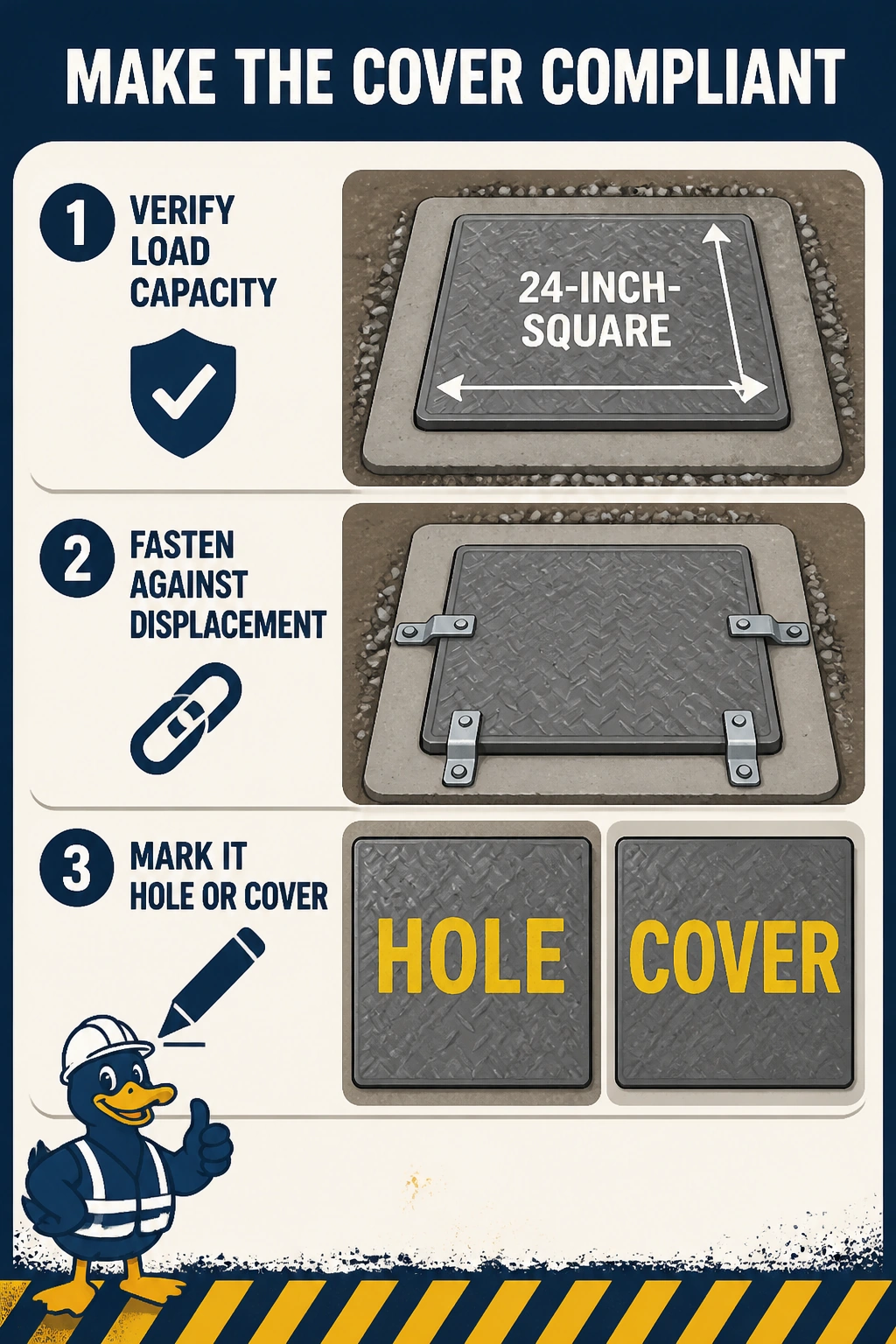
An unmarked, loose piece of plywood looks like scrap until someone picks it up and steps straight into a shaft. To turn a tripping trap into a real floor cover, you have to prove its strength, lock it down, and label it clearly. The trap is thinking bright paint or warning flags alone make a hole cover safe.
Full Explanation
Under 29 CFR 1926.502(i), a compliant floor hole cover requires all three elements in "Verify load capacity, fasten the cover against displacement, and mark it HOLE or COVER". Covers must support at least twice the weight of employees, equipment, and materials that may be imposed on them, be secured to prevent accidental displacement, and be color-coded or marked with "HOLE" or "COVER" so no worker mistakes the panel for loose material. Choosing to "Nail two warning flags to the nearby columns and instruct trades to walk around the plywood sheet" leaves an unsecured panel that can still slide or be lifted by another trade. Opting to "Replace the plywood with orange safety netting stretched across the opening at floor level" fails because plastic warning mesh is not a rated walking-working surface cover. Deciding to "Paint the top of the plywood bright yellow so workers can spot it easily while pushing carts" addresses visibility only and leaves the cover unfastened and unverified for cart loads. As a caveat, even a properly marked and fastened cover must be kept clear of excessive material staging that could exceed its rated capacity. Before reopening the deck, physically test that the fasteners resist shifting and confirm the lettering is legible from walking approaches.
Prefer to study offline? Printable PDF study book + test engine ($7.50, unofficial). These questions stay free here.