
A mechanical crew plans to hoist three full oxygen cylinders in a rack to the third floor using a crane and then store them upright in a staging bay overnight, with the regulators removed. Under OSHA 29 CFR 1926.350(a)(1), what must be in place on every cylinder?
Select an answer to reveal the explanation.
Short Explanation
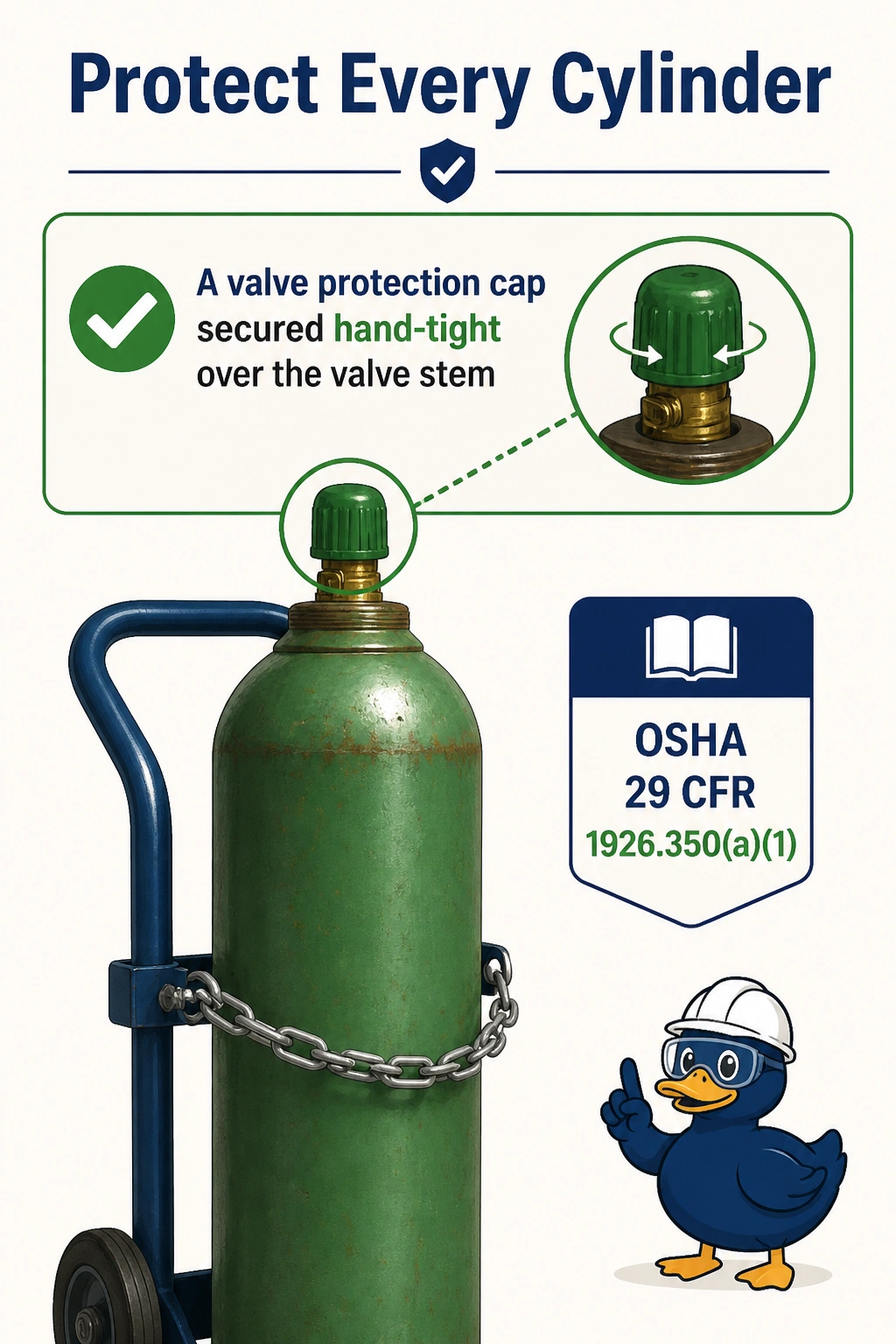
You’re right to focus on the valve: an unprotected cylinder valve can snap during a hoist, turning a high-pressure steel tank into an unguided rocket. When you move or store cylinders without regulators, you need a valve protection cap secured hand-tight over the valve stem; padding or an attached gauge does not protect it.
Full Explanation
OSHA 29 CFR 1926.350(a)(1) requires valve protection caps to be in place and secured whenever compressed gas cylinders are transported, moved, or stored, unless a cylinder is connected for use with a regulator. A valve protection cap secured hand-tight over the valve stem shields the brass valve from impact; if the stem shears, high-pressure gas can escape violently. A plastic zip-tie securing the handwheel in the open position creates an immediate release hazard rather than protecting the valve, and cylinder valves must be closed when not in use. A fabric welding blanket wrapped around the cylinder body does not shield the vulnerable top valve assembly from striking structural steel or crane rigging. A pressure gauge left threaded onto the outlet connection does not provide the required cap and leaves the valve assembly exposed to shearing forces during hoisting. Exam caveat: cylinders must also be hoisted in a cradle, slingboard, or pallet—never by the valve protection cap itself or with electromagnets. For a practical check, walk the cylinder storage rack before each shift and confirm every disconnected cylinder has its valve closed, its cap threaded on, and its body secured upright with a chain.
Prefer to study offline? Printable PDF study book + test engine ($7.50, unofficial). These questions stay free here.