
Carpenters are installing a job-built wooden perimeter guardrail system around an open third-floor concrete slab edge. Under 29 CFR 1926.502, what minimum force must the top edge of the guardrail withstand when applied in any outward or downward direction?
Select an answer to reveal the explanation.
Short Explanation
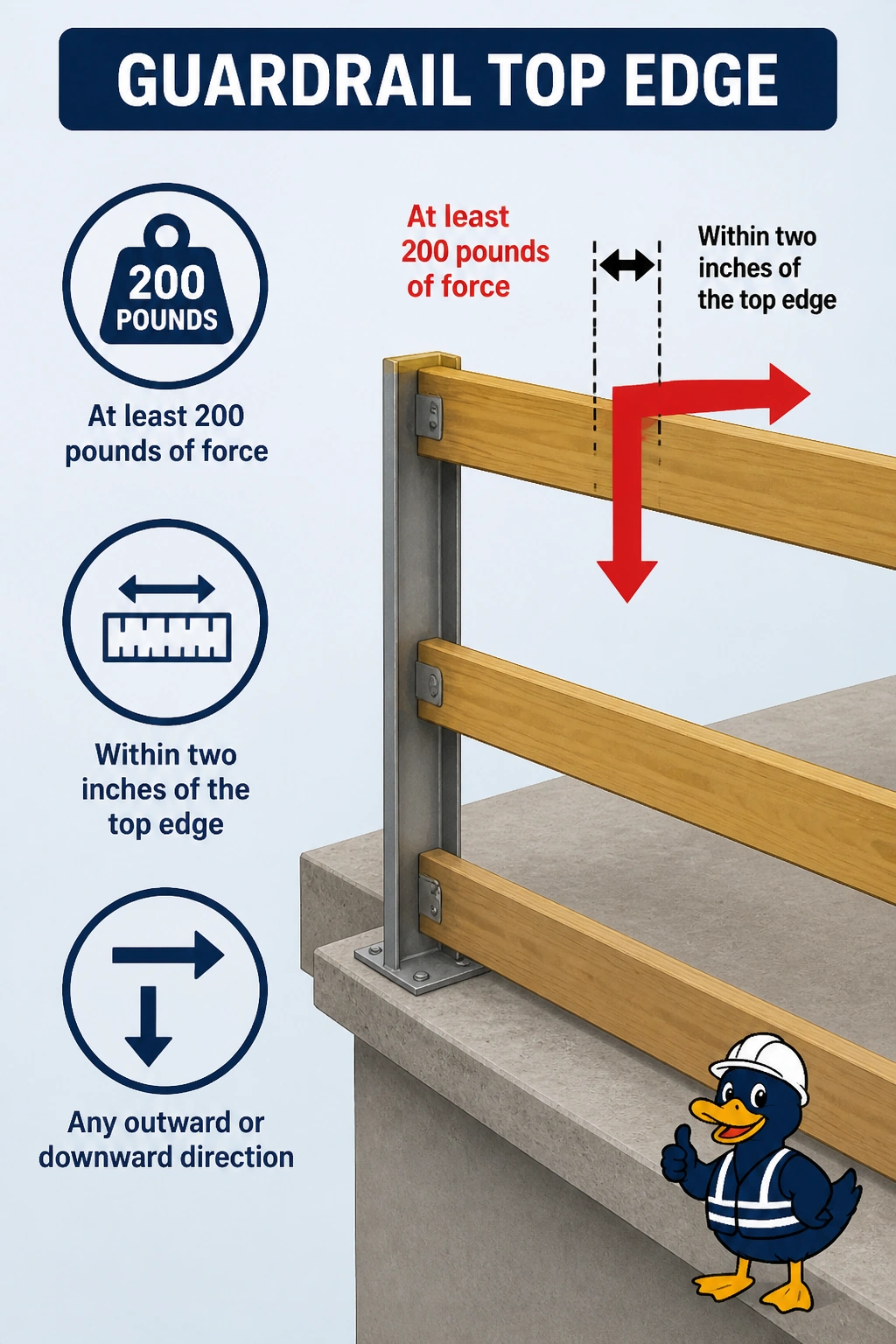
A guardrail is not a visual suggestion—it has to catch your weight if you stumble near an open slab edge. Under 29 CFR 1926.502, the top edge of a guardrail system must withstand at least 200 pounds of outward or downward force without failing. The trap is guessing a much higher or lower load limit or confusing guardrail strength with fall arrest anchorage.
Full Explanation
Under 29 CFR 1926.502, the top rail must meet the requirement of At least 200 pounds of force applied within two inches of the top edge. 1926.502(b)(3): the top rail must withstand, without failure, at least 200 pounds applied within 2 inches of the top edge, in any outward or downward direction, at any point along the top edge. The 39-inch limit applies only to downward loading: when the 200-pound test load is applied downward, the top edge shall not deflect below 39 inches (1926.502(b)(4)). Choosing At least 500 pounds of static force applied at the midpoint between upright posts fails because 500 pounds is not the OSHA top-rail standard, and overbuilding without proper post spacing can still leave weak splices. Selecting At least 100 pounds of outward force with no more than six inches of deflection fails because 100 pounds is half the required top-rail strength and would not reliably arrest a falling worker's momentum. Choosing At least 300 pounds of downward force concentrated at the corner post connection fails because OSHA tests the top edge in both outward and downward directions at any point, not solely downward at corner posts. As a caveat, midrails, screens, and mesh must separately withstand at least 150 pounds of force in any downward or outward direction. For an operational check, inspect post spacing, lumber grade, and nail or bolt connections along every run before allowing trades near the edge.
Prefer to study offline? Printable PDF study book + test engine ($7.50, unofficial). These questions stay free here.