
A geotechnical technician brings a portable nuclear moisture-density gauge onto an active highway grading project to test compacted soil layers. Which control strategy best minimizes ionizing radiation exposure for nearby grading crews?
Select an answer to reveal the explanation.
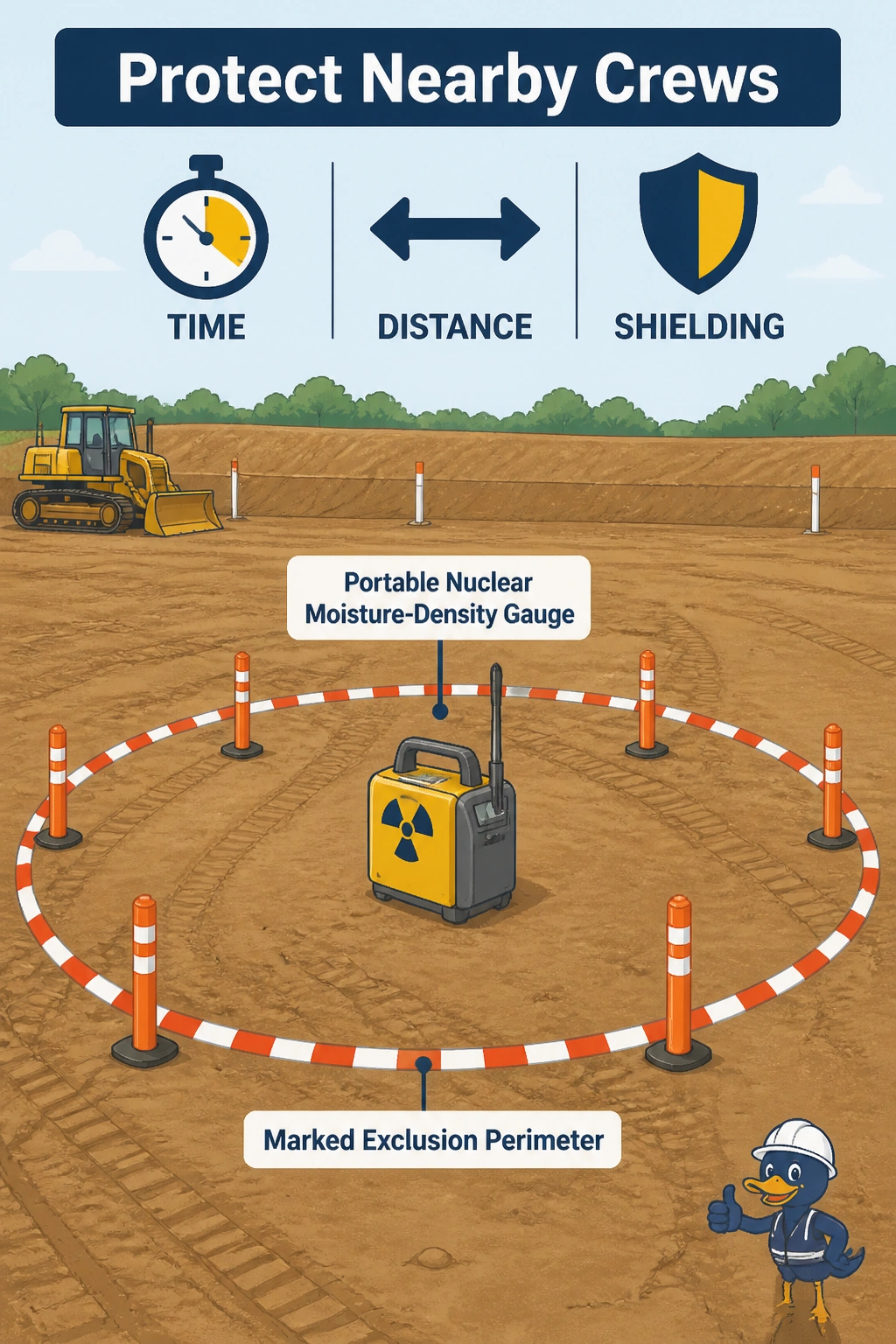
Short Explanation
With invisible radiation, distance is your best friend—like stepping back from a roaring campfire! You protect nearby crews by using time, distance, and shielding: keep them outside a marked perimeter while the gauge is active, since leather aprons, safety glasses, and a darkened display do not stop its radiation.
Full Explanation
Portable nuclear moisture-density gauges contain sealed radioactive sources that emit ionizing radiation, so the core protective mechanism relies on ALARA principles—keeping exposures as low as reasonably achievable. Applying time, distance, and shielding principles by establishing a marked exclusion perimeter around the active gauge reduces dose rates because radiation intensity drops rapidly with distance, while the source rod is retracted into its shielded housing between readings. Requiring nearby equipment operators to wear leather aprons and safety glasses fails because standard leather and polycarbonate eyewear do not block penetrating gamma or neutron radiation. Storing the active gauge inside the crew break trailer between compaction tests creates an unnecessary ongoing exposure hazard in an occupied space. Turning off the electronic display screen when workers walk past only darkens the readout; the sealed radioactive source continues emitting. As a caveat, only trained, authorized operators wearing personal dosimetry should handle the gauge. For an operational check, verify that the perimeter cones are posted, confirm the source rod locks in the shielded position after each test, and inspect the operator’s transport log.
Prefer to study offline? Printable PDF study book + test engine ($7.50, unofficial). These questions stay free here.