
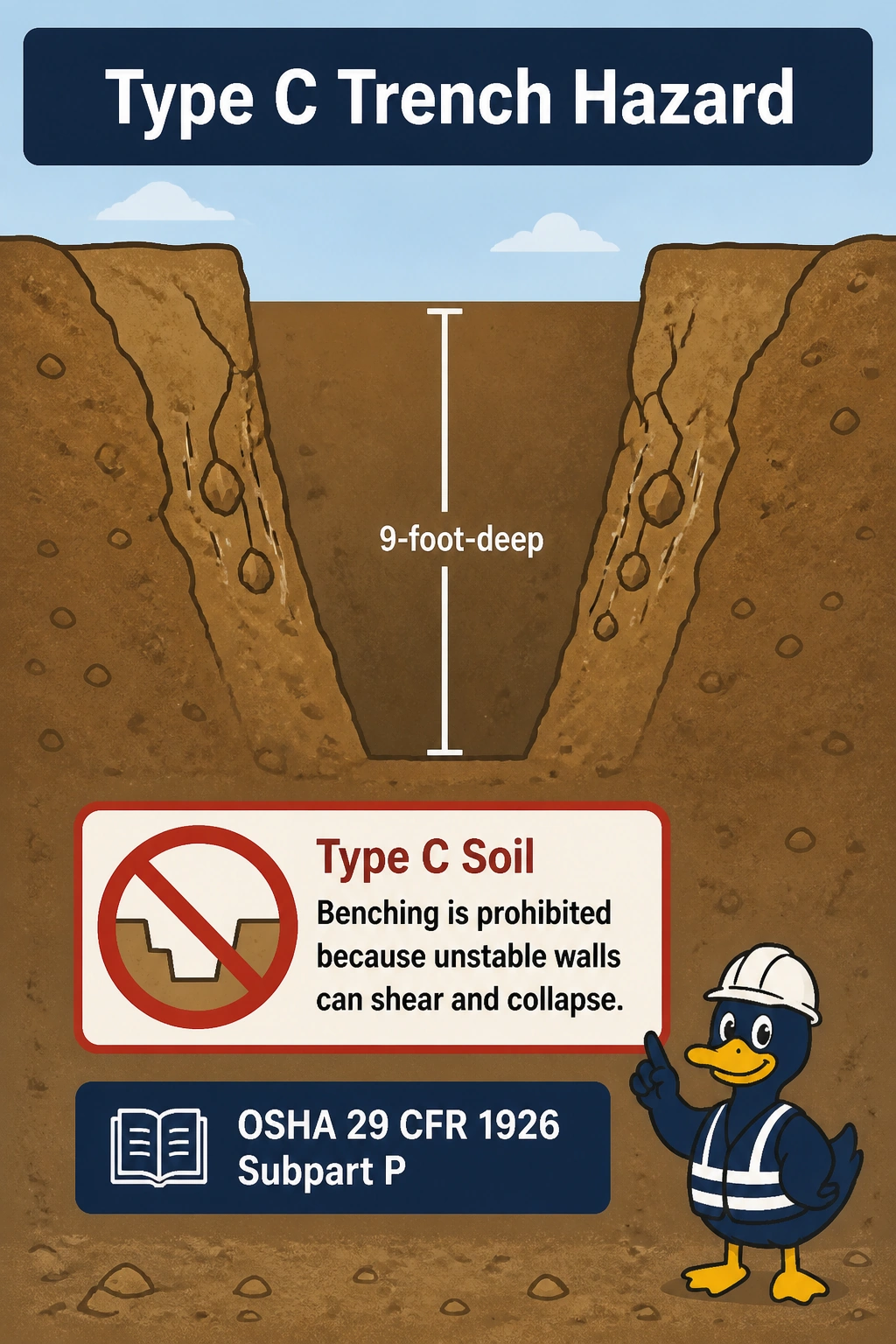
A utility crew is excavating a 9-foot-deep trench in wet, granular Type C soil where groundwater seepage is visible along the lower walls. Under OSHA 29 CFR 1926 Subpart P, why must the safety technician reject the foreman's plan to bench the trench walls?
Select an answer to reveal the explanation.
Short Explanation
Cutting neat stair-steps into trench walls works in stable clay, but in wet, sandy Type C soil those steps crumble like dry sugar. The trap is thinking smaller step heights make benching safe in loose ground, when your rulebook forbids benching Type C soil altogether and requires sloping or shielding.
Full Explanation
Under OSHA 29 CFR 1926 Subpart P Appendix B, benching—excavating the sides of an excavation to form one or a series of horizontal levels or steps—is permitted only in cohesive Type A and Type B soils. Because "Benching is prohibited in Type C soil because unstable walls can shear and collapse", granular, sandy, or water-seeping Type C soils must be protected by sloping at a 1.5 horizontal to 1 vertical angle, shoring, or a trench shield. "Benching is permitted in Type C soil only when the trench is shallower than twelve feet" is false because the prohibition applies at any depth requiring protective systems, not just deep cuts. "Benching is allowed in Type C soil if each vertical step is cut no higher than two feet" confuses Type C rules with cohesive soil benching geometry, which still cannot hold vertical faces in granular or wet ground. "Benching is required in Type C soil whenever a trench box is unavailable on the jobsite" is dangerous because missing equipment never authorizes an outlawed protective method. As a caveat, when layered soils sit over Type C soil, the weaker Type C requirement governs the lower portion or a professional engineer must design the system. As an operational check, have the competent person verify soil classification, water seepage, and either a 1.5:1 slope or a properly rated trench box before entry.
Prefer to study offline? Printable PDF study book + test engine ($7.50, unofficial). These questions stay free here.