
A masonry crew is erecting a three-tier welded-frame scaffold on compacted dirt outside a new retail building. What must be placed beneath every scaffold leg to prevent settling or displacement?
Select an answer to reveal the explanation.
Short Explanation
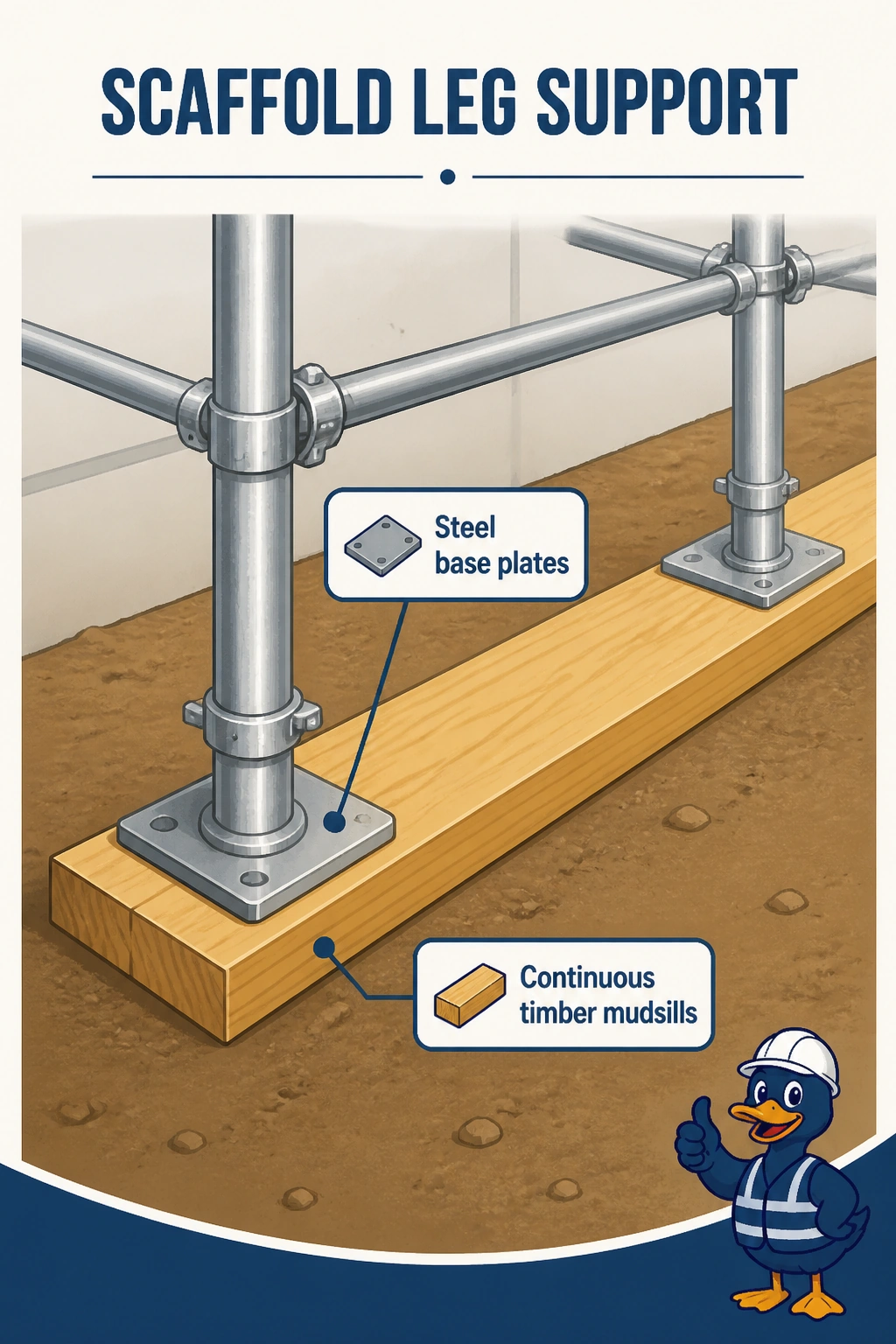
You can picture a scaffold leg like a stiletto heel on soft grass: without a wide, firm footing, you can watch it sink or shift. Under 29 CFR 1926.451(c)(2), you need base plates on mud sills or other adequate firm foundation, typically steel plates on mud sills that spread the load; blocks and shims can crack or topple the frame.
Full Explanation
Under 29 CFR 1926.451(c)(2), supported scaffold poles, legs, posts, frames, and uprights shall bear on base plates and mud sills or other adequate firm foundation, and footings must be level, sound, and rigid. On soil use base plates, which are typically steel, on mud sills that spread the load; OSHA does not specify steel or that the sill be continuous timber, though a continuous sill under both legs of a frame is common practice. Each base plate distributes the concentrated vertical load from a leg, and the mud sill spreads that load across a wider soil-bearing area, helping prevent differential settling, tilting, or collapse. Stacked concrete masonry blocks leveled with cedar shims are unsuitable because concrete blocks and loose shims are unstable and can fracture under eccentric loading. Rubber anti-vibration pads rated for the scaffold's empty weight do not account for workers, tools, and masonry materials, and flexible rubber does not provide a rigid, non-settling footing. Gravel-filled burlap sandbags tamped flat under each frame can shift or deform as moisture and vibration change soil conditions. Masonry blocks, loose shims, sandbags, and flexible pads are unstable objects and are not an adequate foundation (1926.451(c)(2)(ii)). As a practical check, inspect every leg before each shift to confirm its base plate is centered on the mud sill and level, with no washout.
Prefer to study offline? Printable PDF study book + test engine ($7.50, unofficial). These questions stay free here.