
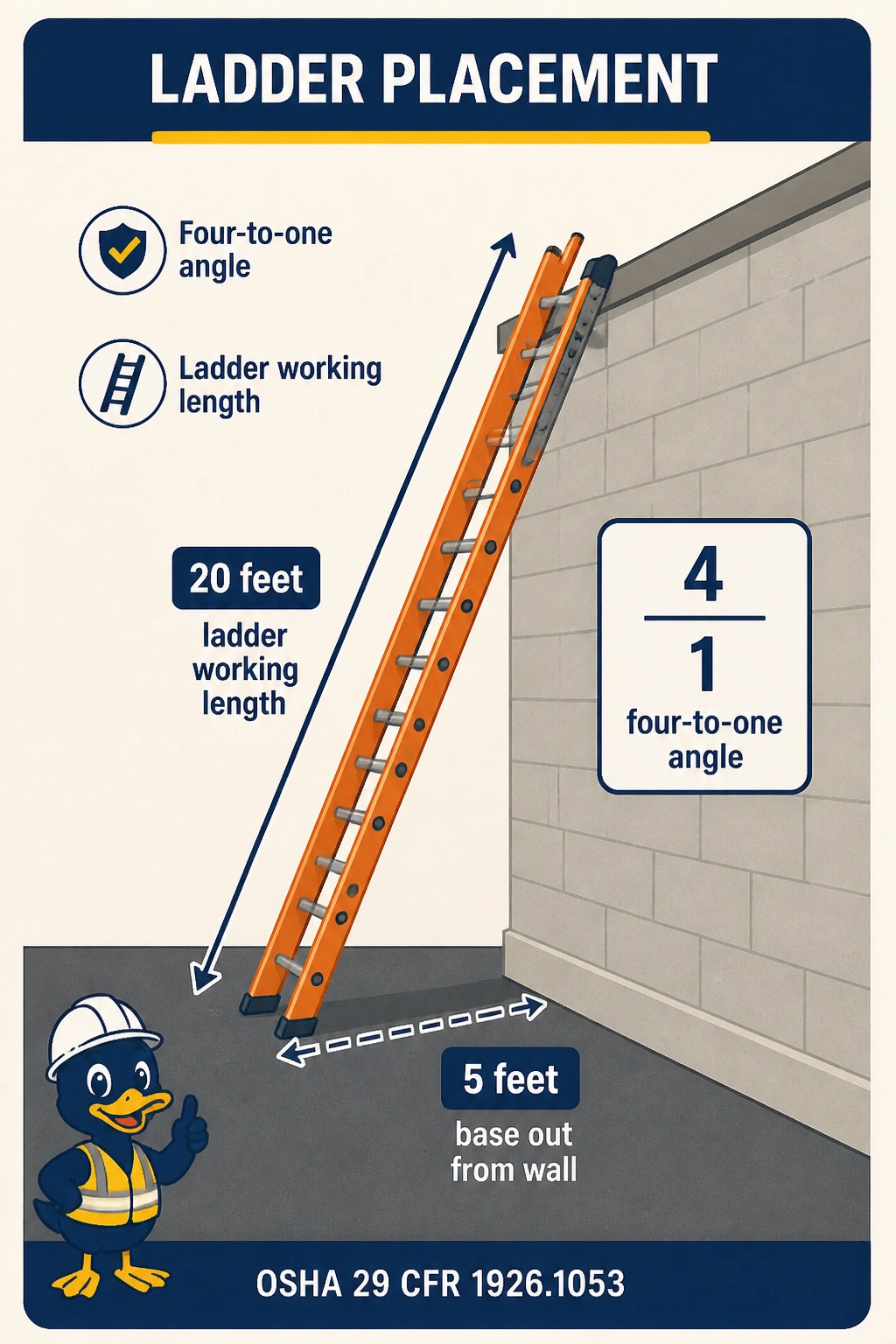
An electrician positions a non-self-supporting extension ladder against a concrete masonry wall at a working length of 20 feet to reach a conduit junction box. Under OSHA 29 CFR 1926.1053, how far from the wall must the base of the ladder be placed?
Select an answer to reveal the explanation.
Short Explanation
Setting a ladder at the right angle keeps you from tipping backward or sliding out at the bottom. The trap is guessing a fixed distance or making the angle too shallow, which overstresses the side rails and invites a base kick-out.
Full Explanation
Under OSHA 29 CFR 1926.1053 ladder angle requirements, a non-self-supporting ladder must be used at an angle such that the horizontal distance from the top support to the foot of the ladder is approximately one-quarter of the working length of the ladder, commonly called the four-to-one ratio. For a working length of 20 feet, dividing 20 by 4 gives 5 feet, so the crew must place the ladder base 5 feet away from the wall to maintain a four-to-one angle. Choosing to place the ladder base 2 feet away from the wall so the rails stay nearly vertical creates an overly steep pitch that increases the risk of the ladder tipping backward as the worker climbs. Choosing to place the ladder base 10 feet away from the wall to create a wider stability base produces a 2-to-1 ratio that is far too shallow, placing excessive bending stress on the rails and increasing the chance of the bottom sliding out. Choosing to place the ladder base 8 feet away from the wall regardless of the working length ignores the proportional relationship between working length and horizontal setback, resulting in an unsafe angle for a 20-foot span. As a caveat, working length is measured along the ladder between the foot and the top support point, not the total manufactured length of the ladder sections. As an operational check, have the worker stand with their toes against the base rails and extend their arms straight out; if their palms comfortably touch the rung at shoulder height, the angle is close to four-to-one.
Prefer to study offline? Printable PDF study book + test engine ($7.50, unofficial). These questions stay free here.