
Masons are laying block from a supported welded-frame scaffold platform that lacks guardrails and personal fall arrest systems. Under OSHA 29 CFR 1926.451(g)(1), at what height above a lower level does fall protection become mandatory on a scaffold?
Select an answer to reveal the explanation.
Short Explanation
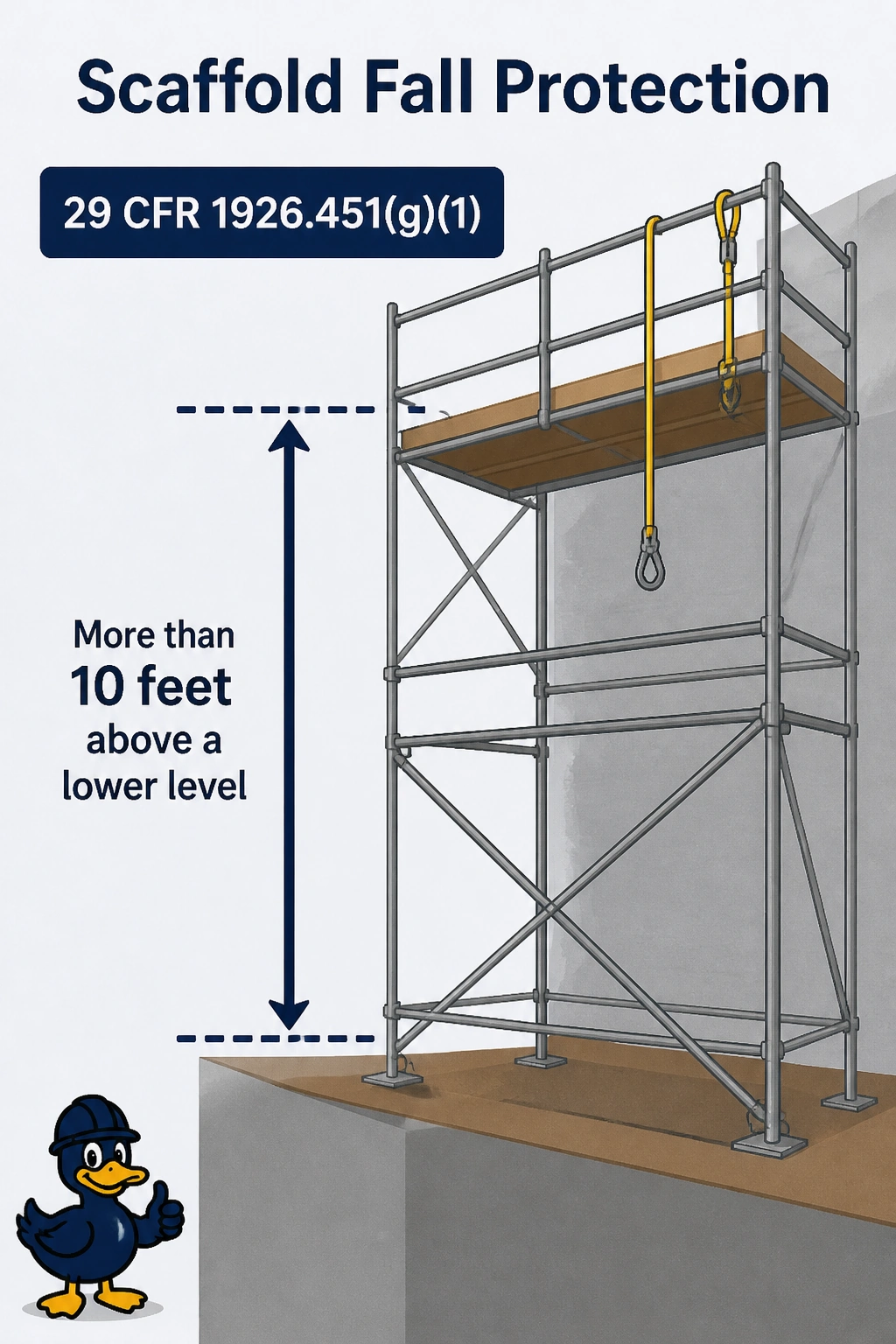
Construction fall-protection heights aren't one-size-fits-all, and scaffolds play by their own rulebook when you step onto a platform. While general construction triggers at 6 feet, OSHA gives supported and suspended scaffolds a 10-foot threshold. Don't fall into the trap of applying your 6-foot general construction rule to every scaffold deck.
Full Explanation
OSHA sets a specific trigger height for scaffolding in Subpart L, making More than 10 feet above a lower level under scaffold standards the correct answer under 29 CFR 1926.451(g)(1). At heights above 10 feet, each employee on a scaffold must be protected from falling to a lower level by guardrails or a personal fall arrest system, depending on the scaffold type. More than 6 feet above a lower level in all cases is a common misconception that applies the general Subpart M construction trigger from 1926.501 to scaffolds, where Subpart L governs instead. More than 15 feet above the finished concrete slab understates protection by using an arbitrary threshold higher than the 10-foot scaffold rule. More than 4 feet above any adjacent ground surface borrows the general industry walking-working surfaces trigger from 29 CFR 1910 rather than construction scaffold standards. An important caveat is that cross-bracing alone is only acceptable as a top rail or midrail under specific geometric height limits, never as a complete guardrail system by itself. As an operational check, measure scaffold platform height from the lowest adjacent landing and verify top rails sit between 38 and 45 inches high before masons climb up.
Prefer to study offline? Printable PDF study book + test engine ($7.50, unofficial). These questions stay free here.