
A warehouse safety director wants to build a 'Just Culture' accountability framework after noticing that workers hide minor mistakes while a few individuals intentionally bypass critical machine guards. Which principle defines a Just Culture approach?
Select an answer to reveal the explanation.
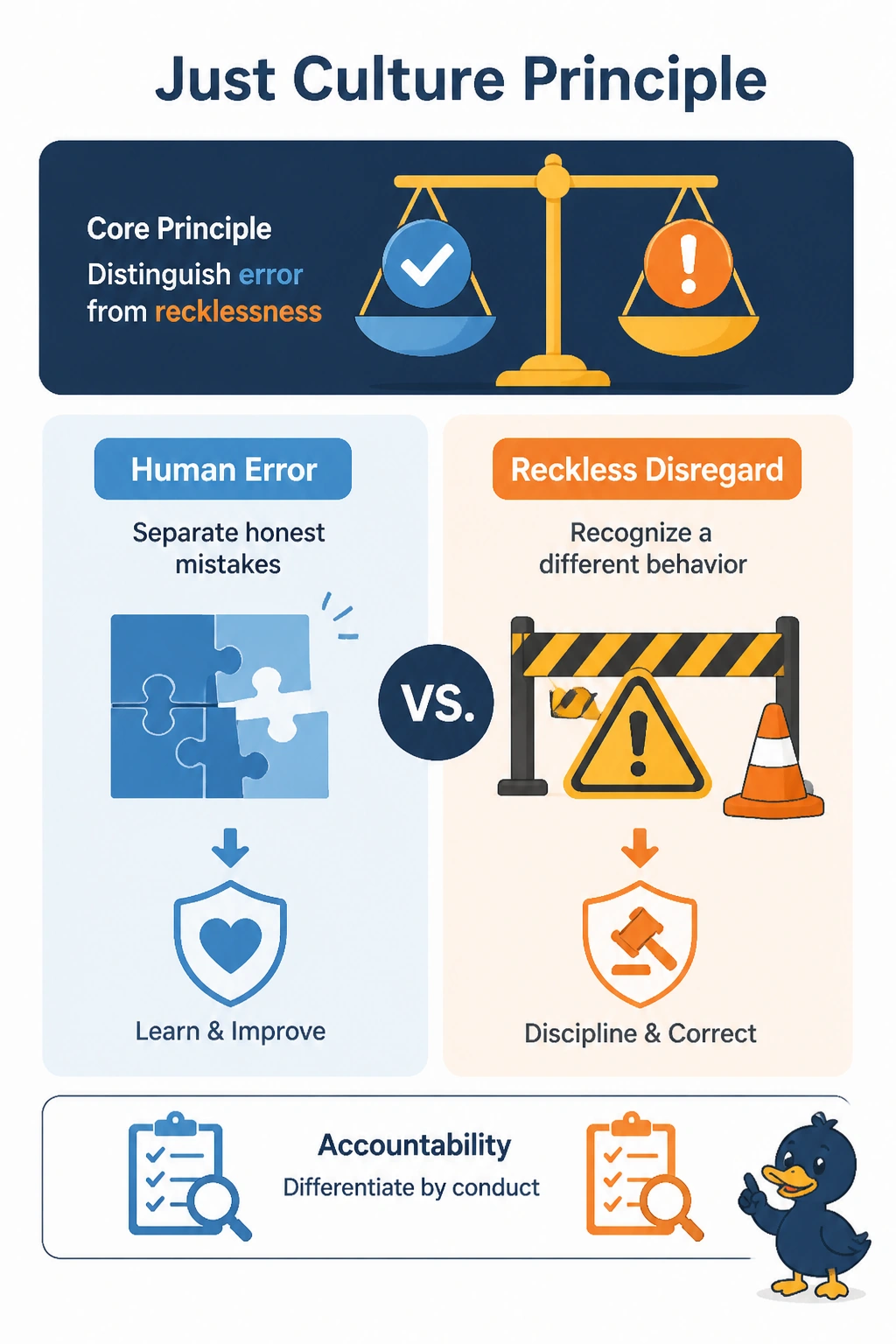
Short Explanation
A Just Culture is neither a blame-free free-for-all nor a punishment factory—it treats your people fairly based on why a mistake happened. Watch out for the extremes of punishing every slip-up or tossing accountability out the window.
Full Explanation
A Just Culture strengthens safety reporting and operational discipline by Distinguishing honest human error from reckless disregard. Under this framework, unintentional slips or lapses are met with coaching and system redesign to remove error traps, at-risk shortcuts are addressed by correcting incentives and clarifying expectations, and conscious, reckless disregard of substantial safety risks receives appropriate disciplinary accountability. Choosing Issuing automatic written warnings for every reported safety near miss creates a punitive climate that drives near-miss and hazard reporting underground. Conversely, choosing Eliminating all disciplinary policies regardless of intentional misconduct creates a blame-free extreme that tolerates deliberate guard bypassing and undermines safety standards. Choosing Ranking individual employees monthly by their personal injury counts encourages underreporting of minor injuries rather than evaluating behavioral intent and system design. Caveat: fair accountability requires that supervisors evaluate whether management pressures or poorly designed workflows pushed workers toward at-risk shortcuts before assigning blame. As an operational check, review recent incident investigations to confirm they separate system-induced errors from intentional violations.
Prefer to study offline? Printable PDF study book + test engine ($7.50, unofficial). These questions stay free here.