
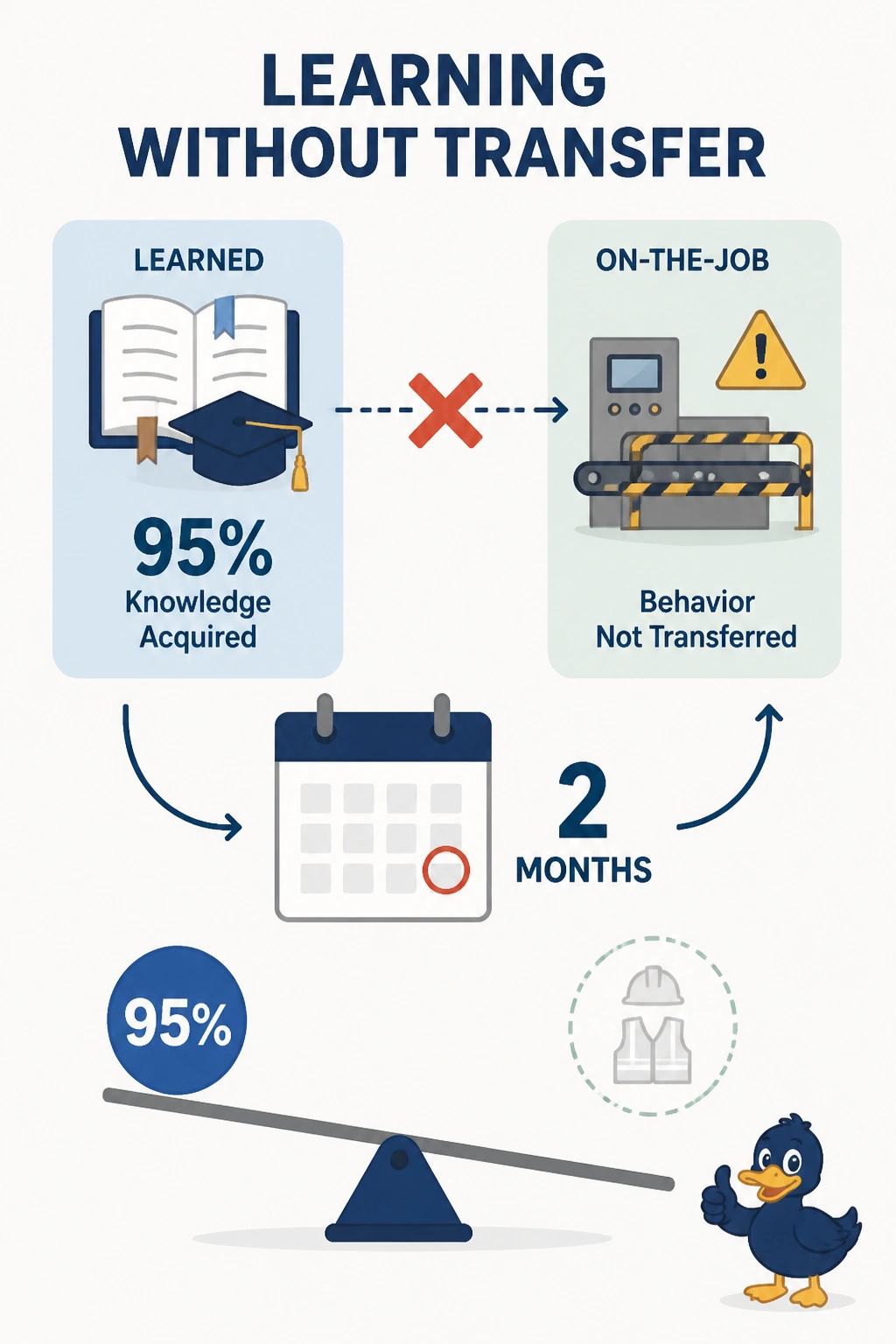
Two months after warehouse associates complete an interactive forklift pedestrian-safety course and score 95% on the written post-test, near-miss reports show operators still fail to sound horns at blind intersections. What does this gap indicate about the training evaluation?
Select an answer to reveal the explanation.
Short Explanation
Knowing the rulebook and playing the game right are two different things, and your warehouse floor is showing that gap. The trap is treating a 95% quiz score as proof that training changed daily habits.
Full Explanation
High quiz scores paired with unsafe floor habits show that Knowledge acquisition occurred without on-the-job behavior transfer. In standard four-level training evaluation, passing a post-test confirms learning in the classroom, whereas sustained horn use at blind corners measures behavior change on the job. Assuming that Written test scores guarantee safe habits on the warehouse floor confuses cognitive recall with real-world performance under production pressure. Relying on Classroom attendance records satisfy all training effectiveness metrics tracks only participation and offers zero insight into whether workers learned or applied the material. Claiming that Immediate reaction surveys after class are the best measure of compliance mistakes participant satisfaction for actual workplace behavior. As a caveat, missing behavior transfer often points to missing coaching, supervisor reinforcement, or environmental cues rather than a weak slide deck. Operationally, conduct unannounced floor observations and pair them with convex mirrors and positive supervisor feedback.
Prefer to study offline? Printable PDF study book + test engine ($7.50, unofficial). These questions stay free here.