
A roofing crew uses a portable extension ladder to climb from a concrete sidewalk onto a flat commercial roof edge 14 feet above the ground. Under OSHA 29 CFR 1926.1053, what must the crew ensure at the top of the ladder?
Select an answer to reveal the explanation.
Short Explanation
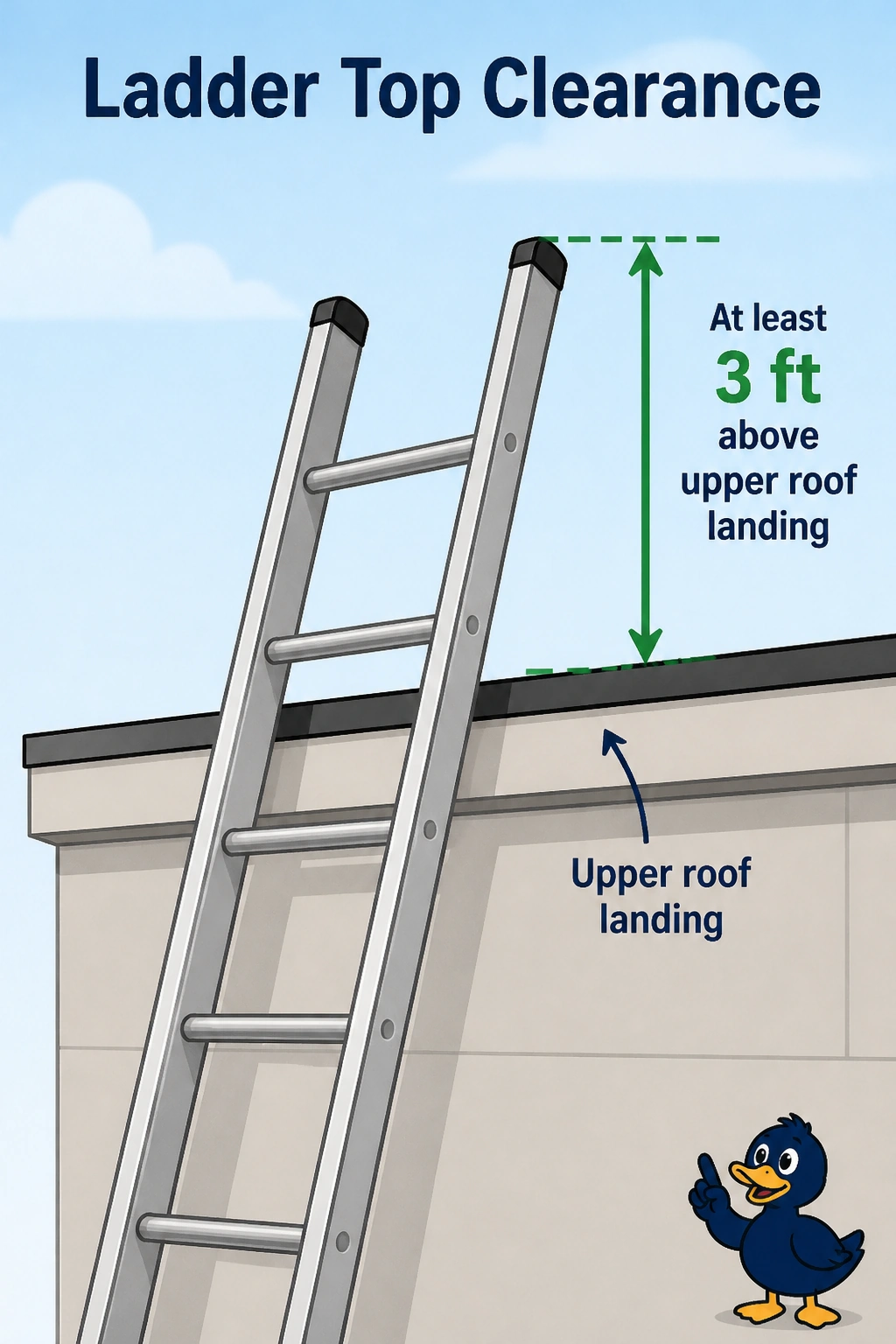
When you step from a ladder onto a roof, you need something secure to hold as you make the transition. OSHA requires you to extend the ladder side rails at least 3 feet above the roof landing to provide handholds. Tying the base to a weighted block or using a different ladder pitch does not replace those handholds.
Full Explanation
Under OSHA 29 CFR 1926.1053, when you use a portable ladder to access an upper landing surface, you must extend the ladder side rails at least 3 feet above the roof landing. Those projecting rails provide stable handholds as you step on and off the roof, where ladder falls often happen. Tying the ladder base to a weighted concrete block does not provide handholds at the roof transition, so that measure does not satisfy the requirement at the top. A 6-to-1 horizontal-to-vertical pitch ratio is also incorrect: OSHA requires a 4-to-1 ratio, or one foot out for every four feet of working length. A 6-to-1 pitch is far too shallow, and the base is likely to slide out rather than tip backward. Choosing an aluminum extension ladder because it is lighter does not address the top-access hazard, and conductive metal ladders pose severe electrocution risks near overhead power lines. One caveat is that workers must never stand on the top rungs above the roof support. For a practical check, measure the side-rail projection to confirm at least 3 feet rather than counting rungs, since rung spacing may be 10 inches.
Prefer to study offline? Printable PDF study book + test engine ($7.50, unofficial). These questions stay free here.