
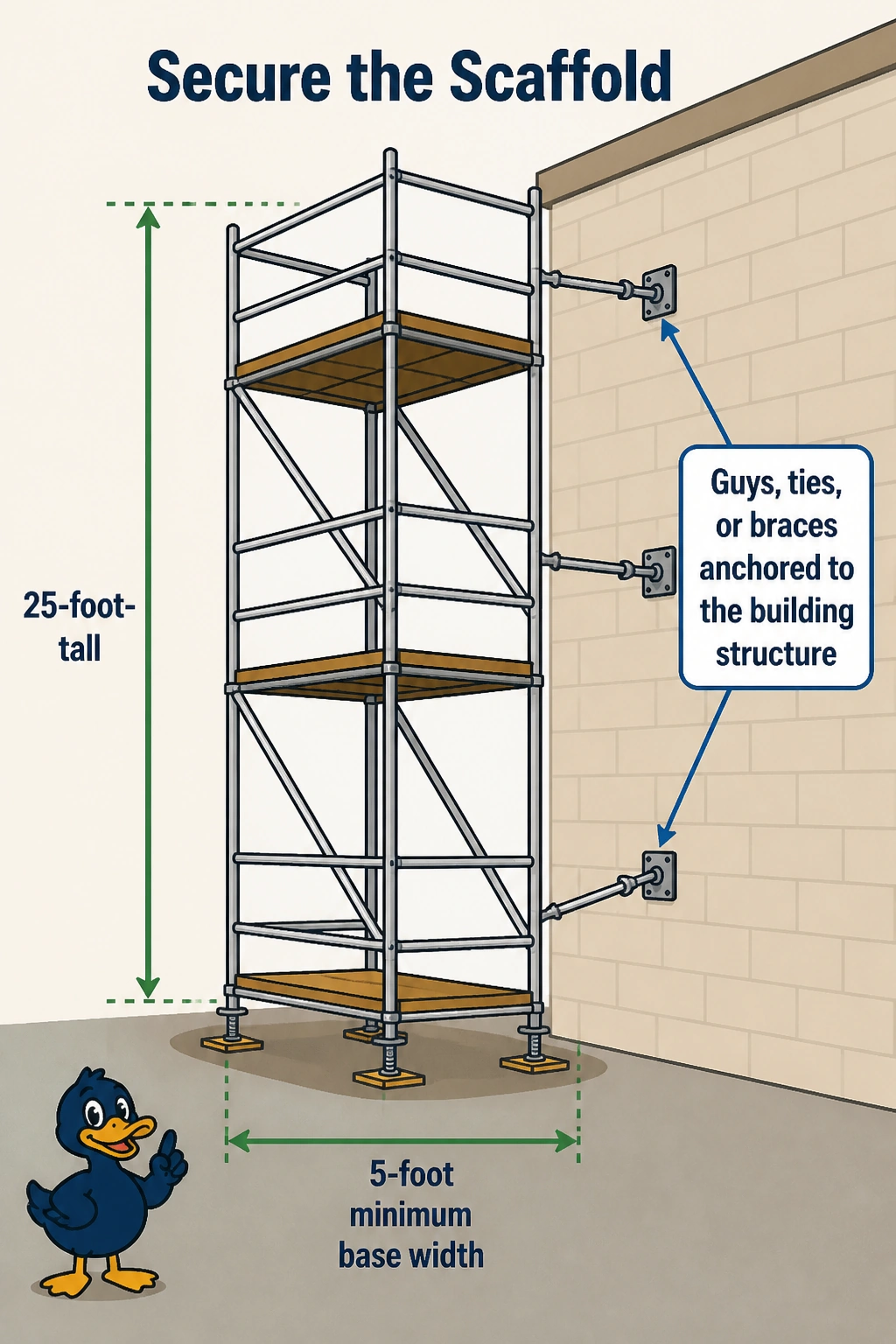
A masonry contractor erects a 25-foot-tall welded-frame supported scaffold with a 5-foot minimum base width along a commercial building facade. Before workers access the upper platform, what must the crew install to prevent the scaffold from tipping under OSHA 29 CFR 1926.451?
Select an answer to reveal the explanation.
Short Explanation
Picture a tall, narrow bookcase on a slick floor: without an anchor to the wall, even a light nudge could tip it over. Since your 25-foot scaffold is five times its 5-foot base width, you need ties (or guys or braces) anchored to the building. Cross-bracing every second frame tier stiffens the frames but does not anchor the whole scaffold against tipping.
Full Explanation
Under OSHA 29 CFR 1926.451, a supported scaffold whose height exceeds four times its minimum base dimension must be restrained from tipping with guys, ties, or braces anchored to the building structure. At 25 feet high on a 5-foot base, this scaffold has a 5-to-1 ratio, creating an overturning moment from wind, material loads, or worker movement that gravity and base plates alone cannot resist. Diagonal cross-bracing on every second frame tier only keeps individual frames plumb and square; it does not anchor the tower against lateral tipping, and leaving alternating tiers without braces weakens rigidity. Toeboards along the outer edge of every working platform prevent tools and masonry from falling off the deck, but provide no overturning resistance. Outrigger planks extending horizontally across the top platform do not widen the ground base to reduce the height-to-base ratio; instead, they add weight and wind area without stabilizing the base. One caveat is that ties must be installed at specified vertical and horizontal intervals and remain in place until dismantling reaches that level. As a practical check, have a competent person measure the height-to-base ratio, verify pull-tested anchor points, and inspect every tie-in before signing the daily scaffold tag.
Prefer to study offline? Printable PDF study book + test engine ($7.50, unofficial). These questions stay free here.