
A maintenance technician needs to clear a jam inside a hydraulic baler and plans to press the control-panel emergency stop button and hang a personal tag on it instead of locking out the main electrical disconnect. Why does this practice violate OSHA's Control of Hazardous Energy standard (29 CFR 1910.147)?
Select an answer to reveal the explanation.
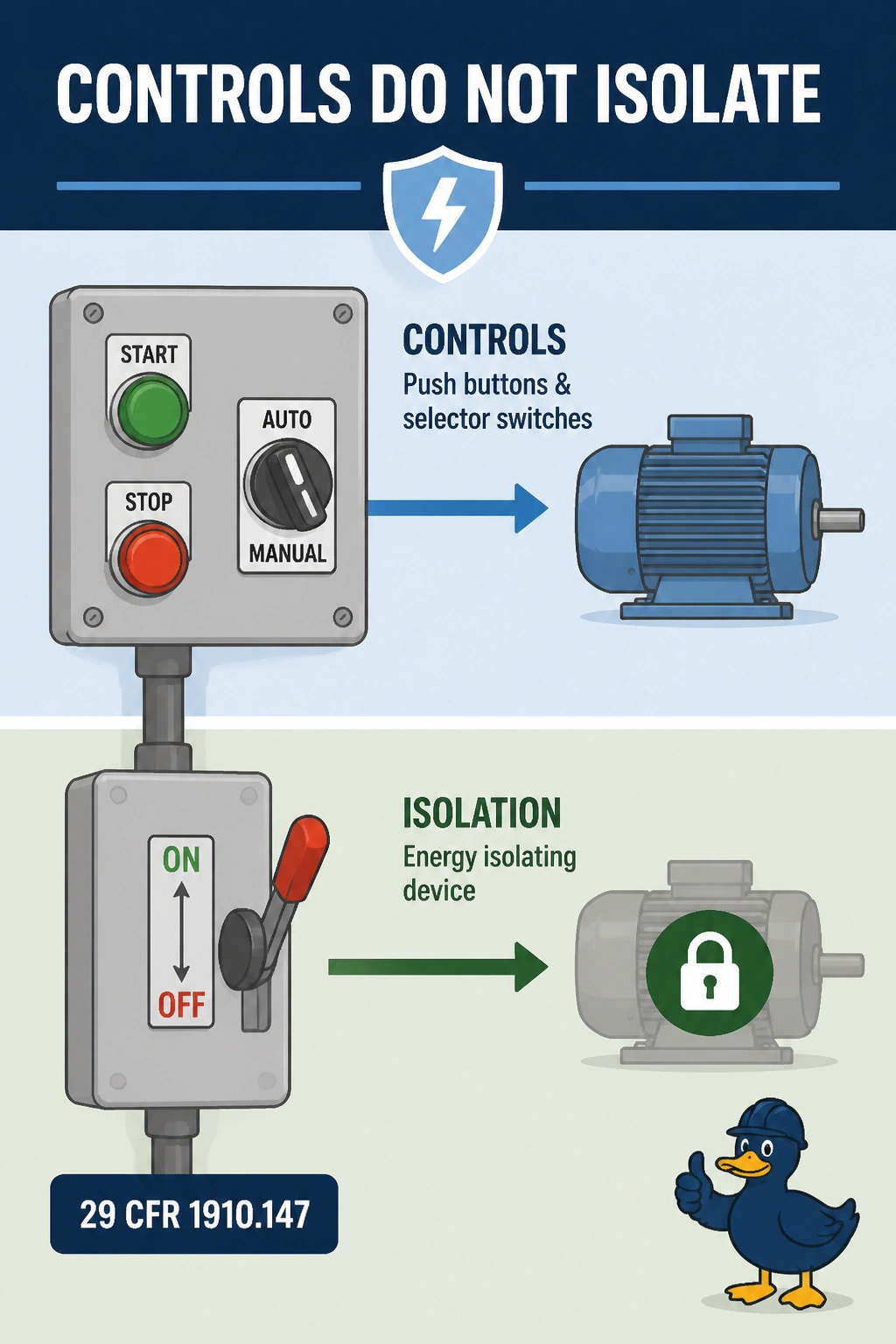
Short Explanation
An emergency stop button feels like a quick shortcut, but you cannot bet your fingers on a control circuit. The trap is treating a stop button as isolation, when OSHA requires a true physical disconnect that blocks power at the source.
Full Explanation
Under 29 CFR 1910.147, an energy-isolating device is a mechanical device that physically prevents the transmission or release of energy, such as a manually operated electrical circuit breaker, disconnect switch, or line valve. Push buttons and selector switches are control circuit devices, not energy-isolating devices, because a short circuit, relay failure, or accidental reset can still re-energize the hydraulic baler while the technician's hands are inside. Emergency stop buttons may only be used by line supervisors during scheduled shift changes is inaccurate because any worker may hit an E-stop in an emergency, yet it never substitutes for lockout. Personal tags must always be accompanied by a group lockbox even on single-energy machines misstates group lockout rules, which apply when multiple employees service equipment together. Control-panel interlocks require a written confined-space permit before any maintenance begins confuses machine guarding and hazardous energy rules with permit-required confined space entry under 29 CFR 1910.146. Caveat: in addition to locking out the electrical disconnect, the technician must also bleed or block stored hydraulic pressure before clearing the jam. Operational check: inspect written machine-specific lockout procedures to confirm every isolation point is a physical disconnect or valve rather than a panel button.
Prefer to study offline? Printable PDF study book + test engine ($7.50, unofficial). These questions stay free here.