
Maintenance workers at a distribution warehouse regularly step onto an elevated mezzanine platform 5 feet above the concrete floor to adjust HVAC dampers near an open edge. Under OSHA's general industry Walking-Working Surfaces standard (29 CFR 1910.28), why is fall protection required at this height?
Select an answer to reveal the explanation.
Short Explanation
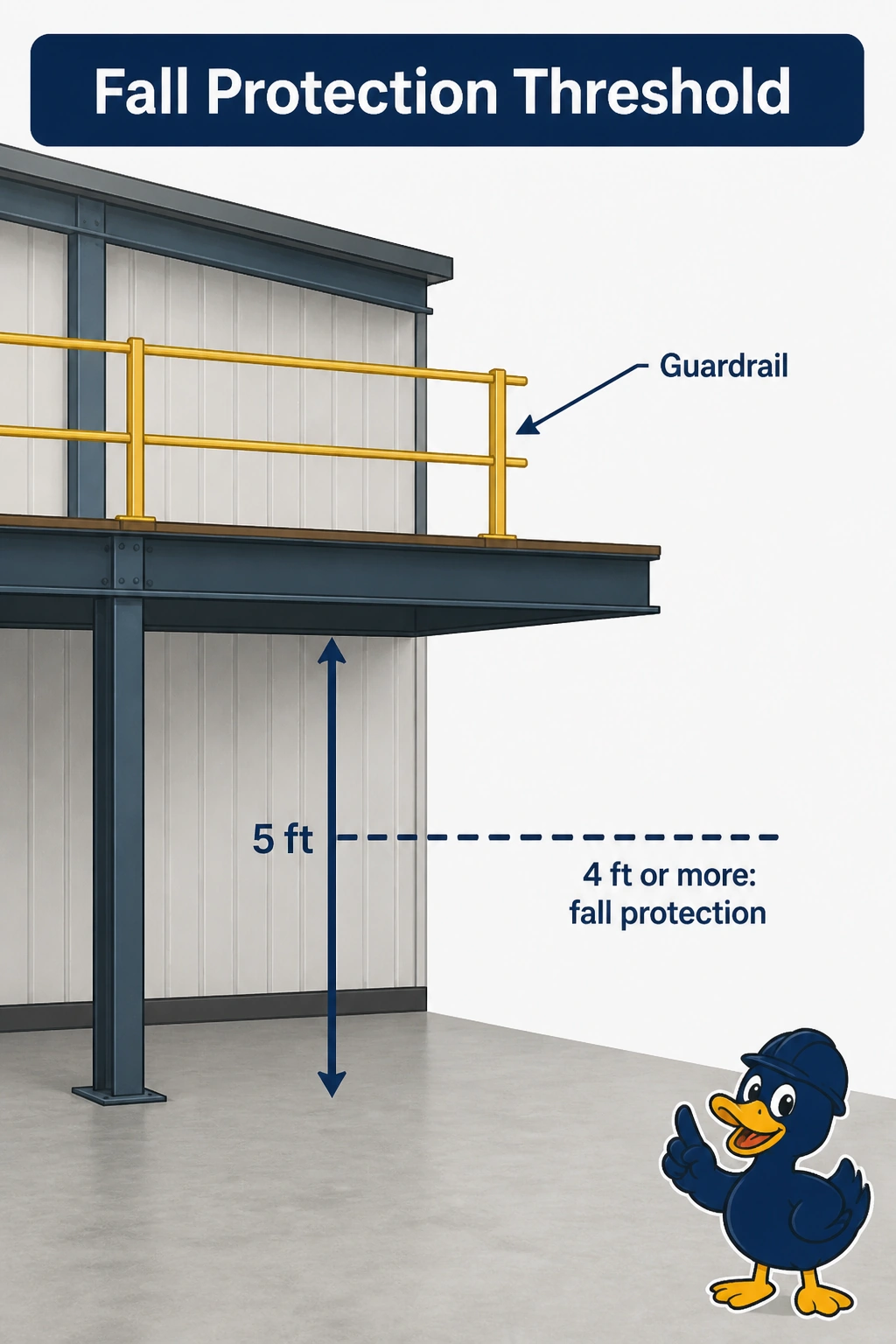
OSHA's fall protection heights shift depending on the industry, and mixing them up is a classic trap. Since you are in a general industry warehouse rather than on a construction site or scaffold, that 5-foot mezzanine crosses the 4-foot trigger.
Full Explanation
Under 29 CFR 1910.28, General industry requires fall protection at 4 feet or more above a lower level for employees on walking-working surfaces with an unprotected side or edge. Because the warehouse mezzanine sits 5 feet above the concrete floor, the employer must protect workers using guardrails, safety nets, or personal fall protection systems. Fall protection applies only when platforms exceed 10 feet in height fails because 10 feet is the general scaffold fall protection threshold in construction (29 CFR 1926.451), not the general industry platform standard. Fall protection is triggered only when carrying tools over 25 pounds is incorrect because fall protection requirements are based on drop height and edge exposure, regardless of tool weight. General industry requires guardrails only on outdoor roof perimeters is wrong because 29 CFR 1910.28 applies to indoor mezzanines, loading platforms, and elevated walkways as well as roofs. As an exam caveat, general industry requires fall protection at any height when workers are positioned above dangerous equipment or machinery. For an operational check, measure every elevated maintenance platform from its walking surface to the floor below and verify compliant guardrail height and midrails where drops reach 4 feet or more.
Prefer to study offline? Printable PDF study book + test engine ($7.50, unofficial). These questions stay free here.