
A hospital safety committee completes a facility-wide hazard assessment and identifies twelve deficiencies ranging from minor housekeeping clutter to an unguarded mechanical power press. How should the committee use a risk matrix to prioritize corrective actions?
Select an answer to reveal the explanation.
Short Explanation
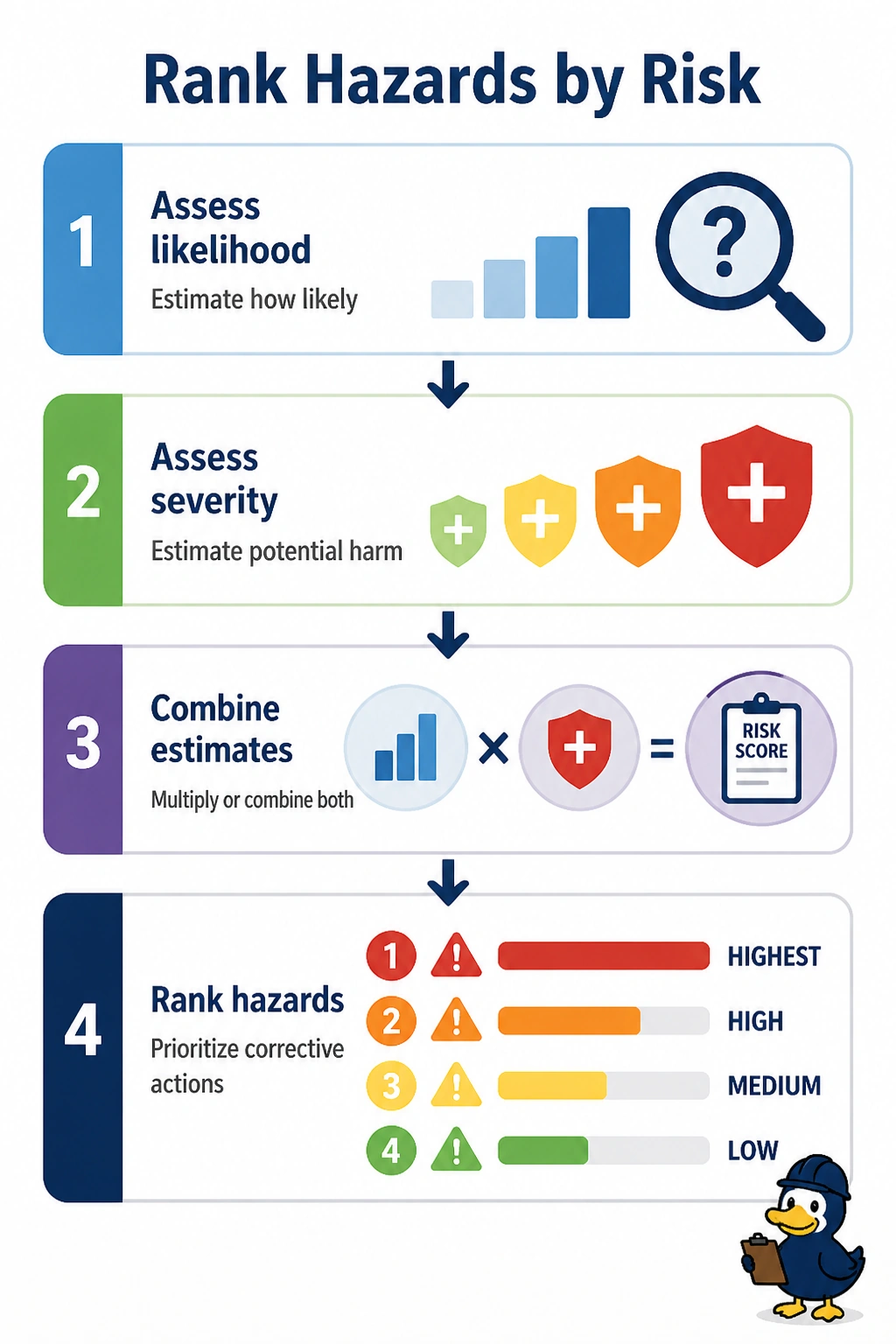
You can turn a long list of safety findings into a clear plan by fixing the most serious, credible threats first. Pair how bad an outcome could be with how likely it is to happen, rather than waiting for an injury or treating every hazard equally; that’s the risk matrix at work.
Full Explanation
Combining estimated severity and likelihood is the purpose of a risk matrix: it lets the committee rank hazards consistently and direct limited time and capital toward high-consequence, credible threats, such as an unguarded mechanical power press, before minor housekeeping clutter. Estimating potential injury severity against probability of occurrence provides a defensible way to triage diverse facility hazards. Ranking hazards solely by the estimated dollar cost of engineering controls ignores risk and can delay urgent life-safety fixes simply because they are expensive. Addressing only hazards that have already produced an OSHA-recordable injury relies on reactive, lagging data and leaves severe hazards, including unguarded equipment, unaddressed until someone is hurt. Prioritizing corrective actions strictly in the chronological order reported can put trivial issues logged early ahead of critical amputation hazards discovered later in the walk-through. Caveat: qualitative risk ratings involve judgment, so define clear anchor criteria for severity and likelihood levels beforehand to avoid inconsistent scoring. Practical check: assign interim safeguards immediately to any high-risk item whose permanent engineering fix requires procurement lead time.
Prefer to study offline? Printable PDF study book + test engine ($7.50, unofficial). These questions stay free here.