
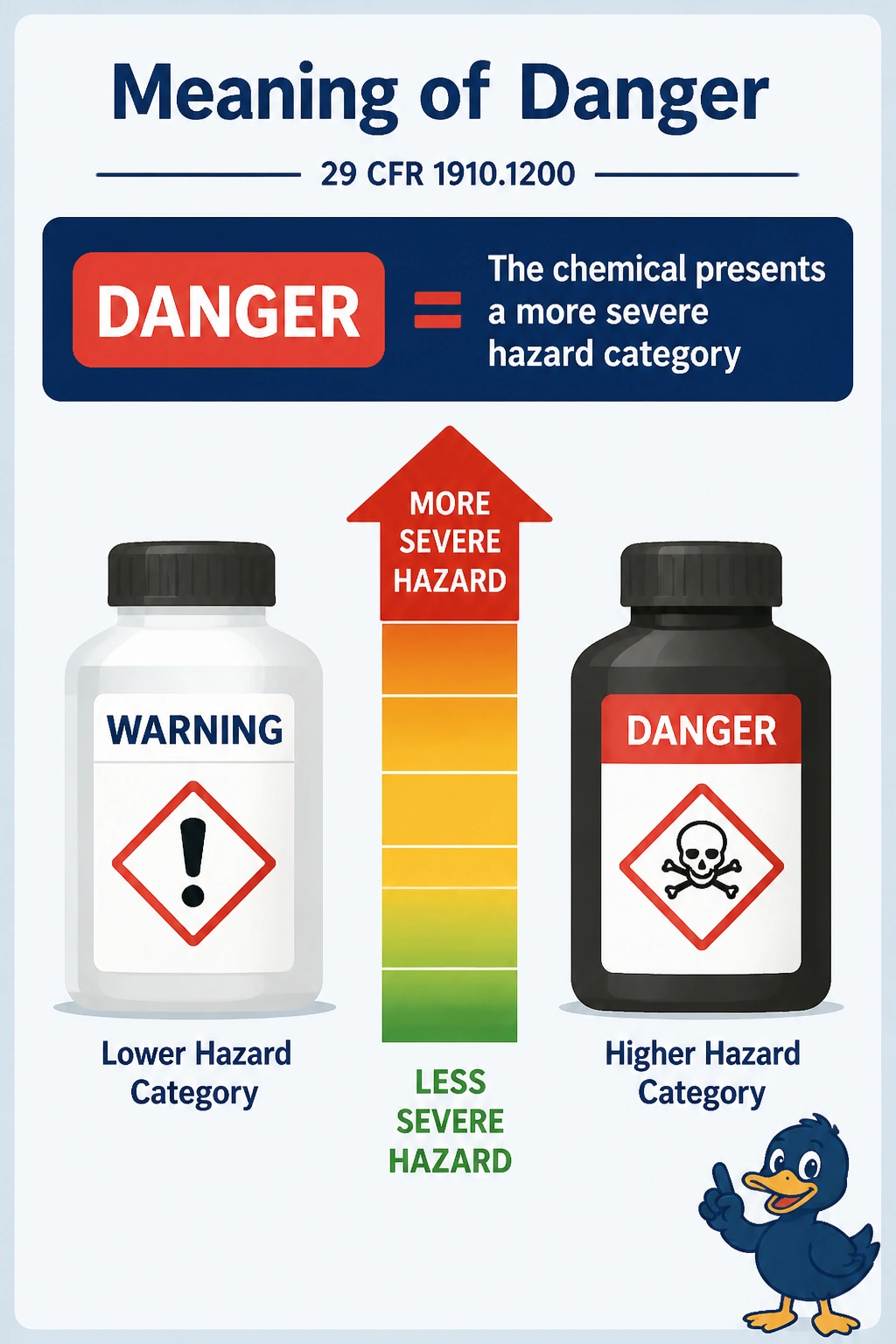
A lab technician compares two chemical container labels under OSHA's Hazard Communication Standard (29 CFR 1910.1200): one bottle displays the signal word "Danger," while the second bottle displays "Warning." What does the signal word "Danger" indicate on the first label?
Select an answer to reveal the explanation.
Short Explanation
On a GHS label, that single bold word at the top is your quick volume knob for hazard severity. Don't read "Danger" as an outright ban on using the chemical; it simply warns you that the product sits in a higher hazard tier than "Warning."
Full Explanation
Under OSHA's Hazard Communication Standard (29 CFR 1910.1200), GHS labels use only two signal words to alert workers to the relative level of severity: "Danger" means The chemical presents a more severe hazard category, while "Warning" is reserved for less severe hazard categories. Only one signal word appears on a label, corresponding to the most severe hazard class assigned to that chemical. The chemical is strictly prohibited from indoor laboratory use fails because signal words communicate hazard severity and required precautions rather than banning indoor use. The chemical requires a written Process Safety Management plan is incorrect because Process Safety Management under 29 CFR 1910.119 is triggered by threshold quantities of specific highly hazardous chemicals, not by a container's signal word. The chemical is an acute carcinogen with no safe exposure limit is wrong because "Danger" applies across many severe physical and health hazards, including high flammability, corrosivity, and acute toxicity, not exclusively carcinogenicity. As an exam caveat, a container with multiple hazards displays only "Danger" if at least one hazard category requires it. For an operational check, inspect secondary workplace containers to confirm the signal word, pictograms, and hazard statements match the manufacturer's Safety Data Sheet.
Prefer to study offline? Printable PDF study book + test engine ($7.50, unofficial). These questions stay free here.