
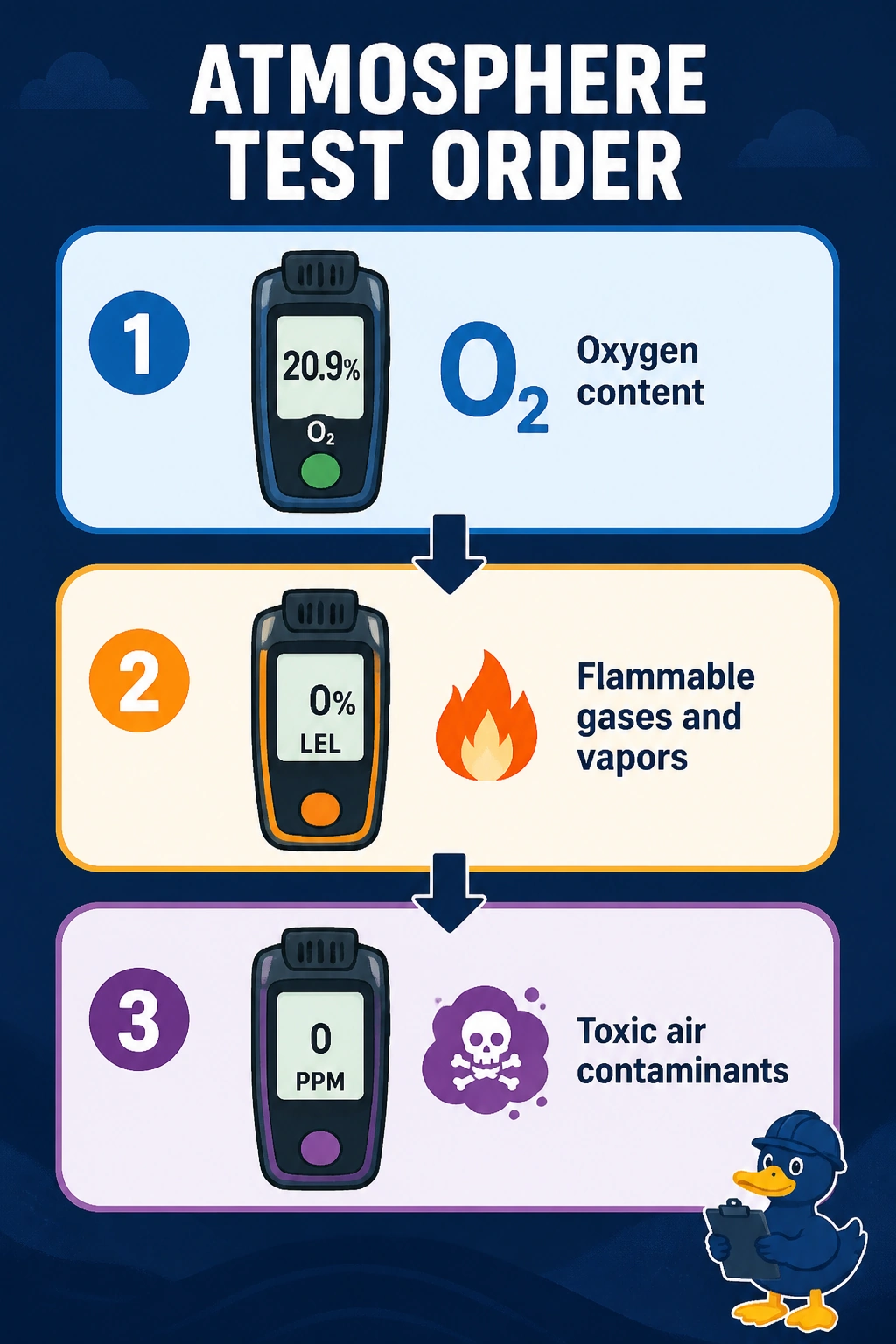
Before an employee enters a permit-required confined space at a wastewater treatment plant, the attendant prepares a calibrated multi-gas meter to test the internal atmosphere. In what order must the hazards be tested under OSHA's confined space standard?
Select an answer to reveal the explanation.
Short Explanation
Most flammable gas sensors need oxygen to burn the sample just like a car engine needs air, so checking flammability before oxygen can give you a false zero. The trap is testing for toxins or explosive vapors first.
Full Explanation
OSHA 29 CFR 1910.146 requires testing a permit-required confined space atmosphere in a strict sequence: Oxygen content first, then flammable gases and vapors, and finally toxic air contaminants. Oxygen must be verified first because oxygen deficiency is immediately life-threatening and because catalytic lower explosive limit (LEL) sensors depend on sufficient oxygen to accurately detect flammable vapors. Testing Toxic air contaminants first, then oxygen content, and finally any flammable gases and vapors risks missing an oxygen-deficient atmosphere and misreading combustible gas levels. Checking Flammable gases and vapors first, then toxic air contaminants, and finally oxygen content can produce an artificially low LEL reading in an oxygen-starved space, creating a false sense of safety. Sampling All three atmospheric hazards simultaneously only at the bottommost point of the space ignores stratified gases—lighter-than-air vapors collect near the top while heavier gases sink. As a caveat, even with a multi-gas meter that displays all channels at once, the technician must evaluate oxygen validity before trusting the LEL readout and test at top, middle, and bottom levels. For an operational check, perform a fresh-air zero and bump test on the meter before each shift and log all pre-entry readings at 4-foot vertical intervals.
Prefer to study offline? Printable PDF study book + test engine ($7.50, unofficial). These questions stay free here.