
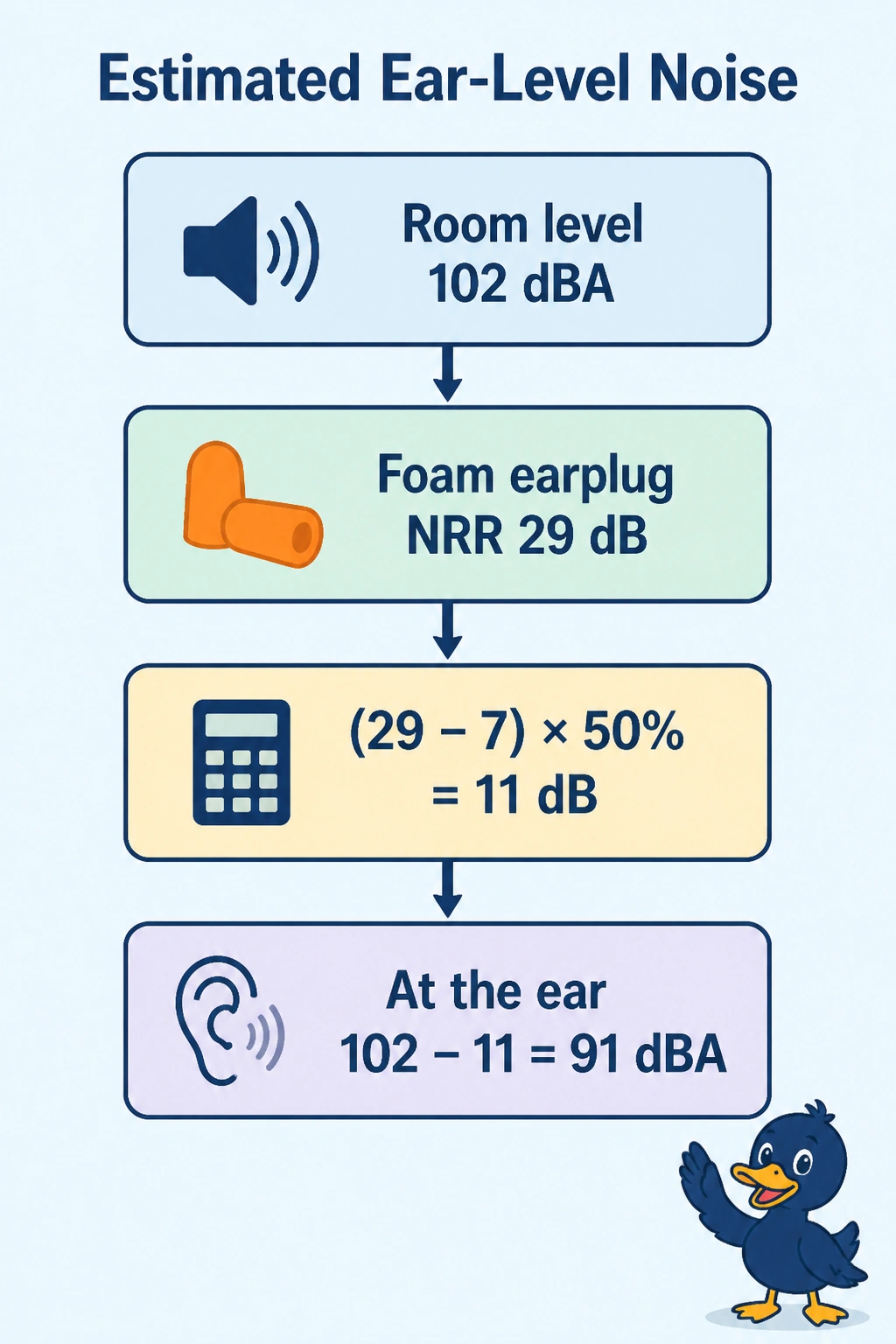
A stamping press room has an average A-weighted noise level of 102 dBA, and operators wear foam earplugs with a labeled Noise Reduction Rating (NRR) of 29 dB. Using OSHA's standard 50% derating method for A-weighted exposures [(NRR - 7) / 2], what is the estimated effective noise level reaching an operator's ear?
Select an answer to reveal the explanation.
Short Explanation
Laboratory earplug ratings rarely match real-world shop floors where sweat, talking, and imperfect insertion reduce protection. That is why you subtract 7 dB for A-weighted noise and then cut the remaining NRR in half before subtracting from room noise. The trap is subtracting the full package rating and assuming workers are completely safe.
Full Explanation
To estimate real-world attenuation for A-weighted exposures under OSHA's 50% derating method, first subtract 7 dB from the labeled NRR to convert from C-weighted to A-weighted measurements: 29 - 7 = 22 dB. Next, divide by 2 to account for field fit variability: 22 / 2 = 11 dB of effective attenuation. Subtracting 11 dB from 102 dBA yields 91.0 dBA using the 11 dB derated attenuation. Selecting 73.0 dBA using the full labeled NRR omits both the 7 dB spectral adjustment and the 50% safety factor, drastically overestimating protection. Choosing 80.0 dBA without the 50% reduction applies only the 7 dB subtraction (102 - 22 = 80.0 dBA) and ignores real-world fit loss. Selecting 87.5 dBA by halving the raw NRR divides 29 by 2 (14.5 dB) without deducting 7 dB first (102 - 14.5 = 87.5 dBA). 91.0 dBA is the engineering-control derating, not the Appendix B protected level. Do not read it as proof that these plugs fail the hearing-conservation adequacy test. Mandatory Appendix B subtracts only 7 dB for A-weighted noise, so 102-22 = 80 dBA. Engineering controls are still required because the unprotected level is 102 dBA, above the 90 dBA PEL.
Prefer to study offline? Printable PDF study book + test engine ($7.50, unofficial). These questions stay free here.