
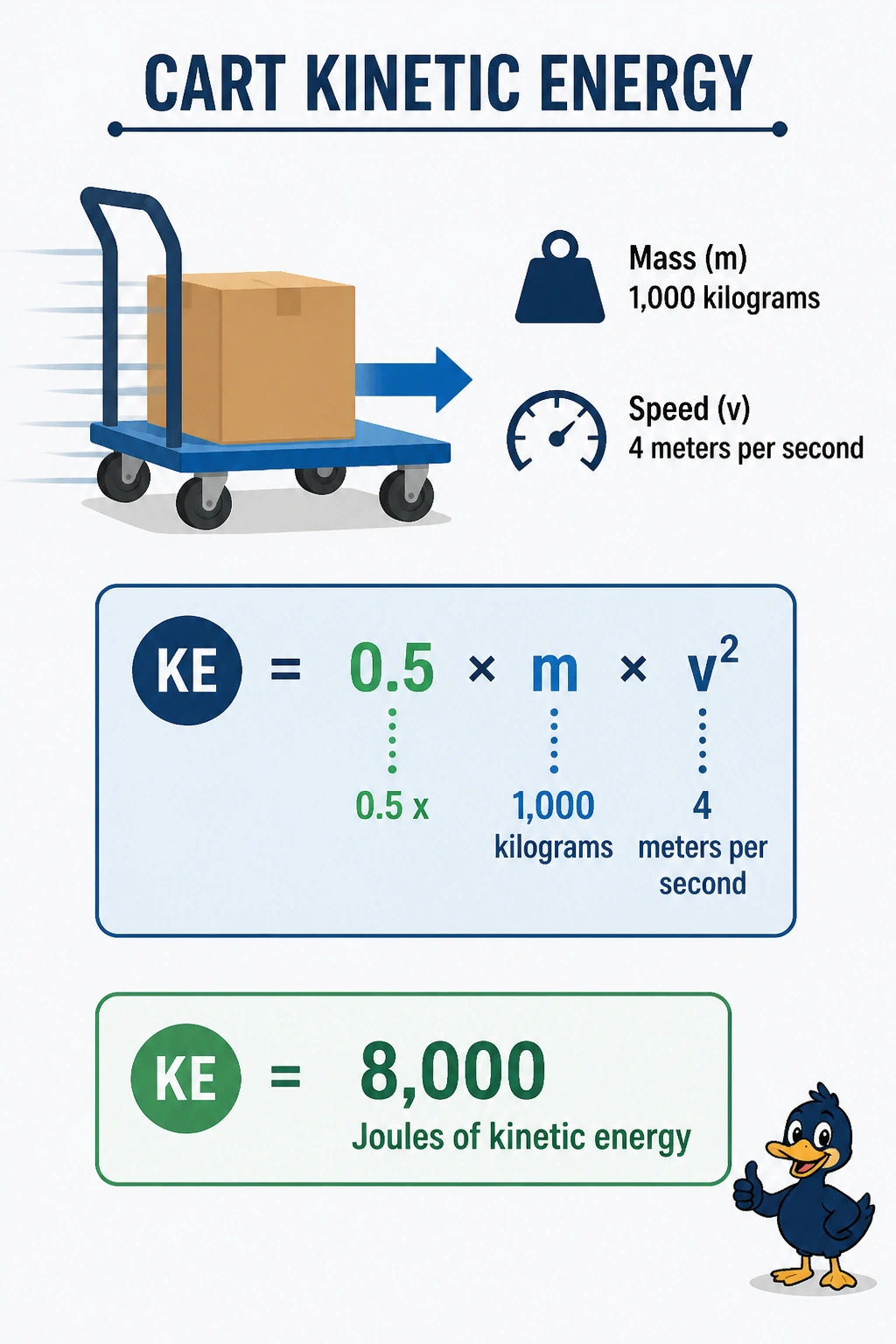
A warehouse safety specialist is evaluating barrier strength for a loaded utility cart with a total mass of 1,000 kilograms traveling at 4 meters per second. Using the kinetic energy formula KE = 0.5 x m x v^2, what is the cart's kinetic energy in Joules?
Select an answer to reveal the explanation.
Short Explanation
Kinetic energy grows with the square of speed, which is why even a modest increase in vehicle velocity packs a huge punch. A common trap is forgetting to square the velocity or dropping the one-half factor, so plug your numbers into the formula step by step.
Full Explanation
Using the kinetic energy equation KE = 0.5 x m x v^2, substituting mass m = 1,000 kg and velocity v = 4 m/s gives KE = 0.5 x 1,000 x (4^2) = 0.5 x 1,000 x 16 = 8,000 Joules of kinetic energy. Because velocity is squared, doubling vehicle speed quadruples the impact energy that a guardrail or rack protector must absorb. Selecting 2,000 Joules of kinetic energy results from forgetting to square the velocity (0.5 x 1,000 x 4). Selecting 16,000 Joules of kinetic energy results from omitting the 0.5 multiplier (1,000 x 16), which doubles the true energy. Selecting 4,000 Joules of kinetic energy results from computing momentum (m x v = 1,000 x 4) rather than kinetic energy, mixing up two distinct physical quantities. As a caveat, real-world barrier ratings also depend on impact angle, bumper height, and anchor bolt pullout strength, not kinetic energy alone. Operationally, verify that installed warehouse bollards and rack-end guards are rated above the maximum expected kinetic energy at governed facility speed limits.
Prefer to study offline? Printable PDF study book + test engine ($7.50, unofficial). These questions stay free here.