
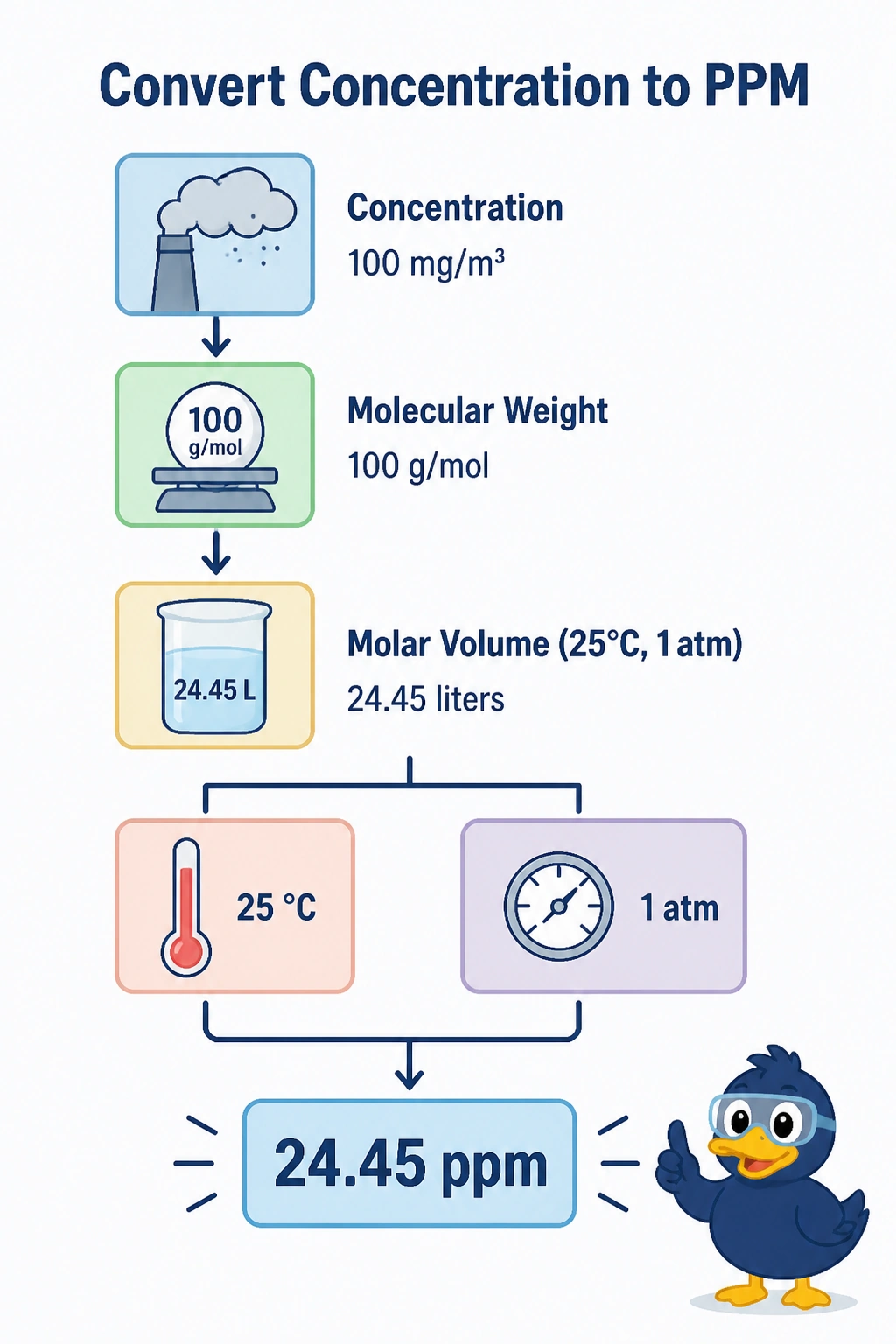
An industrial hygienist measures an airborne concentration of 100 milligrams per cubic meter (mg/m³) for an organic solvent with a molecular weight of 100 grams per mole at 25 degrees Celsius and 1 atmosphere (molar volume = 24.45 liters). What is this concentration in parts per million (ppm)?
Select an answer to reveal the explanation.
Short Explanation
Think of 24.45 liters per mole as your bridge between weighing a vapor in air and counting its molecules in parts per million at room conditions. The classic trap is dividing by 24.45 instead of multiplying, which skews your exposure number when comparing it to an OSHA limit.
Full Explanation
Industrial hygiene air-sampling labs often report vapor concentrations in milligrams per cubic meter (mg/m³), whereas many occupational exposure limits are published in parts per million (ppm). At standard room conditions of 25 degrees Celsius and 1 atmosphere, one mole of an ideal gas occupies 24.45 liters, giving the conversion formula ppm = (concentration in mg/m³ × 24.45) / molecular weight. Plugging in the measured values yields (100 × 24.45) / 100 = 24.45 ppm, confirming 24.45 ppm as the true concentration. Choosing 40.90 ppm occurs when you divide by 24.45 rather than multiply and misplace the decimal point, inverting the molar volume relationship. Selecting 100.00 ppm mistakenly treats mg/m³ and ppm as numerically equal, ignoring both the 24.45-liter molar volume and the solvent's molecular weight. Picking 244.50 ppm introduces a tenfold decimal-place error when dividing the product by the molecular weight of 100 grams per mole. As a key caveat, the 24.45 constant holds only at 25°C and 1 atmosphere; sampling at high altitude or elevated process temperatures requires recalculating molar volume via the ideal gas law. For an operational check, log ambient temperature and barometric pressure on every air-sampling field sheet before converting laboratory results.
Prefer to study offline? Printable PDF study book + test engine ($7.50, unofficial). These questions stay free here.