
A stamping plant evaluates a $25,000 automated die-loader guard system that is projected to yield $60,000 in discounted total safety and productivity benefits over its service life. What is the Benefit-Cost Ratio (BCR) of this investment, and how should leadership interpret it?
Select an answer to reveal the explanation.
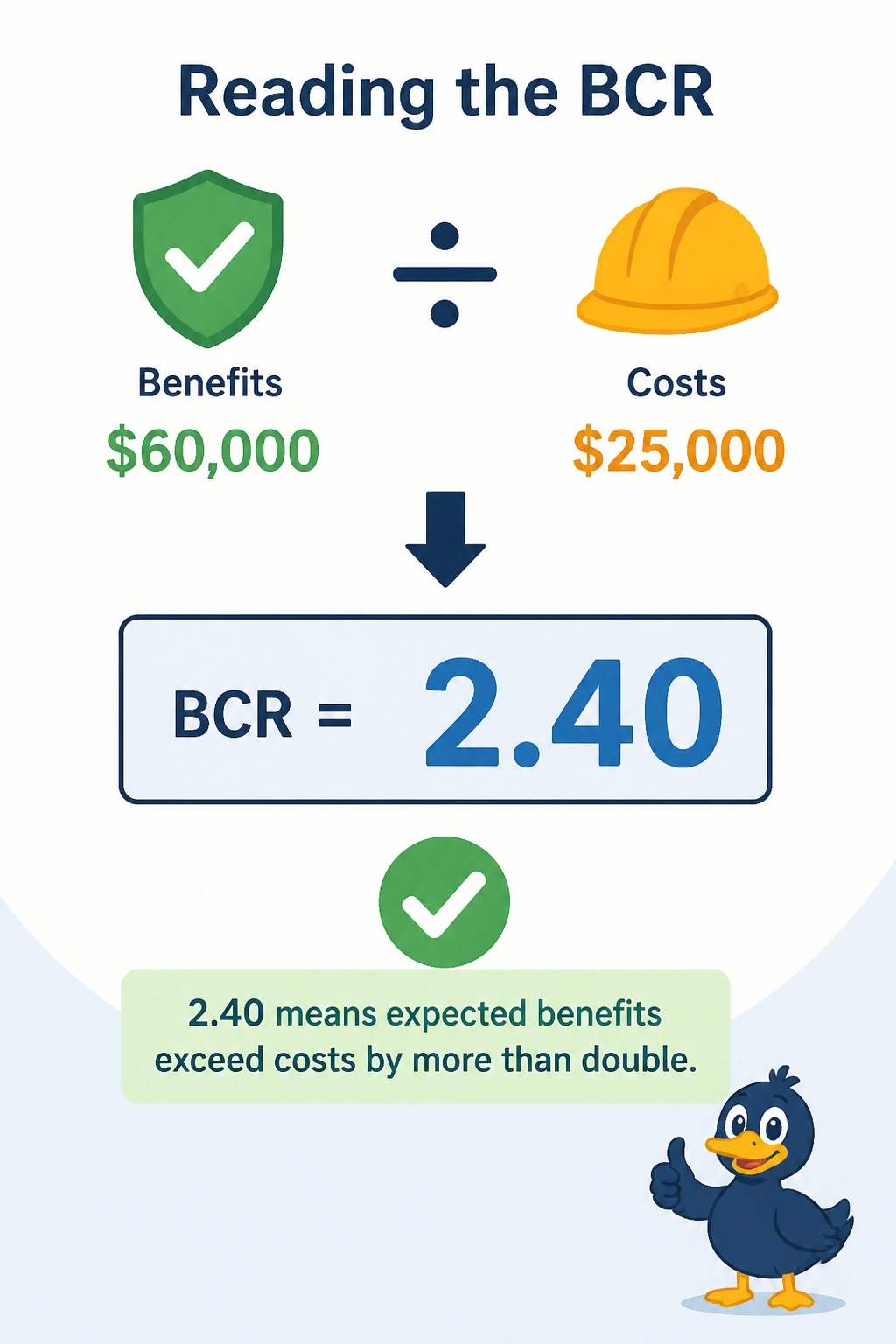
Short Explanation
Think of the Benefit-Cost Ratio as how many dollars come back for every dollar you spend. The trap is flipping the fraction upside down or subtracting the cost first, when you simply divide total benefits by total costs and look for a result above 1.0.
Full Explanation
The Benefit-Cost Ratio (BCR) is calculated by dividing total discounted benefits by total costs: $60,000 divided by $25,000 equals 2.40. Therefore, 2.40, indicating expected benefits exceed costs by more than double is correct because every $1.00 invested returns $2.40 in value, making the project financially favorable whenever BCR exceeds 1.0. Dividing in reverse ($25,000 / $60,000) produces 0.42, indicating the project costs more than twice its expected financial return, which is the inverse cost-to-benefit ratio. Subtracting the $25,000 cost from $60,000 first to get $35,000 net benefit and dividing by $25,000 yields 1.40, indicating the net benefit after subtracting the initial capital investment, which is Return on Investment (140%) rather than BCR. Concluding 2.40, indicating the project should be rejected because the ratio exceeds 1.0 reverses the decision rule, because projects below 1.0 fail to recover their costs. As a caveat, financial ratios should support—not override—mandatory regulatory compliance when a hazard requires immediate guarding. As an operational check, verify that ongoing maintenance and training expenses are included in the total cost denominator before presenting the BCR.
Prefer to study offline? Printable PDF study book + test engine ($7.50, unofficial). These questions stay free here.