
A chemical plant assigns technicians to wear full-facepiece negative-pressure air-purifying respirators with an Assigned Protection Factor (APF) of 50 in an atmosphere containing a solvent whose OSHA Permissible Exposure Limit (PEL) is 10 parts per million. Assuming the result does not exceed the Immediately Dangerous to Life or Health level, what is the respirator's Maximum Use Concentration (MUC)?
Select an answer to reveal the explanation.
Short Explanation
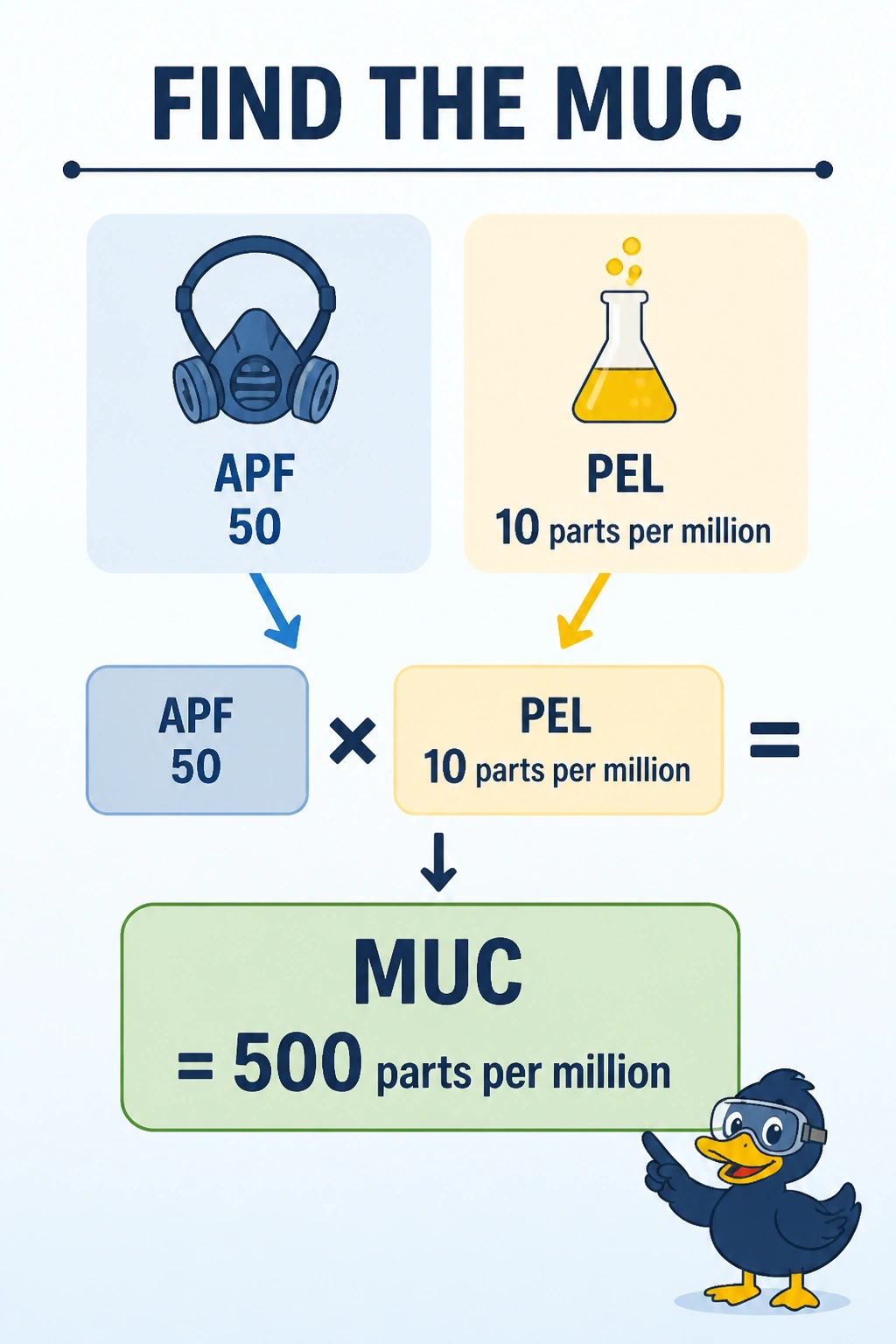
Think of Assigned Protection Factor as a multiplier on how much dirtier the outside air can be before your respirator's margin runs out. Under OSHA 29 CFR 1910.134, you multiply the APF by the Permissible Exposure Limit to find the Maximum Use Concentration. The trap is dividing, using the APF alone, or guessing a factor from a different respirator class.
Full Explanation
Under OSHA 29 CFR 1910.134, the Maximum Use Concentration (MUC) is the upper atmospheric concentration of a hazardous substance from which an employee can be expected to be protected when wearing a respirator, calculated as MUC = APF × PEL. Multiplying an APF of 50 by the 10 parts per million PEL gives 500 parts per million, making "500 parts per million" the correct result. Choosing "250 parts per million" reflects an incorrect half-scale calculation rather than multiplying the full APF by the PEL. Choosing "1,000 parts per million" doubles the true limit, as if the respirator had an APF of 100 instead of 50. Choosing "50 parts per million" confuses the dimensionless Assigned Protection Factor of 50 with a concentration limit in parts per million. Caveat: even when APF × PEL yields a higher number, the MUC can never exceed the chemical's Immediately Dangerous to Life or Health (IDLH) concentration or any substance-specific OSHA standard limit, and organic vapor cartridges still require an objective change-out schedule. Operational check: compare personal air-sampling data against the calculated MUC and IDLH ceiling before assigning air-purifying respirators, and upgrade to supplied-air equipment if concentrations approach either limit.
Prefer to study offline? Printable PDF study book + test engine ($7.50, unofficial). These questions stay free here.