
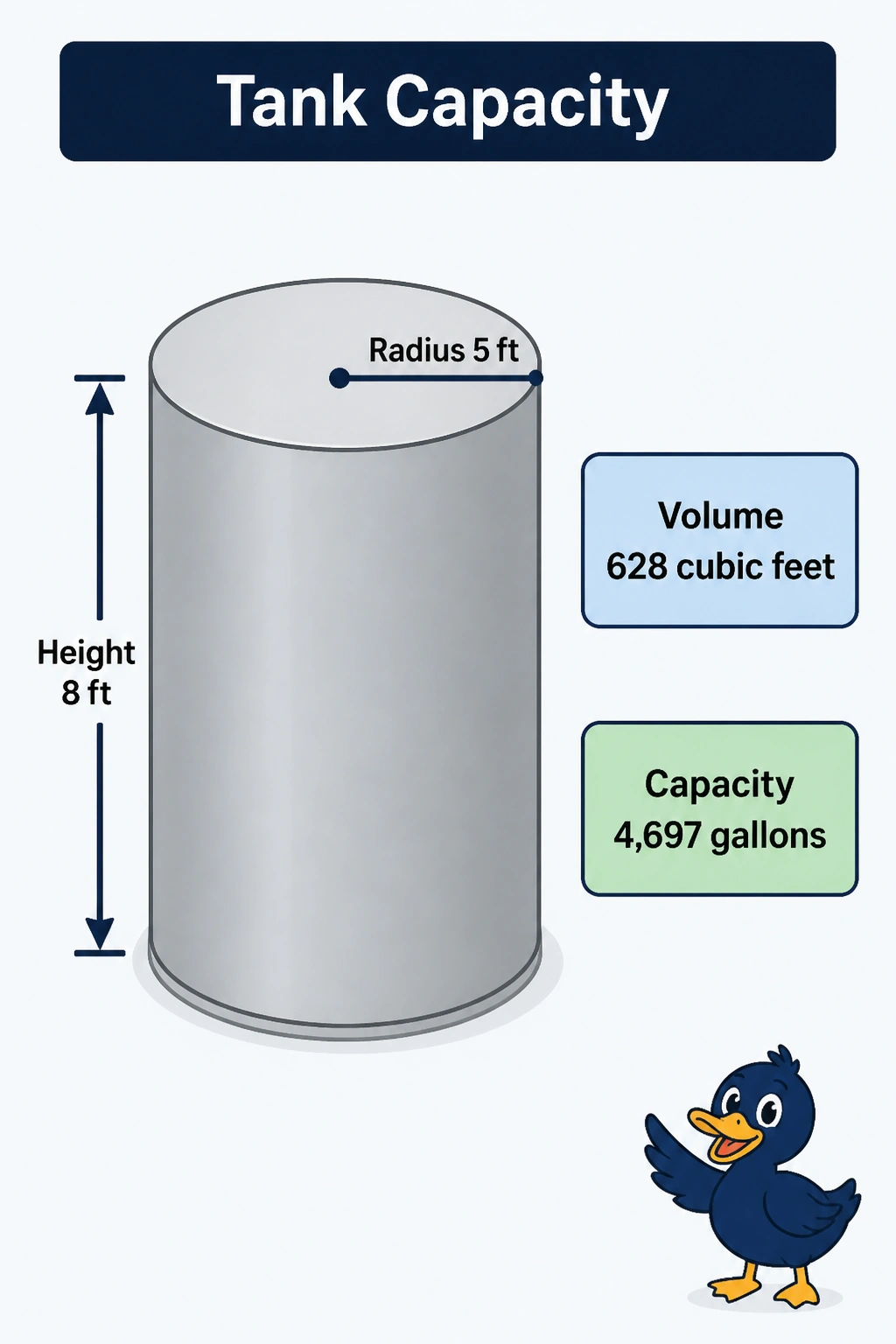
A chemical plant installs a vertical cylindrical storage tank with an inside radius of 5 feet and a height of 8 feet. Using pi = 3.14 and 7.48 gallons per cubic foot, what is the maximum liquid capacity of the tank?
Select an answer to reveal the explanation.
Short Explanation
Think of a cylindrical tank as stacked circular slices—you find the circle's area first, multiply by the height for cubic feet, and then convert to gallons. The trap is forgetting the 7.48 multiplier or doubling the radius, which throws your capacity estimate way off.
Full Explanation
To find the liquid capacity of a vertical cylindrical tank, first calculate the internal volume in cubic feet using V = pi x r^2 x h, then multiply by 7.48 gallons per cubic foot. With a radius of 5 feet and a height of 8 feet, V = 3.14 x 5^2 x 8 = 3.14 x 25 x 8 = 628 cubic feet; multiplying 628 by 7.48 gives 4,697.44 gallons, making 4,697 gallons the correct answer. 18,790 gallons results from mistakenly squaring a 10-foot diameter instead of the 5-foot radius, inflating the area fourfold. 1,879 gallons comes from computing the lateral surface area (2 x pi x r x h = 251.2) multiplied by 7.48 instead of using the cylinder volume formula. 628 gallons stops after finding the volume in cubic feet without converting cubic feet to gallons. As a calculation caveat, always verify whether a problem gives diameter or radius before squaring, and round only at the final step. Operationally, confirm usable working capacity separately from gross geometric volume because high-level alarms and freeboard space reduce safe fill limits.
Prefer to study offline? Printable PDF study book + test engine ($7.50, unofficial). These questions stay free here.