
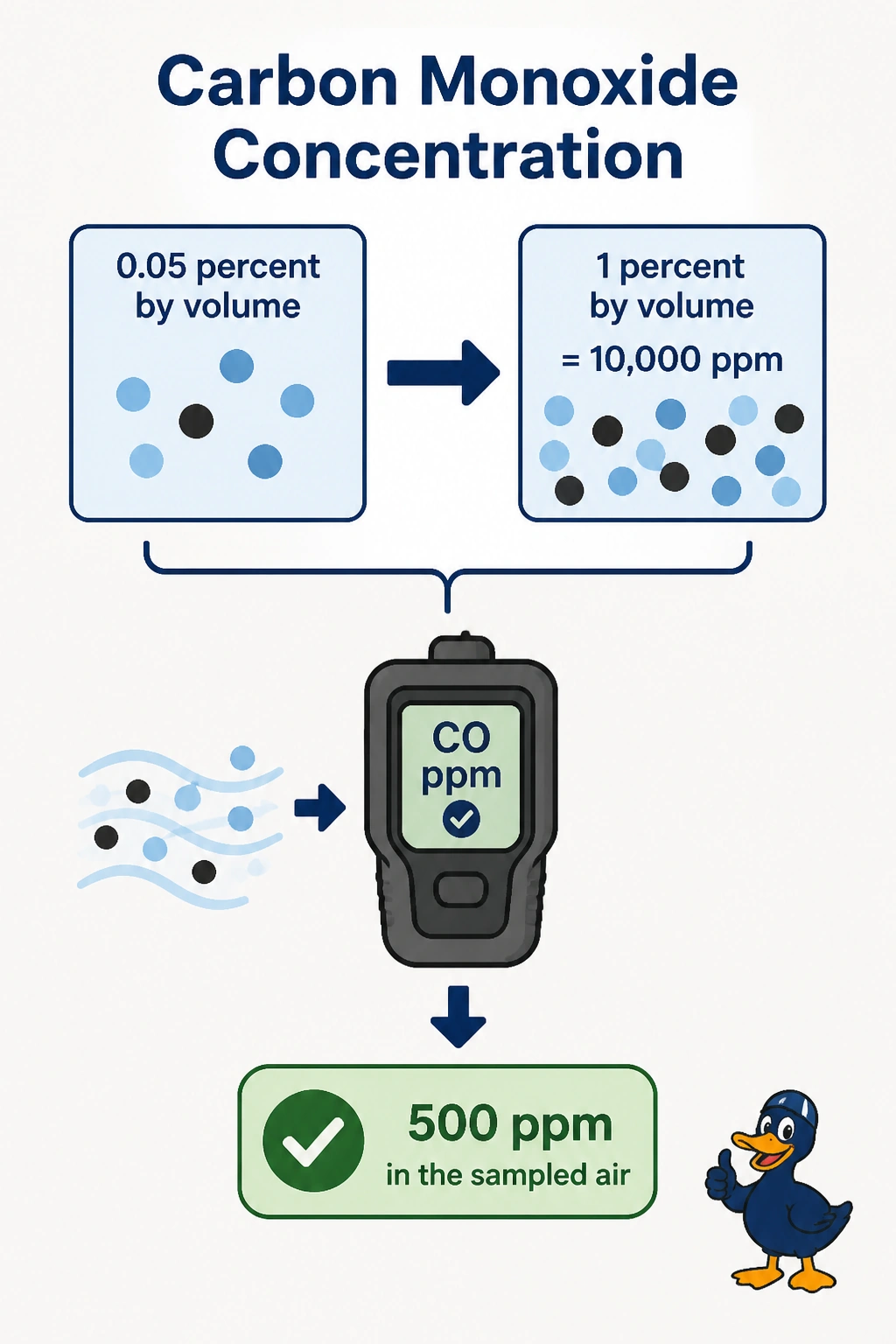
An air-monitoring instrument displays a carbon monoxide concentration of 0.05 percent by volume inside a warehouse loading bay. Knowing that 1 percent by volume equals 10,000 parts per million (ppm), what is this concentration in ppm?
Select an answer to reveal the explanation.
Short Explanation
Moving between percent and parts per million is just shifting the decimal point four places, so you multiply any percentage by 10,000 to convert it. The trap is dropping or adding a zero when you multiply 0.05 by 10,000.
Full Explanation
Because 1 percent equals one part per hundred and ppm means parts per million, multiplying any percentage by 10,000 converts it directly to ppm: 0.05 x 10,000 = 500, yielding 500 ppm in the sampled air. That conversion is critical on the floor because many combustible gas or oxygen sensors read in percent while toxic exposure limits for gases like carbon monoxide are published in ppm. Selecting 50 ppm multiplies by 1,000 instead of 10,000 and understates the result by a factor of ten. 500 ppm is ten times the 50 ppm PEL; the NIOSH IDLH is 1,200 ppm. Choosing 5,000 ppm in the sampled air comes from treating 0.05 as 0.5 percent, overstating the reading tenfold. Picking 0.5 ppm in the sampled air reverses the math by dividing by 100 instead of multiplying by 10,000, understating the result by a factor of 1,000. As an important caveat, 500 ppm of carbon monoxide is above the 50 ppm PEL/action range, so this reading requires ventilation and follow-up action rather than routine monitoring. For an operational check, verify your direct-reading meter's display units before entering a space and write the 1% = 10,000 ppm conversion factor on your calibration log.
Prefer to study offline? Printable PDF study book + test engine ($7.50, unofficial). These questions stay free here.