
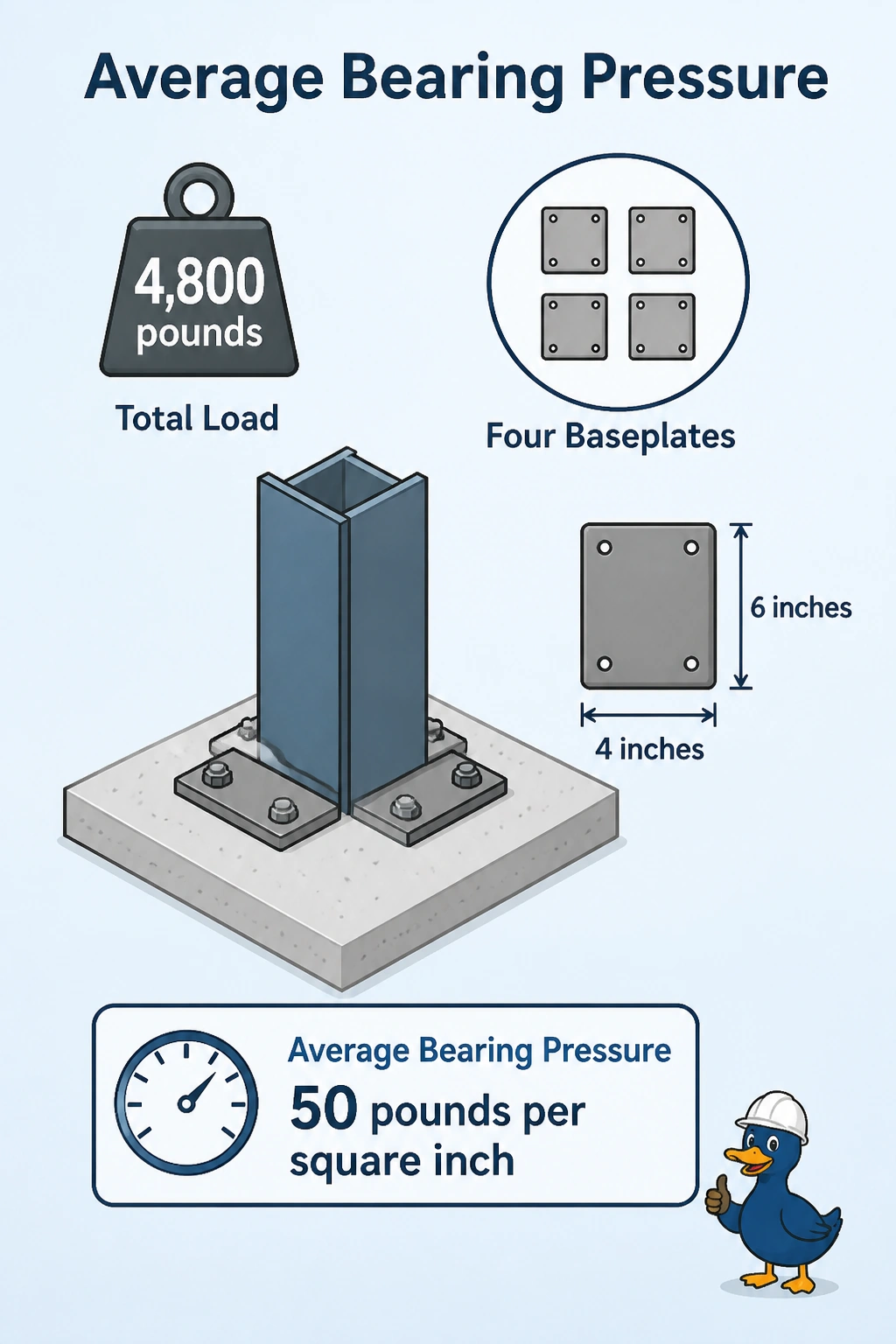
A warehouse storage rack carrying a total load of 4,800 pounds rests evenly on four steel baseplates, each measuring 6 inches by 4 inches. What is the average bearing pressure exerted on the concrete floor?
Select an answer to reveal the explanation.
Short Explanation
Pressure is just total weight divided by total contact area, so once you add up all four baseplates, the math falls right into place. The trap is dividing the entire 4,800-pound rack by only one baseplate's 24 square inches, which inflates your answer fourfold.
Full Explanation
Bearing pressure equals total applied force divided by total contact area (P = F / A). Each steel baseplate measures 6 inches by 4 inches, giving 24 square inches per plate. Multiplying by four baseplates yields a total contact area of 96 square inches. Dividing the 4,800-pound load by 96 square inches gives 50 pounds per square inch across all four baseplates. Dividing 4,800 pounds by a single 24-square-inch plate produces 200 pounds per square inch on the concrete, which mistakenly assigns the entire rack weight to one leg. Dividing by 48 square inches (two plates) gives 100 pounds per square inch per baseplate, which undercounts the total bearing area. Dividing one leg's 1,200-pound share by all 96 square inches yields 12.5 pounds per square inch total load, which mixes single-leg force with four-plate area. As a caveat, this calculation assumes uniform weight distribution across level floor slabs; uneven shimming or off-center pallet loading concentrates stress on fewer legs. For an operational check, inspect baseplate anchors and concrete slabs beneath heavily loaded racks for cracking or spalling, and verify floor slab psi ratings with structural engineering.
Prefer to study offline? Printable PDF study book + test engine ($7.50, unofficial). These questions stay free here.