
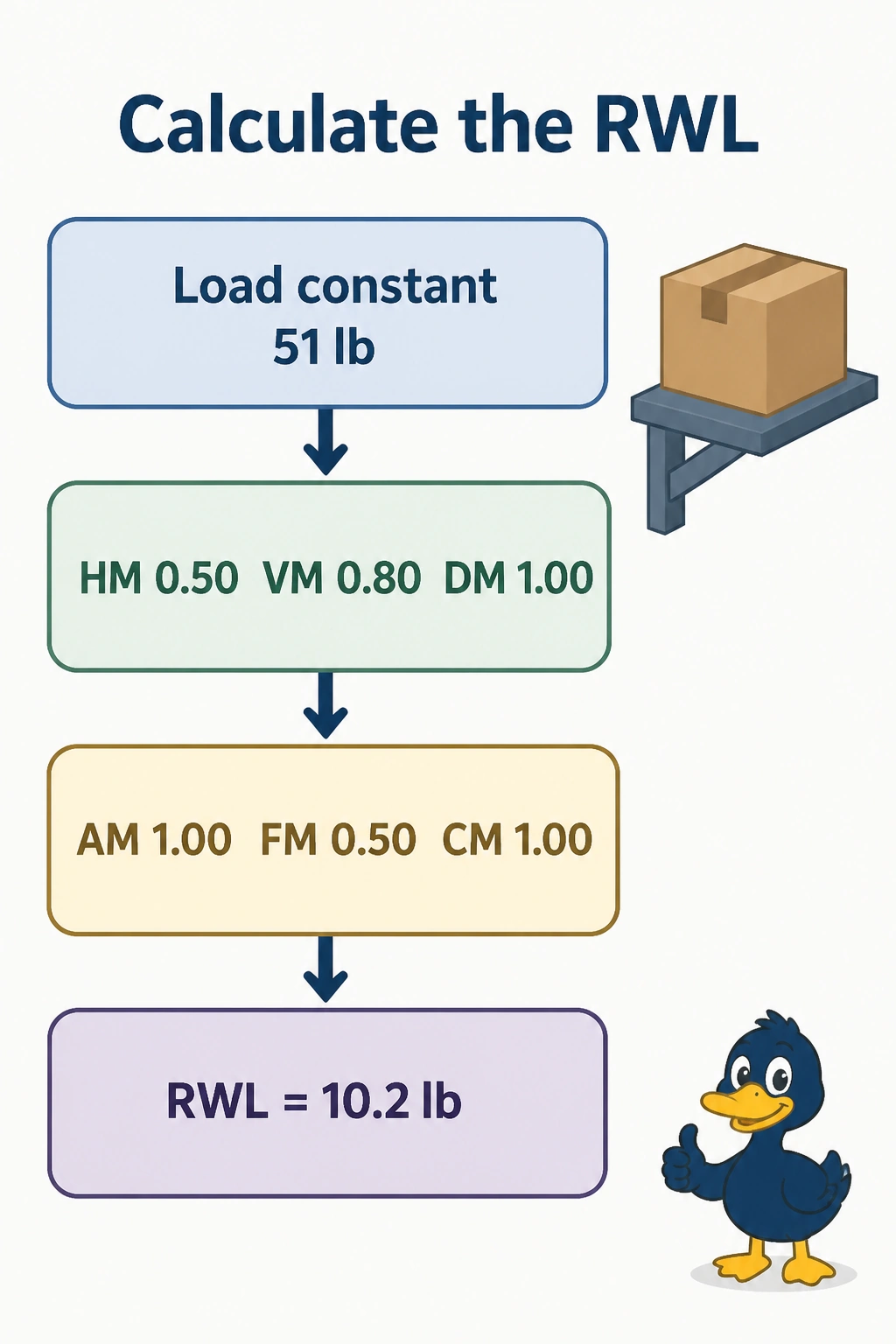
An ergonomist evaluates a warehouse lifting task using the Revised NIOSH Lifting Equation with a Load Constant of 51 pounds and the following task multipliers: Horizontal Multiplier = 0.50, Vertical Multiplier = 0.80, Distance Multiplier = 1.00, Asymmetric Multiplier = 1.00, Frequency Multiplier = 0.50, and Coupling Multiplier = 1.00. What is the Recommended Weight Limit (RWL) for this task?
Select an answer to reveal the explanation.
Short Explanation
The NIOSH lifting equation works like a series of discount coupons stacked together—every awkward factor shrinks what your back can safely handle! Watch out for the trap of skipping one multiplier when multiplying across all six factors.
Full Explanation
Under the Revised NIOSH Lifting Equation, the Recommended Weight Limit (RWL) equals the Load Constant multiplied by all six task multipliers: RWL = LC x HM x VM x DM x AM x FM x CM. Substituting the given values yields 51 x 0.50 x 0.80 x 1.00 x 1.00 x 0.50 x 1.00. First, 51 x 0.50 = 25.5; next, 25.5 x 0.80 = 20.4; finally, 20.4 x 0.50 = 10.2 pounds. Each multiplier ranges from 0 to 1 and reduces the 51-pound ideal starting point whenever reach, height, travel distance, twisting, lift frequency, or hand coupling deviates from optimal conditions. Selecting 20.4 pounds occurs if you multiply by the horizontal and vertical multipliers but omit the 0.50 frequency penalty. Selecting 25.5 pounds reflects applying only the horizontal multiplier while ignoring both vertical height and lifting frequency. Selecting 40.8 pounds results from multiplying 51 by 0.80 alone and dropping both 0.50 multipliers. Caveat: the RWL applies to two-handed, smooth manual lifts under normal environmental conditions and must be divided into the actual load weight to find the Lifting Index. As an operational check, re-measure horizontal reach at both the origin and destination of the lift to verify which posture governs.
Prefer to study offline? Printable PDF study book + test engine ($7.50, unofficial). These questions stay free here.