
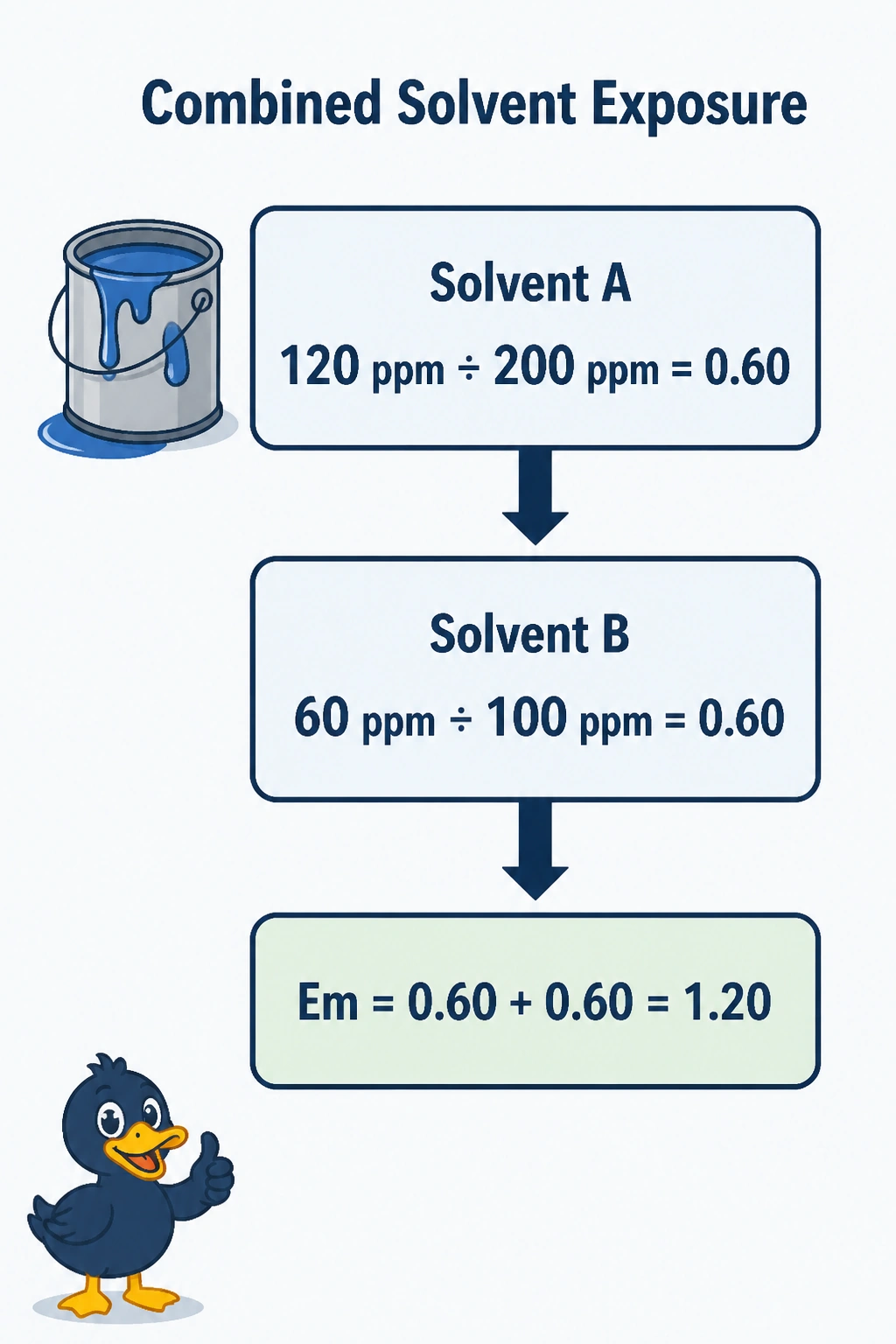
A paint-mixing operator is exposed over an 8-hour shift to two solvents with additive central nervous system effects: Solvent A at 120 ppm (PEL = 200 ppm) and Solvent B at 60 ppm (PEL = 100 ppm). Using OSHA's additive mixture formula (29 CFR 1910.1000), what is the combined equivalent exposure ratio (Em)?
Select an answer to reveal the explanation.
Short Explanation
When two solvents hit the same target organ, their effects stack up like bricks on a single shelf—even if each chemical looks safe on its own. The trap is averaging the two ratios together, which hides the combined dose that pushes your worker past the legal limit.
Full Explanation
Under OSHA 29 CFR 1910.1000, the equivalent exposure ratio for additive substances is Em = (C1 / L1) + (C2 / L2), which yields (120 / 200) + (60 / 100) = 0.60 + 0.60 = 1.20, which exceeds 1.0 and indicates an overexposure. Even though each solvent alone is at 60% of its individual Permissible Exposure Limit, their combined central nervous system burden exceeds unity and requires engineering, work-practice, or respiratory controls. Selecting 0.60, because the average of the two individual exposure ratios is below 1.0 incorrectly averages the fractions instead of summing them. Selecting 0.90, because the combined concentration is divided by the higher 200 ppm PEL and 1.80, because the combined concentration is divided by the lower 100 ppm PEL both improperly add raw parts-per-million concentrations that have different toxicological limits. Caveat: the additive formula applies when substances affect the same organ system; chemicals with truly independent target organs are evaluated separately unless toxicological data shows interaction. As an operational check, review full-shift air sampling reports for co-exposures in solvent-blending areas and calculate Em before declaring compliance.
Prefer to study offline? Printable PDF study book + test engine ($7.50, unofficial). These questions stay free here.