
Under OSHA's 5 dB exchange rate (where 95 dBA allows 4 hours and 100 dBA allows 2 hours), a press operator is exposed to 95 dBA for 2 hours, 100 dBA for 0.5 hours, and 75 dBA for the remaining 5.5 hours of an 8-hour shift. What is the operator's total daily noise dose?
Select an answer to reveal the explanation.
Short Explanation
Noise dose math is just adding up fractions of your daily noise budget, and quiet time below 80 dBA costs you zero. The trap is forgetting to convert each exposure interval into a fraction of its allowed duration before summing.
Full Explanation
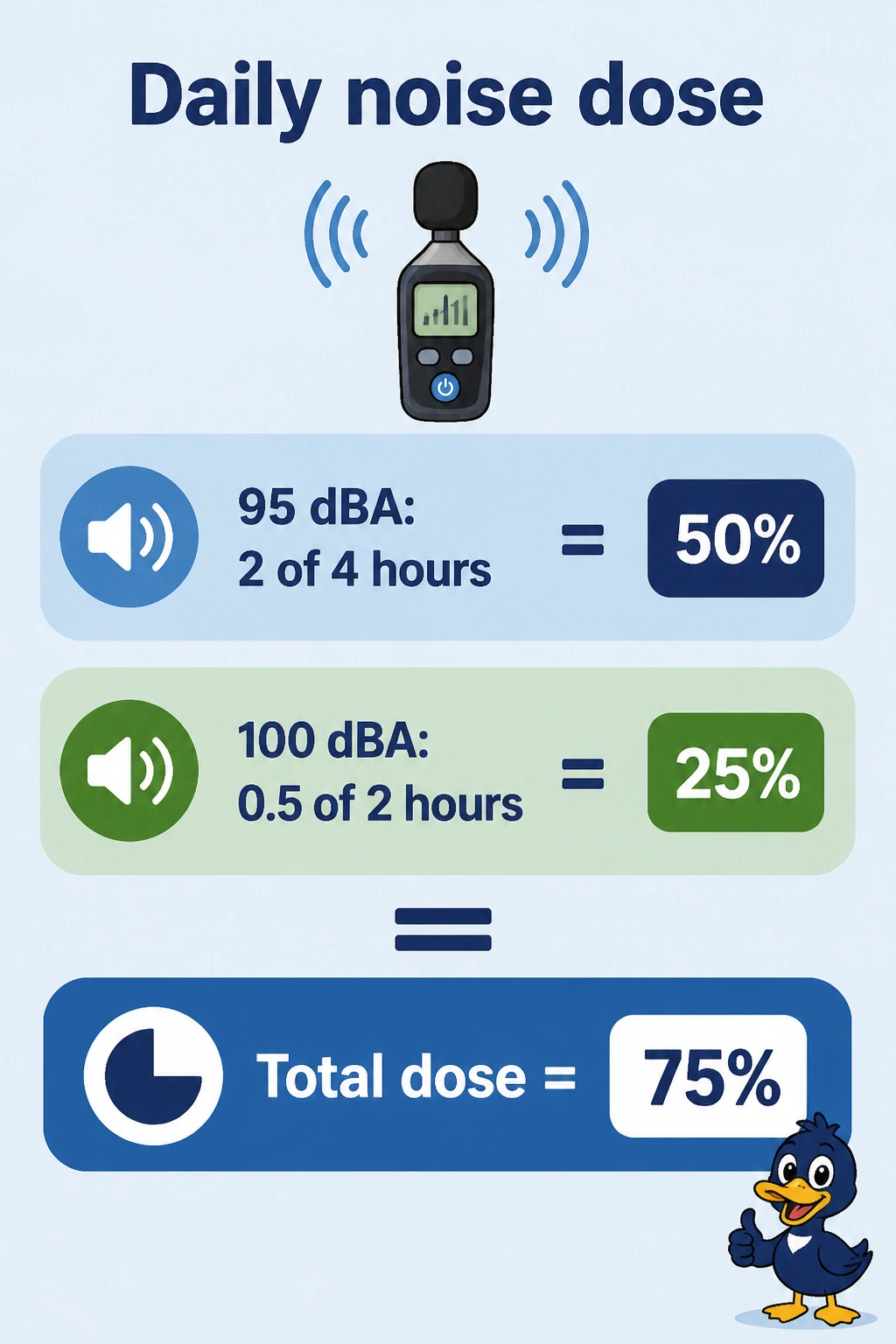
Under OSHA 29 CFR 1910.95, total daily noise dose is calculated by dividing each actual exposure duration by the maximum permitted duration at that sound level and summing the fractions: D = 100 x (C1/T1 + C2/T2 + ...). Here, 2 hours at 95 dBA divided by the 4-hour limit equals 0.50 (50%), and 0.5 hours at 100 dBA divided by the 2-hour limit equals 0.25 (25%). Exposure at 75 dBA falls below the 80 dBA hearing conservation threshold and contributes 0%, yielding 75 percent of the permissible daily noise dose. Selecting 50 percent of the permissible noise dose accounts only for the 95 dBA interval while omitting the 100 dBA exposure. Selecting 100 percent of the permissible noise dose typically results from misreading the 100 dBA interval as 1 full hour instead of 0.5 hours. Selecting 125 percent of the permissible noise dose overcounts the low-level 75 dBA interval or misapplies the permitted durations. Caveat: a 75% dose exceeds OSHA's 50% action level (equivalent to an 85 dBA 8-hour TWA), so the operator must be enrolled in a hearing conservation program even though the 100% PEL is not exceeded. Operational check: verify dosimeter threshold settings are configured to 80 dBA for hearing conservation screening and 90 dBA for PEL compliance.
Prefer to study offline? Printable PDF study book + test engine ($7.50, unofficial). These questions stay free here.