
An industrial radiography facility stores a calibration check source with an initial activity of 80 millicuries (mCi) and a half-life of 6 hours. Assuming no material is added or removed, how much activity remains after 18 hours?
Select an answer to reveal the explanation.
Short Explanation
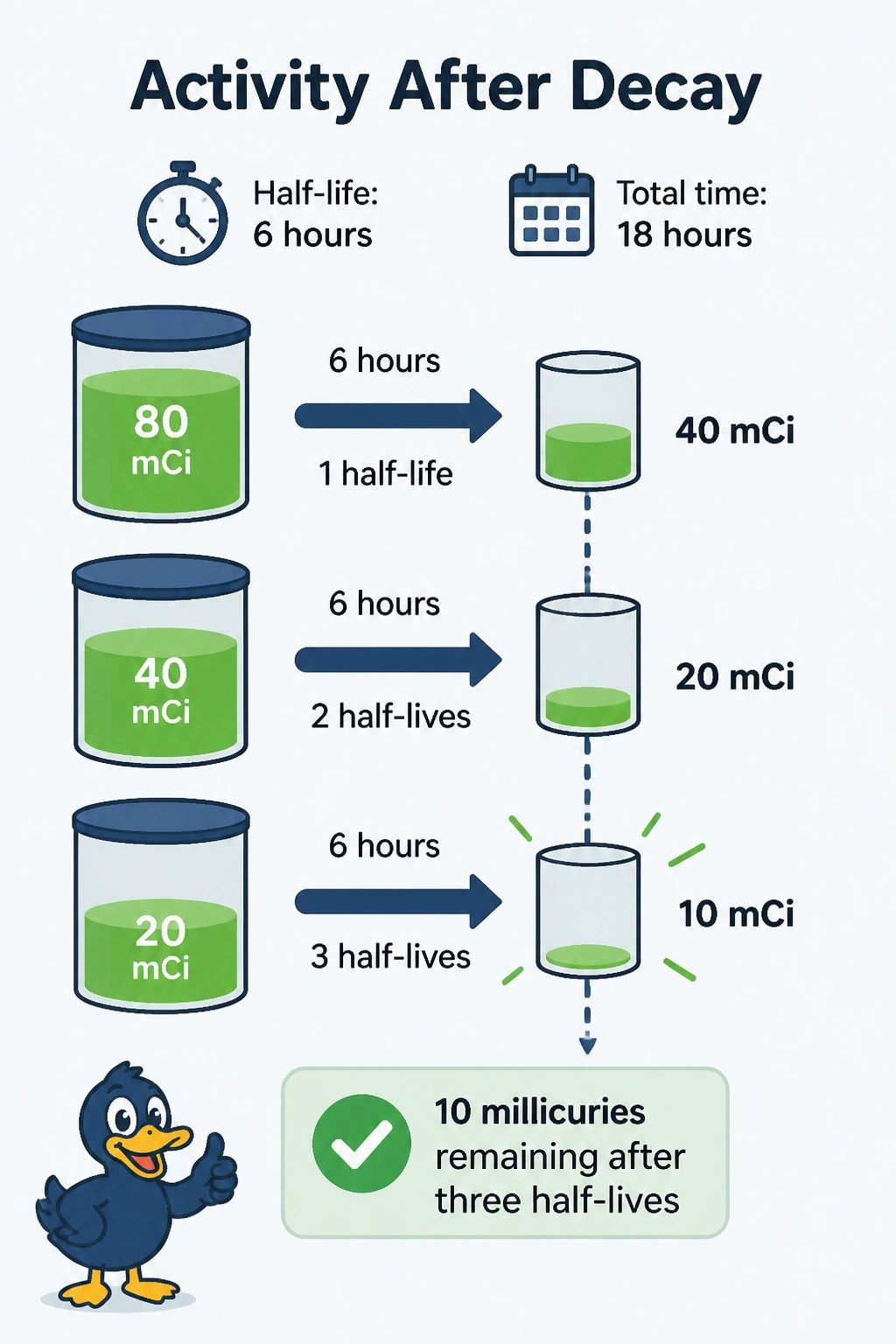
Radioactive decay works like folding a sheet of paper in half—each half-life cuts whatever is left in half again, never down to zero in one jump. Because 18 hours equals three 6-hour half-lives, you halve 80 three times to land on 10 millicuries. The trap is dividing the starting activity linearly by three instead of applying exponential halving.
Full Explanation
Radioactive decay follows an exponential law where each elapsed half-life reduces the remaining activity by 50 percent. Dividing the 18-hour elapsed time by the 6-hour half-life gives exactly three half-lives: after 6 hours the activity drops from 80 to 40 mCi, after 12 hours it drops to 20 mCi, and after 18 hours it reaches 10 millicuries remaining after three half-lives. Selecting 40 millicuries remaining after one decay interval fails because it only accounts for the first 6 hours rather than the full 18-hour storage period. Selecting 20 millicuries remaining after two decay intervals fails because it stops at 12 hours and misses the final 6-hour decay step. Selecting 26.7 millicuries calculated by dividing by three fails because radioactive decay is exponential, not linear; dividing 80 mCi by 3 ignores the constant fractional decay per unit time. As a caveat, this calculation gives the activity of the parent isotope only; if the isotope decays into a radioactive daughter product, total radiation dose rate may still require separate shielding checks. For an operational check, verify the source's reference date on its decay chart and confirm with a calibrated survey meter before handling or shipping.
Prefer to study offline? Printable PDF study book + test engine ($7.50, unofficial). These questions stay free here.