
A food processing plant plans to spend $45,000 to install an automated pallet-wrapping system that will reduce annual stretch-film waste and ergonomic injury costs by $15,000 per year. Assuming constant annual savings and ignoring the time value of money, what is the simple payback period?
Select an answer to reveal the explanation.
Short Explanation
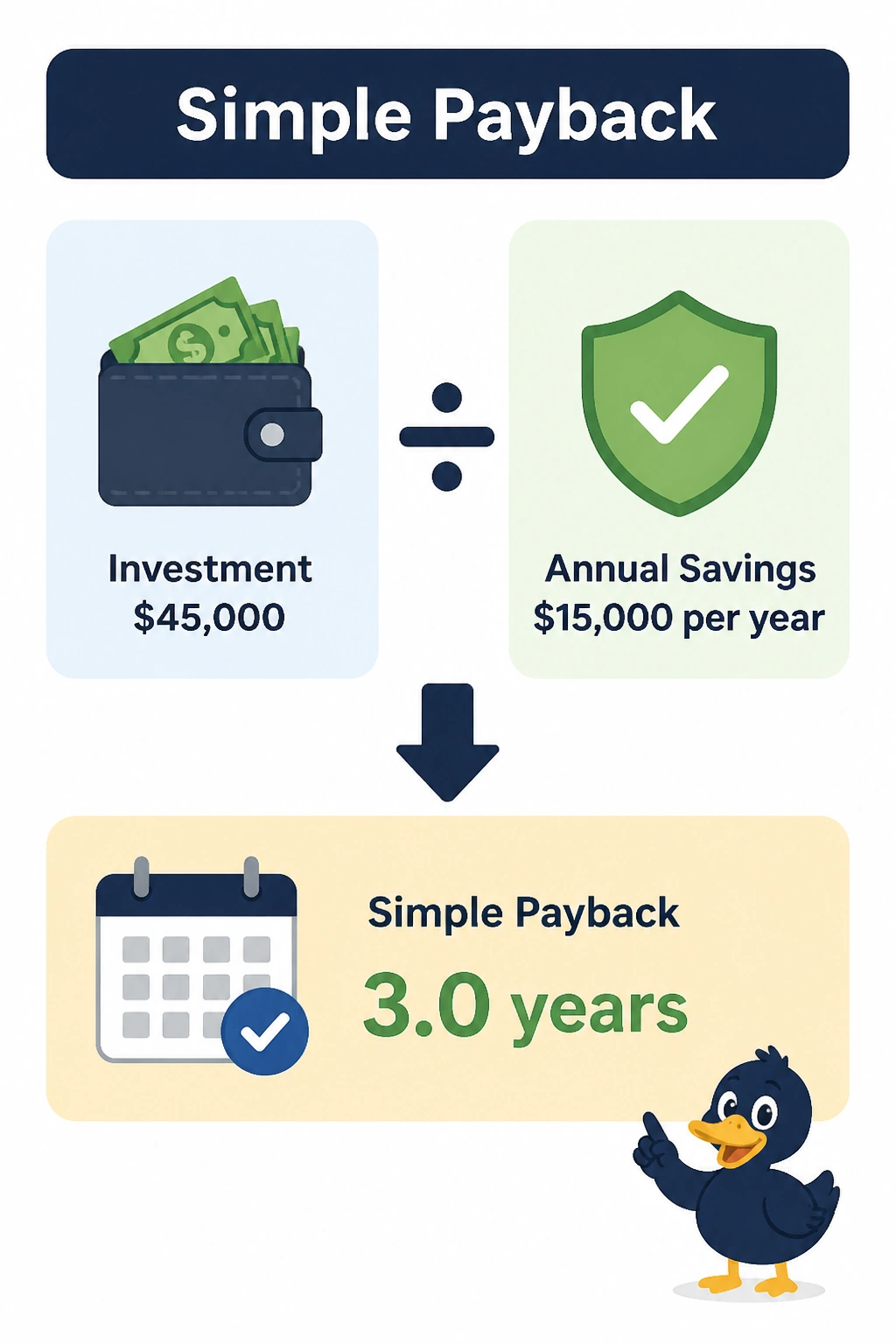
Simple payback period tells leadership how many years it takes for your safety investment to earn back its upfront sticker price. Divide the initial cost by the annual savings, and watch out for the classic trap of flipping the fraction upside down.
Full Explanation
Simple payback period is calculated by dividing the total initial capital investment by the expected net annual cash savings: $45,000 divided by $15,000 per year equals 3.0 years. Selecting 3.0 years accurately reflects the break-even point where cumulative savings match the upfront equipment cost. Choosing 0.33 years results from inverting the formula ($15,000 divided by $45,000), which represents the annual return ratio rather than the time required to recover the investment. Selecting 1.5 years cuts the true recovery time in half, as if annual savings were $30,000 instead of $15,000. Selecting 4.5 years overestimates the break-even timeline by adding an extra year and a half beyond the three-year recovery point. One important caveat is that simple payback ignores the time value of money, ongoing maintenance expenses, and any savings occurring after the break-even year, so large multi-year capital projects often pair payback with net present value or internal rate of return. As an operational check, track actual annual stretch-film usage and workers' compensation claim reductions after installation to verify that realized savings match the $15,000-per-year projection.
Prefer to study offline? Printable PDF study book + test engine ($7.50, unofficial). These questions stay free here.