
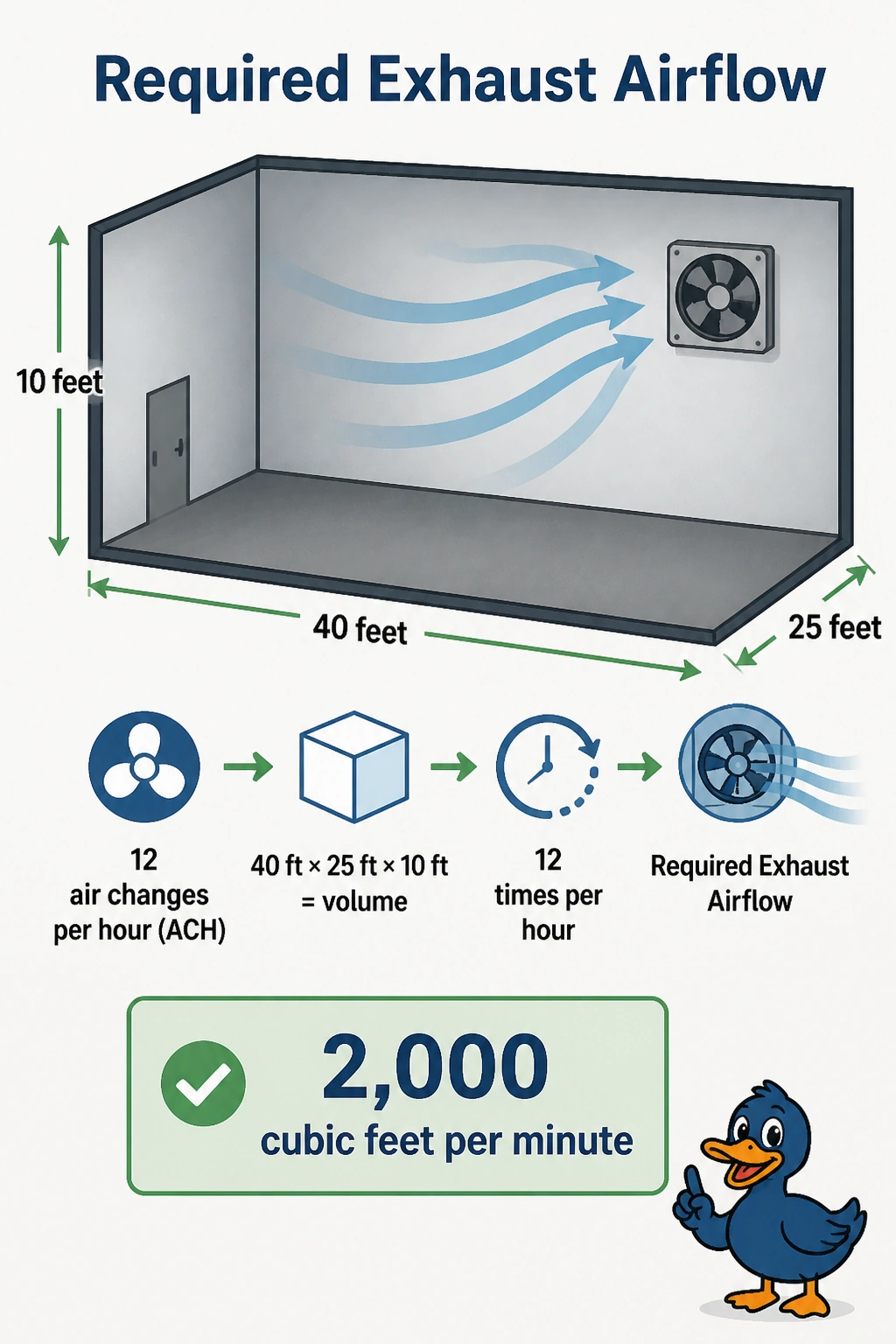
A chemical laboratory room measures 40 feet long, 25 feet wide, and 10 feet high. To achieve 12 air changes per hour (ACH), what total exhaust airflow rate in cubic feet per minute (CFM) is required?
Select an answer to reveal the explanation.
Short Explanation
Air changes per hour tells you how many times an entire room of air gets swapped out every sixty minutes, not every minute. The trap is forgetting to divide the hourly total by sixty, or dropping one of the room dimensions in your volume math. Multiply length, width, height, and ACH, then divide by sixty.
Full Explanation
To find the required volumetric exhaust rate, first compute the room volume by multiplying length, width, and height: 40 feet times 25 feet times 10 feet equals 10,000 cubic feet. Multiplying 10,000 cubic feet by 12 air changes per hour yields 120,000 cubic feet per hour, and dividing by 60 minutes per hour produces 2,000 cubic feet per minute. Selecting 200 cubic feet per minute typically reflects omitting the 10-foot ceiling height from the volume calculation or misplacing a decimal, which would yield only 1.2 air changes per hour. Choosing 1,200 cubic feet per minute results from dividing by 100 instead of 60 or assuming a 6,000-cubic-foot room, leaving the lab under-ventilated. Picking 120,000 cubic feet per minute forgets to convert hours to minutes, overstating fan capacity by a factor of sixty and sizing an unrealistically massive system. As a caveat, room-level air changes measure general dilution ventilation and do not substitute for local exhaust hoods over open toxic chemical containers. For an operational check, verify actual exhaust flow at the lab's register grilles with a calibrated capture hood and confirm makeup air balances the exhaust.
Prefer to study offline? Printable PDF study book + test engine ($7.50, unofficial). These questions stay free here.