
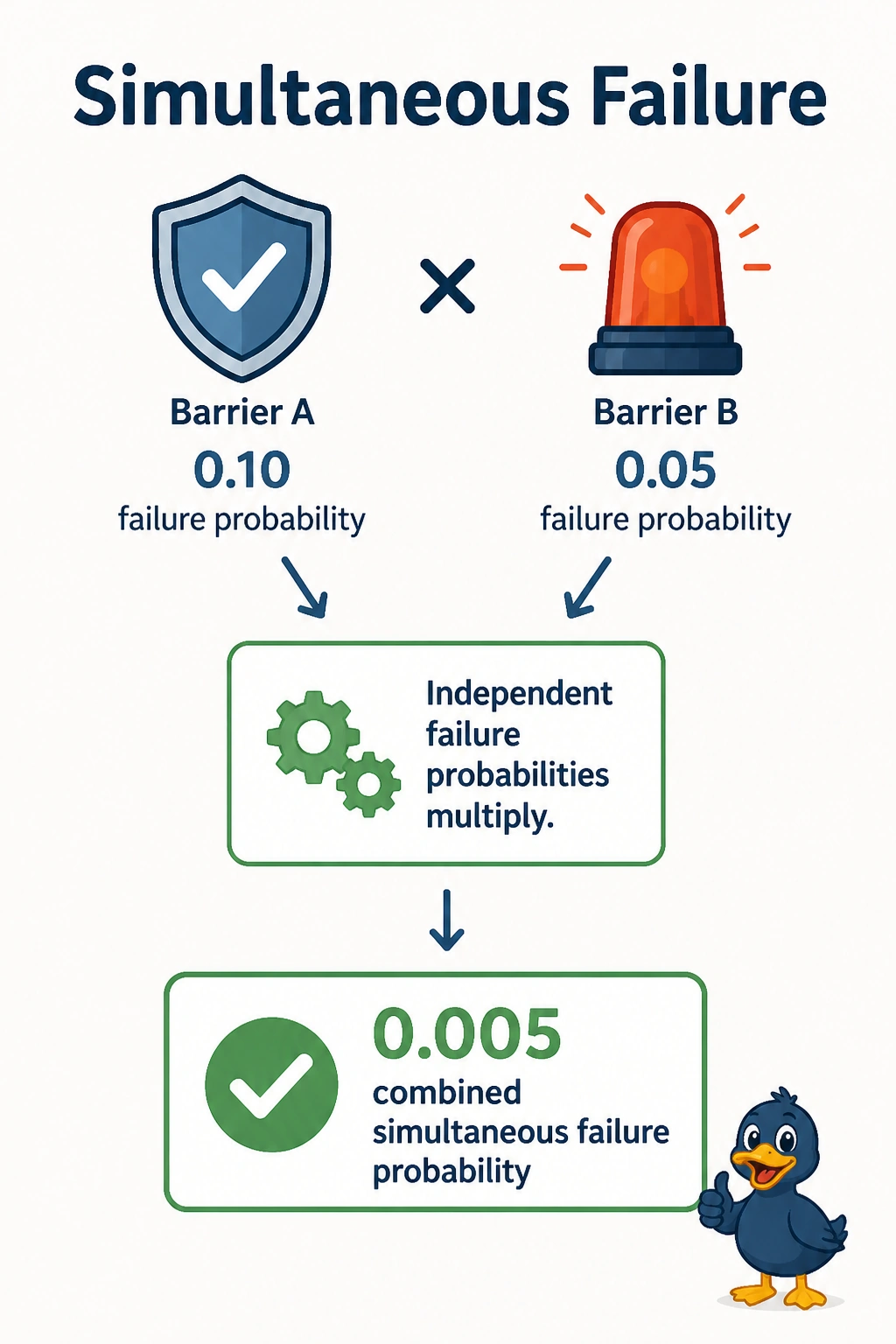
A chemical reactor uses two independent pressure-relief safety interlocks arranged in parallel so that either interlock alone can prevent overpressurization. Interlock A has a failure-on-demand probability of 0.10 and Interlock B has a failure-on-demand probability of 0.05; what is the probability that both interlocks fail simultaneously on demand?
Select an answer to reveal the explanation.
Short Explanation
Parallel safety devices work like a belt and suspenders: both have to snap at the same time for your pants to fall. The trap is adding the two failure numbers together, which actually describes a series system rather than redundant parallel protection.
Full Explanation
Because the two interlocks operate in parallel and independently, the reactor loses protection only if both fail together, so multiplying 0.10 by 0.05 yields a 0.005 combined simultaneous failure probability. Selecting 0.150 combined failure probability mistakenly adds the individual failure rates, which approximates the failure probability of a series configuration where either component failing causes system failure. Choosing 0.050 combined failure probability merely repeats the lower failure rate of Interlock B alone and ignores the extra redundancy provided by Interlock A. Picking 0.950 combined failure probability confuses failure probability with Interlock B's single-component reliability (1 minus 0.05). One critical caveat is that this multiplication rule assumes true independence; a common-cause failure such as a shared power supply or plugged impulse line can defeat both interlocks at once. As an operational check, review piping and instrumentation diagrams and proof-test logs to verify physical separation and independent testing for each redundant interlock.
Prefer to study offline? Printable PDF study book + test engine ($7.50, unofficial). These questions stay free here.