
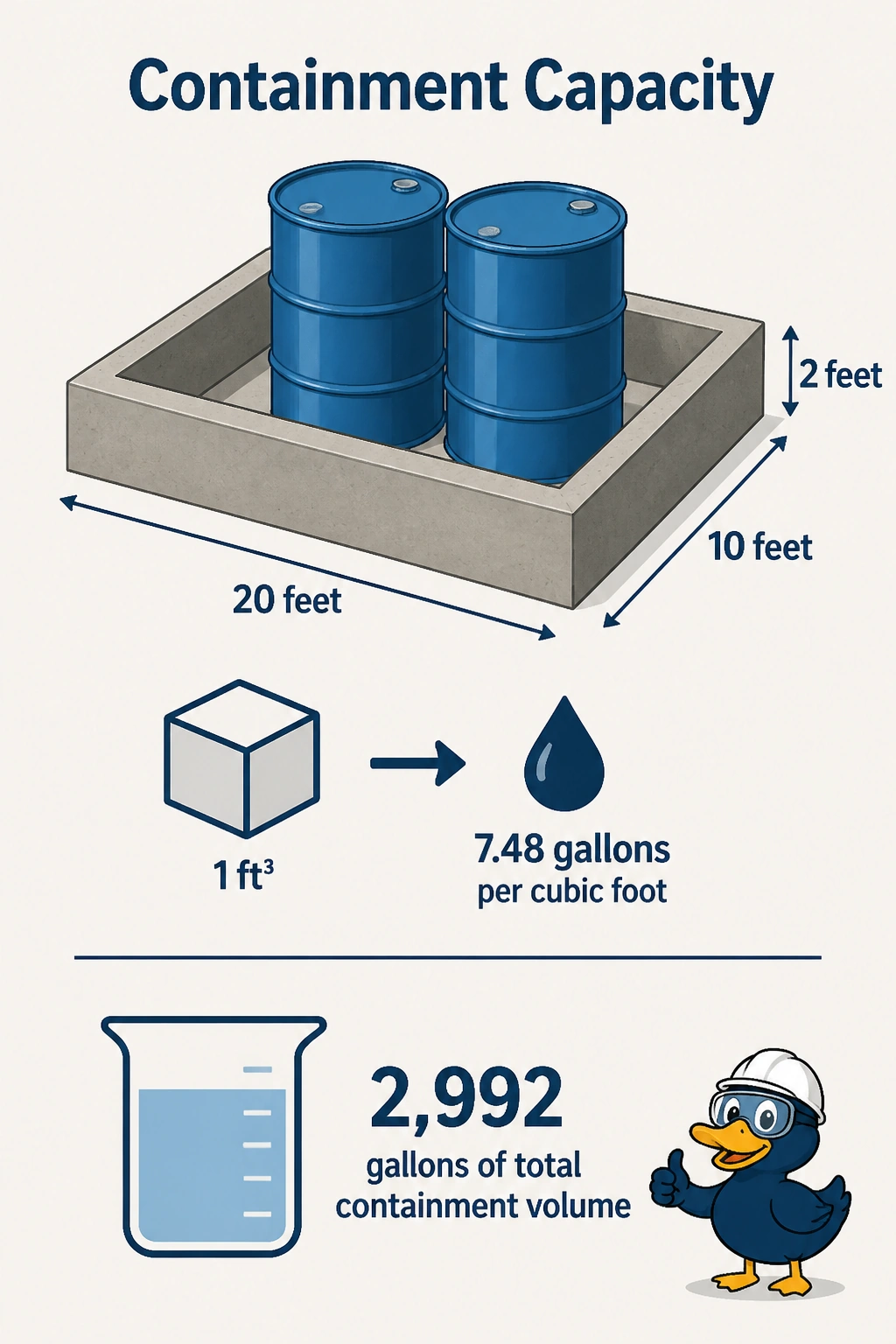
A facility builds a rectangular secondary containment dike around a chemical tank measuring 20 feet long, 10 feet wide, and 2 feet high inside dimensions. Using 7.48 gallons per cubic foot, what is the maximum liquid capacity of the containment dike?
Select an answer to reveal the explanation.
Short Explanation
Containment math is a straightforward two-step multiply, as long as you keep your units straight! The common trap is stopping right after you find the cubic footage or dropping the wall height, which leaves your dike undersized on paper.
Full Explanation
To find the liquid capacity of a rectangular containment dike, first multiply length, width, and interior height to get cubic feet: 20 ft x 10 ft x 2 ft = 400 cubic feet. Next, multiply 400 cubic feet by 7.48 gallons per cubic foot to get 2,992 gallons, making "2,992 gallons of total containment volume" the correct capacity. Selecting "400 gallons of total containment volume" stops after calculating cubic feet and forgets to convert cubic feet into gallons. Choosing "1,496 gallons of total containment volume" uses only 1 foot of dike height instead of the full 2-foot wall height (20 x 10 x 1 x 7.48 = 1,496). Selecting "5,984 gallons of total containment capacity" erroneously doubles the true volume. As a caveat, gross dike capacity must also account for displacement from the tank's footprint, piping, and any accumulated rainwater when verifying whether the dike can hold 100 percent of the largest container plus freeboard. For an operational check, subtract the tank base volume and inspect outdoor dikes after storms to ensure drain valves remain closed and stormwater is pumped out promptly.
Prefer to study offline? Printable PDF study book + test engine ($7.50, unofficial). These questions stay free here.