
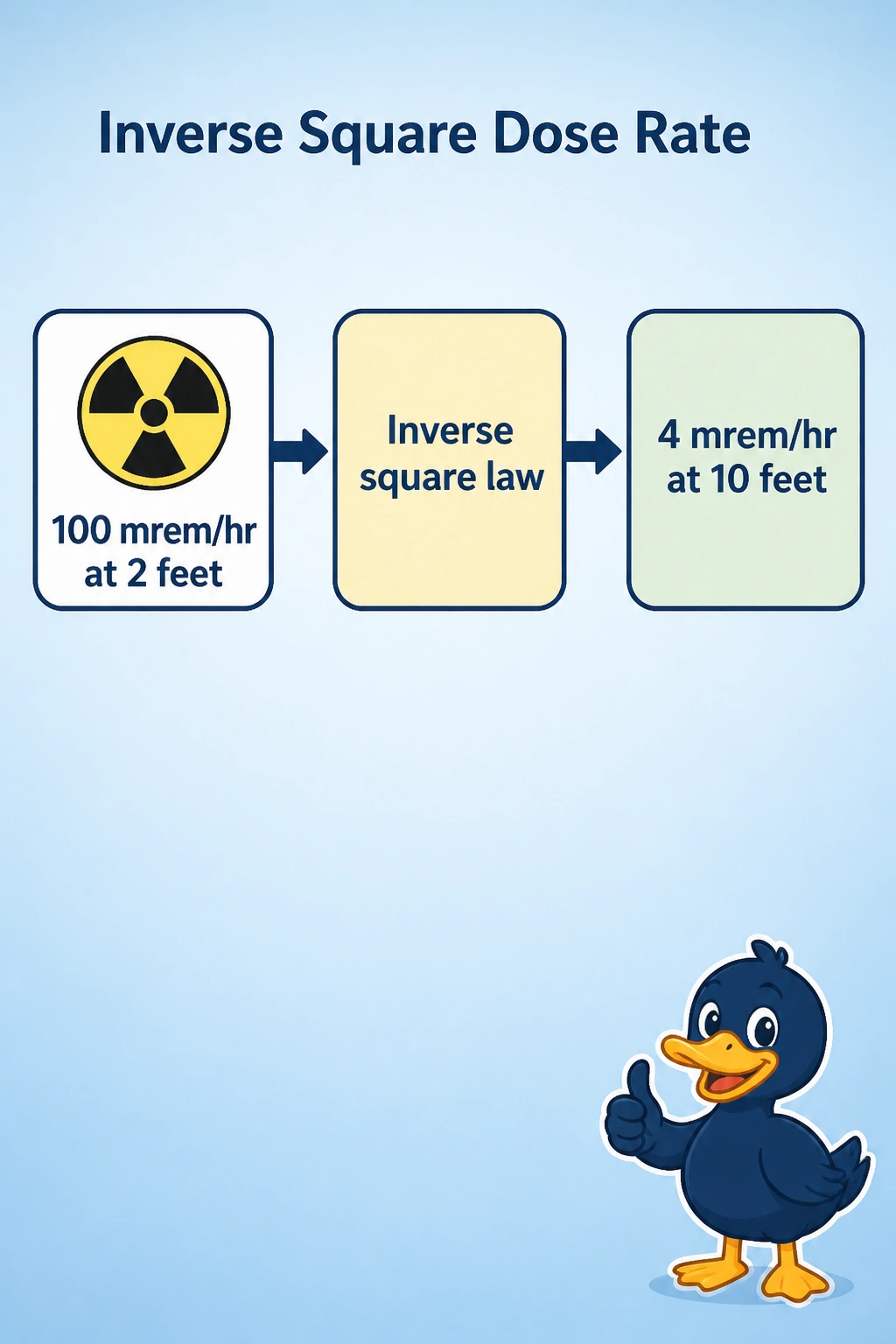
A gamma radiography source produces a dose rate of 100 millirem per hour (mrem/hr) at a distance of 2 feet from the source. Using the inverse square law, what is the dose rate at a distance of 10 feet from the source?
Select an answer to reveal the explanation.
Short Explanation
Stepping back from a point radiation source gives you huge protection because the beam spreads out in all directions at once. Don't fall into the trap of dividing linearly by the distance; square the ratio so you capture the full drop in dose rate.
Full Explanation
The correct answer is 4 mrem/hr using the inverse square law, which states that radiation intensity from a point source is inversely proportional to the square of the distance: I2 = I1 x (d1 / d2)^2. Substituting the given values gives I2 = 100 mrem/hr x (2 ft / 10 ft)^2 = 100 x (0.2)^2 = 100 x 0.04 = 4 mrem/hr. Increasing distance fivefold reduces the dose rate by a factor of twenty-five. 20 mrem/hr based on linear distance scaling fails because it divides 100 by 5 without squaring the distance ratio, severely overestimating the dose rate. 1 mrem/hr by dividing by distance squared is incorrect because it divides 100 by 10^2 while ignoring the initial 2-foot reference distance. 25 mrem/hr using half the initial distance is wrong because it applies an arbitrary factor of four rather than the fivefold distance increase from 2 feet to 10 feet. As an exam caveat, the inverse square law assumes a point source in air with negligible scatter or shielding attenuation. For an operational check, always verify boundary dose rates with a calibrated survey meter before establishing radiation barricades.
Prefer to study offline? Printable PDF study book + test engine ($7.50, unofficial). These questions stay free here.