
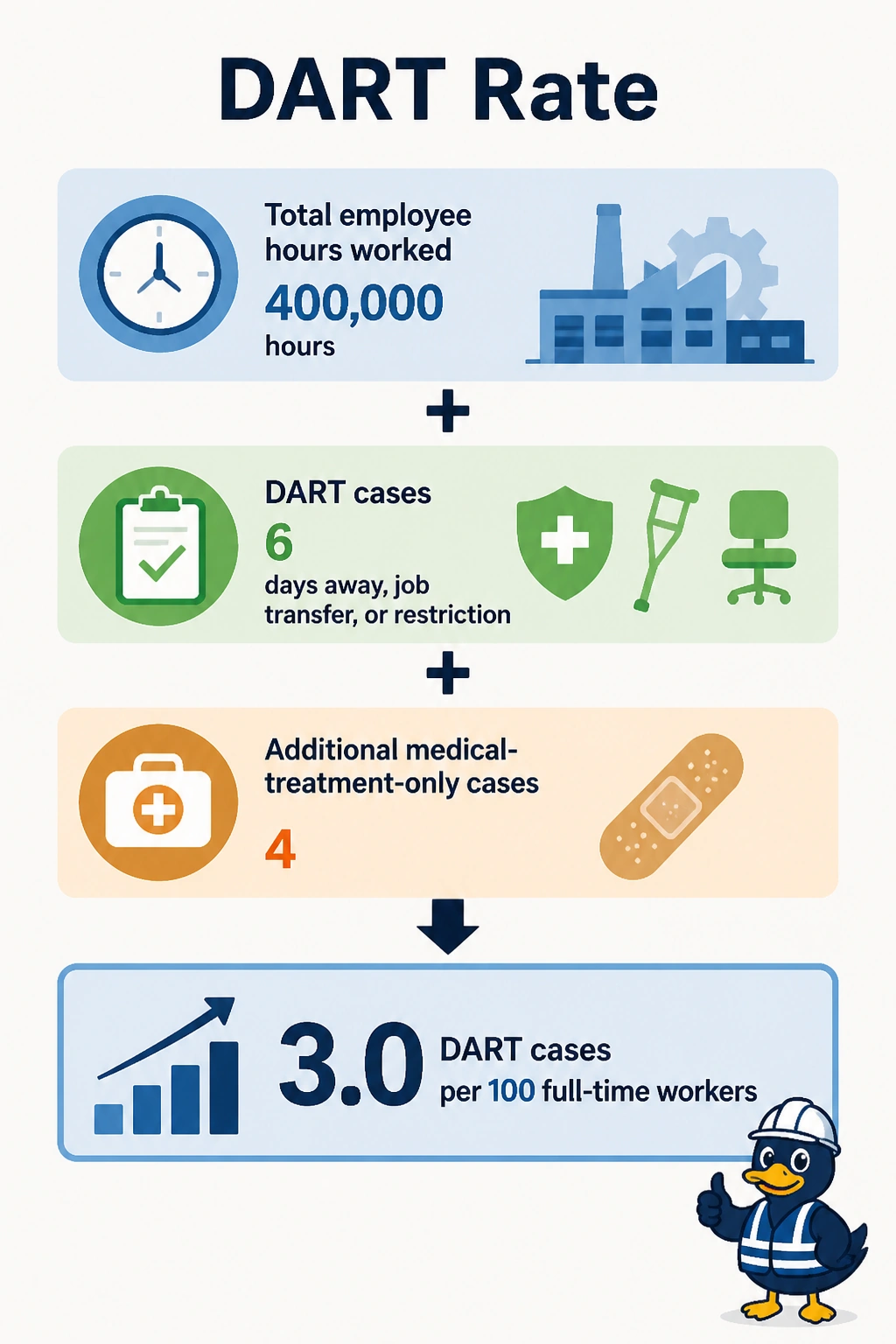
During a calendar year, a logistics warehouse records 400,000 total employee hours worked, 6 OSHA-recordable cases involving days away from work, job transfer, or restriction, and 4 additional recordable cases requiring only medical treatment beyond first aid. What is the warehouse's DART rate?
Select an answer to reveal the explanation.
Short Explanation
Don't let those extra medical-treatment cases pull you into calculating TRIR instead of DART! When you filter down to only the days-away, restricted, or transferred cases and multiply by 200,000, the math lands cleanly on 3.0.
Full Explanation
The OSHA Days Away, Restricted, or Transferred (DART) rate is calculated as (number of DART cases times 200,000) divided by total hours worked, where 200,000 represents 100 full-time employees working 40 hours per week for 50 weeks. Plugging in the 6 qualifying cases gives (6 times 200,000) divided by 400,000, which equals 3.0 DART cases per 100 full-time workers. Choosing 5.0 recordable cases per 100 full-time workers mistakenly adds the 4 medical-treatment-only cases into the numerator, yielding the Total Recordable Incident Rate instead of the DART rate. Selecting 2.0 recordable cases per 100 full-time workers uses only the 4 medical-treatment-only cases and excludes the actual DART cases. Selecting 1.5 DART cases per 100 full-time workers incorrectly uses a 100,000-hour multiplier instead of OSHA's standard 200,000-hour base. Caveat: a single employee injury that involves both days away and subsequent job restriction counts as only one DART case on the OSHA 300 Log, not two. Operational check: audit the OSHA 300 Log columns for days away and job transfer or restriction against total payroll hours before publishing annual safety metrics.
Prefer to study offline? Printable PDF study book + test engine ($7.50, unofficial). These questions stay free here.