
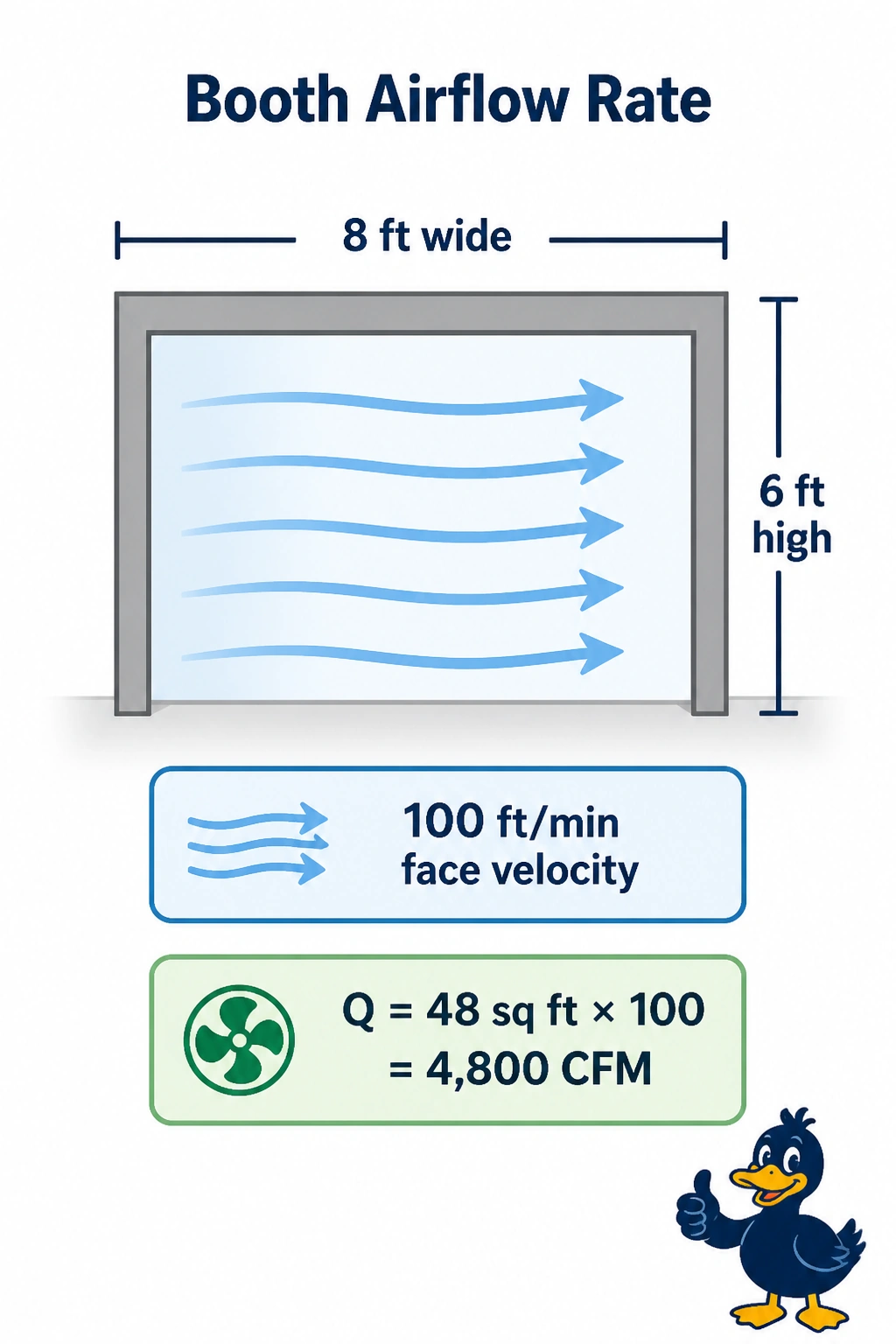
A spray-finishing booth has an open face measuring 8 feet wide by 6 feet high, and an industrial hygienist measures an average face velocity of 100 feet per minute across the opening. What is the volumetric airflow rate in cubic feet per minute?
Select an answer to reveal the explanation.
Short Explanation
Airflow math is just like finding the volume of a box moving past a doorway every minute—multiply area by speed and you are home free. The trap is adding the booth dimensions instead of multiplying them or slipping a decimal place. Multiply width by height first, then multiply by face velocity.
Full Explanation
4,800 cubic feet per minute is the correct volumetric airflow rate using the fundamental ventilation equation Q = A × V, where Q is volumetric flow rate in cubic feet per minute, A is cross-sectional opening area in square feet, and V is average air velocity in feet per minute. First compute the open face area by multiplying 8 feet by 6 feet to get 48 square feet, then multiply 48 square feet by the 100 feet per minute average face velocity to obtain 4,800 cubic feet per minute. 1,400 cubic feet per minute results from mistakenly adding 8 and 6 to get 14 before multiplying by 100. 2,400 cubic feet per minute represents half the actual airflow, such as erroneously halving the opening area or velocity. 48,000 cubic feet per minute introduces an extra factor of ten, a decimal error that would drastically overstate fan capacity. Caveat: a single velocity reading at the center of a booth overestimates true average flow because air moves faster near the center than along walls and corners. As an operational check, traverse the entire booth face on a multi-point grid with a calibrated anemometer to calculate a true average face velocity before signing off on ventilation performance.
Prefer to study offline? Printable PDF study book + test engine ($7.50, unofficial). These questions stay free here.