
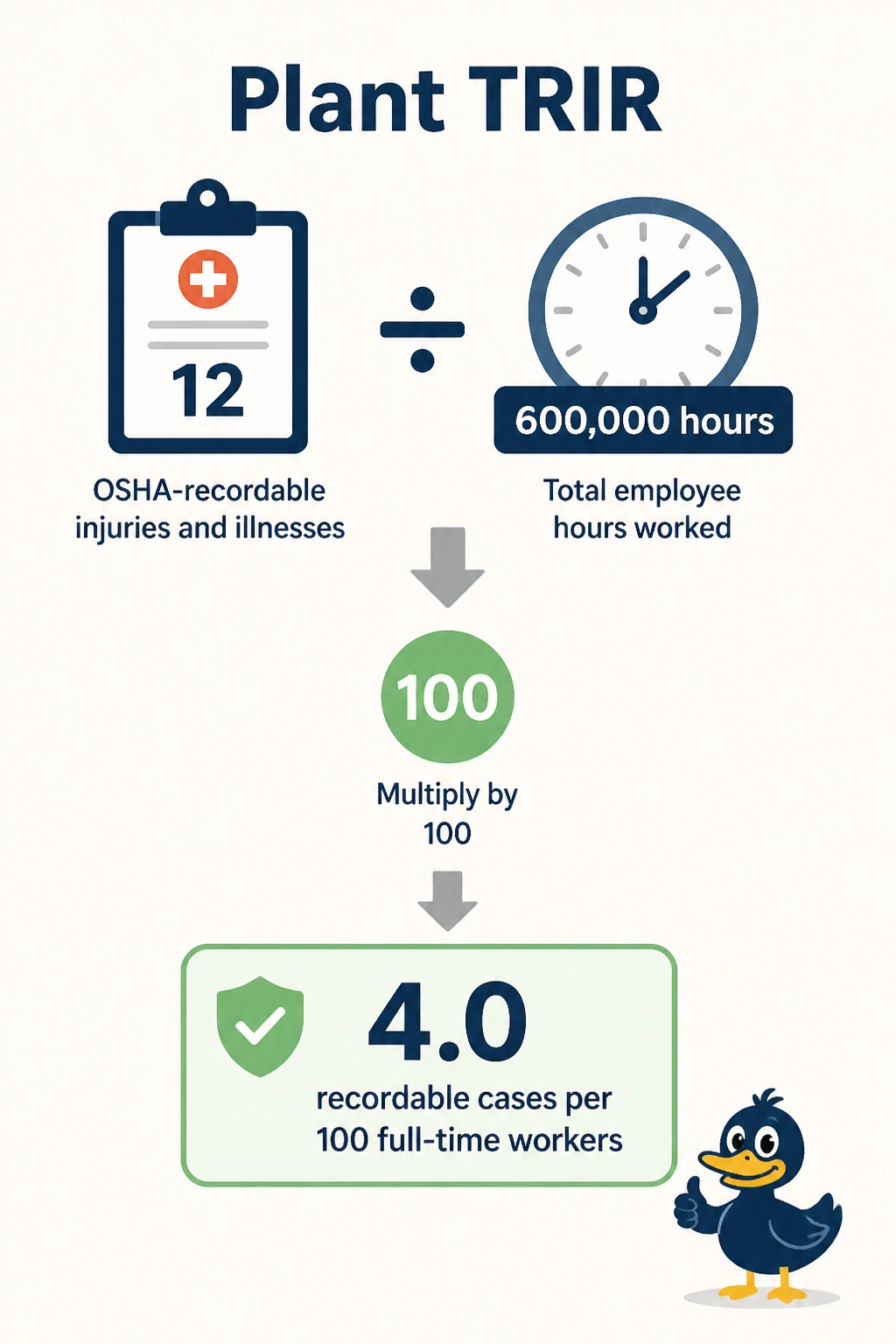
A manufacturing plant recorded 12 OSHA-recordable injuries and illnesses during a calendar year in which employees worked a total of 600,000 hours. What is the plant's Total Recordable Incident Rate (TRIR)?
Select an answer to reveal the explanation.
Short Explanation
Think of the 200,000 constant in the TRIR formula as your universal yardstick—it converts any plant's raw hours into a standard crew of 100 full-time workers. The trap is swapping in 100,000 or 1,000,000, which skews your rate by a factor of two or five.
Full Explanation
The OSHA Total Recordable Incident Rate equals the number of recordable cases multiplied by 200,000 and divided by total employee hours worked, giving (12 x 200,000) / 600,000 = 4.0 recordable cases per 100 full-time workers. The 200,000 factor represents 100 full-time employees working 40 hours per week for 50 weeks per year, allowing fair comparisons across facilities of different sizes. Selecting 2.0 recordable cases per 100 full-time workers results from multiplying by 100,000 instead of 200,000, which understates the injury rate by half. Selecting 20.0 recordable cases per 100 full-time workers results from multiplying by 1,000,000, a factor sometimes used in international per-million-hours metrics rather than OSHA's 100-worker baseline. Selecting 0.04 recordable cases per 100 full-time workers divides 12 cases by 300 full-time equivalents without scaling up to the 100-worker benchmark. Caveat: only include OSHA-recordable cases from Form 300 and actual hours worked, excluding vacation, sick leave, and holidays. Operational check: cross-check payroll hours worked against Form 300A totals before publishing annual TRIR figures to leadership.
Prefer to study offline? Printable PDF study book + test engine ($7.50, unofficial). These questions stay free here.