
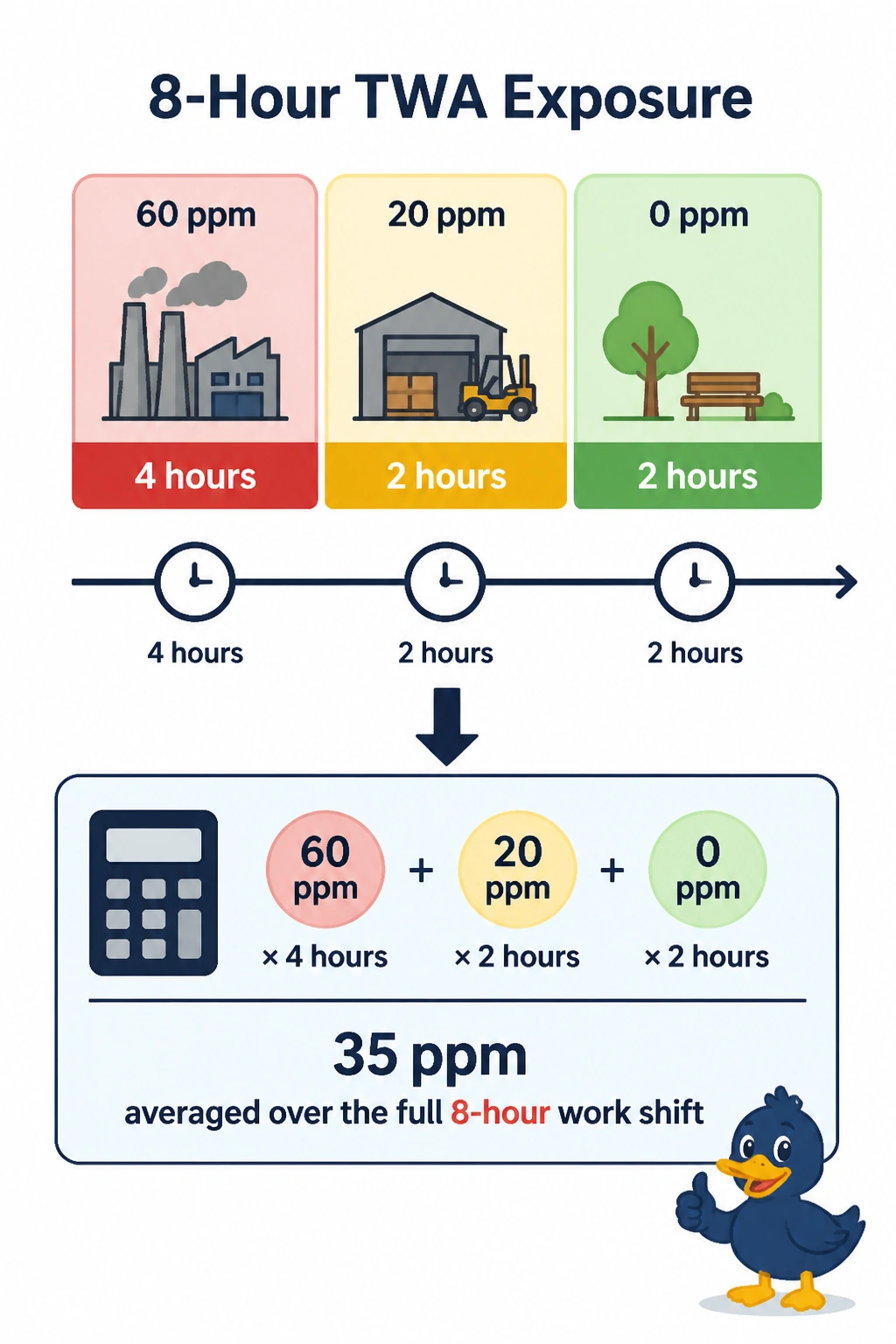
A chemical operator is exposed to toluene vapor for 4 hours at 60 ppm, followed by 2 hours at 20 ppm, and spends the remaining 2 hours of an 8-hour shift in a clean control room at 0 ppm. What is the operator's 8-hour Time-Weighted Average (TWA) exposure?
Select an answer to reveal the explanation.
Short Explanation
An 8-hour TWA spreads every breath of exposure—and every clean hour—across the entire 8-hour shift, so you cannot drop the zero-exposure hours. The trap is dividing by 6 active hours or averaging the three numbers without weighting by time.
Full Explanation
To compute an 8-hour Time-Weighted Average, multiply each concentration by its duration, sum the products, and divide by 8 hours: [(4 hr x 60 ppm) + (2 hr x 20 ppm) + (2 hr x 0 ppm)] / 8 hr = (240 + 40 + 0) / 8 = 280 / 8 = 35 ppm. This yields 35 ppm averaged over the full 8-hour work shift. Choosing 40 ppm based on the two exposure periods mistakenly takes the unweighted average of 60 ppm and 20 ppm, ignoring that the 60 ppm exposure lasted twice as long and omitting the 2 clean hours. Choosing 47 ppm averaged across six active hours correctly weights 240 plus 40 to get 280, but incorrectly divides by 6 hours instead of the mandatory 8-hour reference period. Choosing 27 ppm using the simple mean of three readings averages 60, 20, and 0 by 3, which ignores time weighting entirely. As a caveat, OSHA's 8-hour TWA denominator remains 8 hours even if an employee works a shorter or longer shift. Operationally, verify that pump run-times and task logs account for all 8 hours before comparing to a PEL.
Prefer to study offline? Printable PDF study book + test engine ($7.50, unofficial). These questions stay free here.