
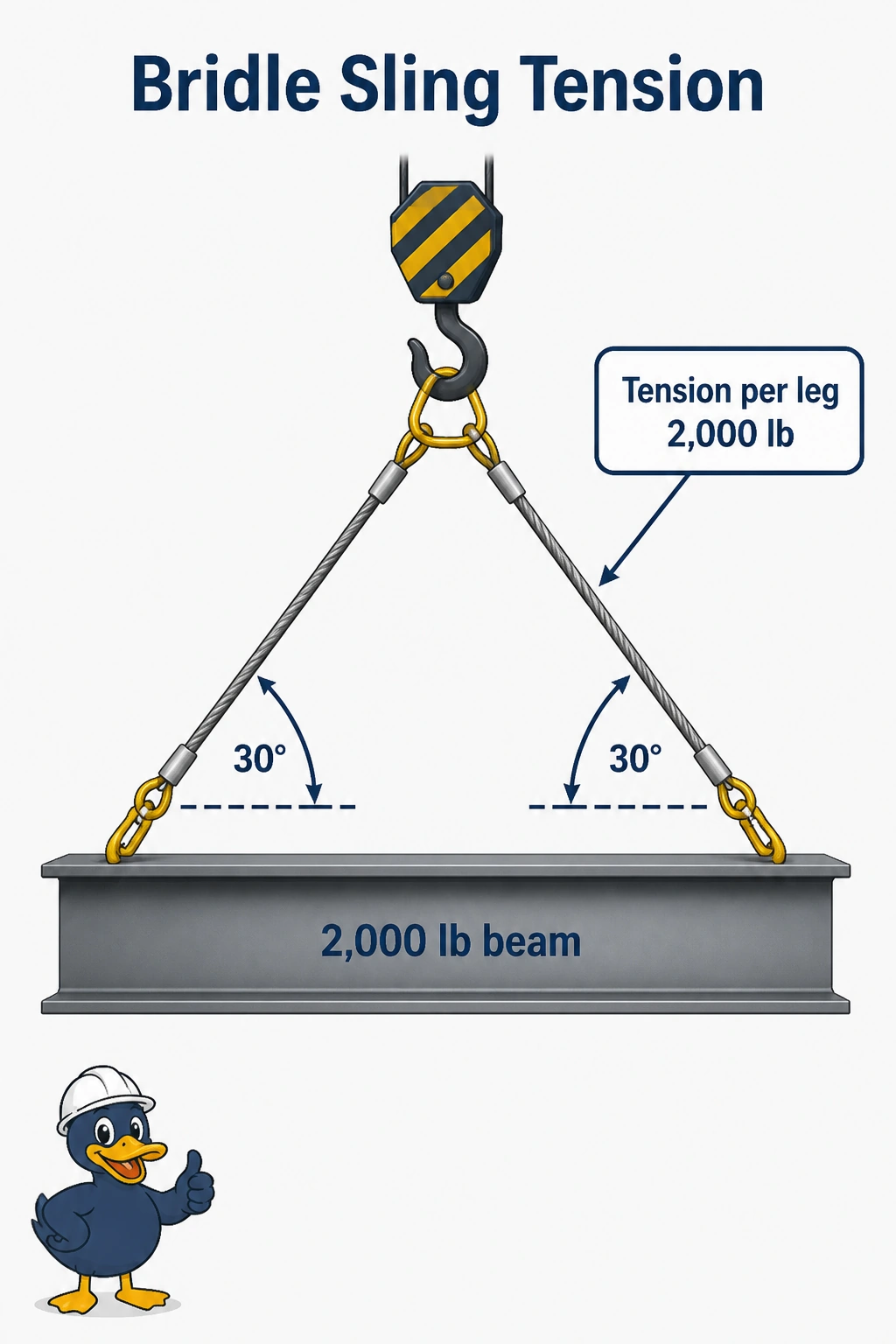
A rigger lifts a 2,000-pound steel beam using a symmetrical two-leg bridle sling where each leg forms a 30-degree angle with the horizontal beam (sin 30 degrees = 0.50; cos 30 degrees = 0.866). Ignoring sling weight, what is the tension in each sling leg?
Select an answer to reveal the explanation.
Short Explanation
Shallow sling angles multiply tension fast: at 30 degrees, each leg has to pull as hard as the entire beam weighs just to give you half the vertical lift. The trap is splitting the weight in two and forgetting the angle factor.
Full Explanation
For a symmetrical two-leg bridle sling, each leg supports half the vertical load (2,000 / 2 = 1,000 pounds), and leg tension equals that vertical share divided by the sine of the horizontal sling angle: 1,000 / sin(30 degrees) = 1,000 / 0.50 = 2,000 pounds. Thus, the tension is 2,000 pounds per sling leg due to the 30-degree horizontal angle. Selecting 1,000 pounds per sling leg based on dividing the beam weight equally only works for a vertical 90-degree lift and severely underestimates actual sling stress. Choosing 1,155 pounds per sling leg using the cosine of the horizontal angle misapplies the trigonometric function, swapping a 30-degree horizontal angle for a 60-degree angle. Calculating 4,000 pounds per sling leg by dividing total load by the sine of 30 degrees forgets to divide the 2,000-pound load across both legs before applying the angle factor. As a caveat, ASME B30.9, not 29 CFR 1926.251, is the source of the under-30-degree limit: slings shall not be used at an angle of loading less than 30 degrees from horizontal except as recommended by the sling manufacturer or a qualified person; this lift is at 30 degrees, which is the limit, not below it. For an operational check, measure the vertical height and sling length on the lift plan and confirm the rated working load limit on each sling tag exceeds 2,000 pounds.
Prefer to study offline? Printable PDF study book + test engine ($7.50, unofficial). These questions stay free here.