
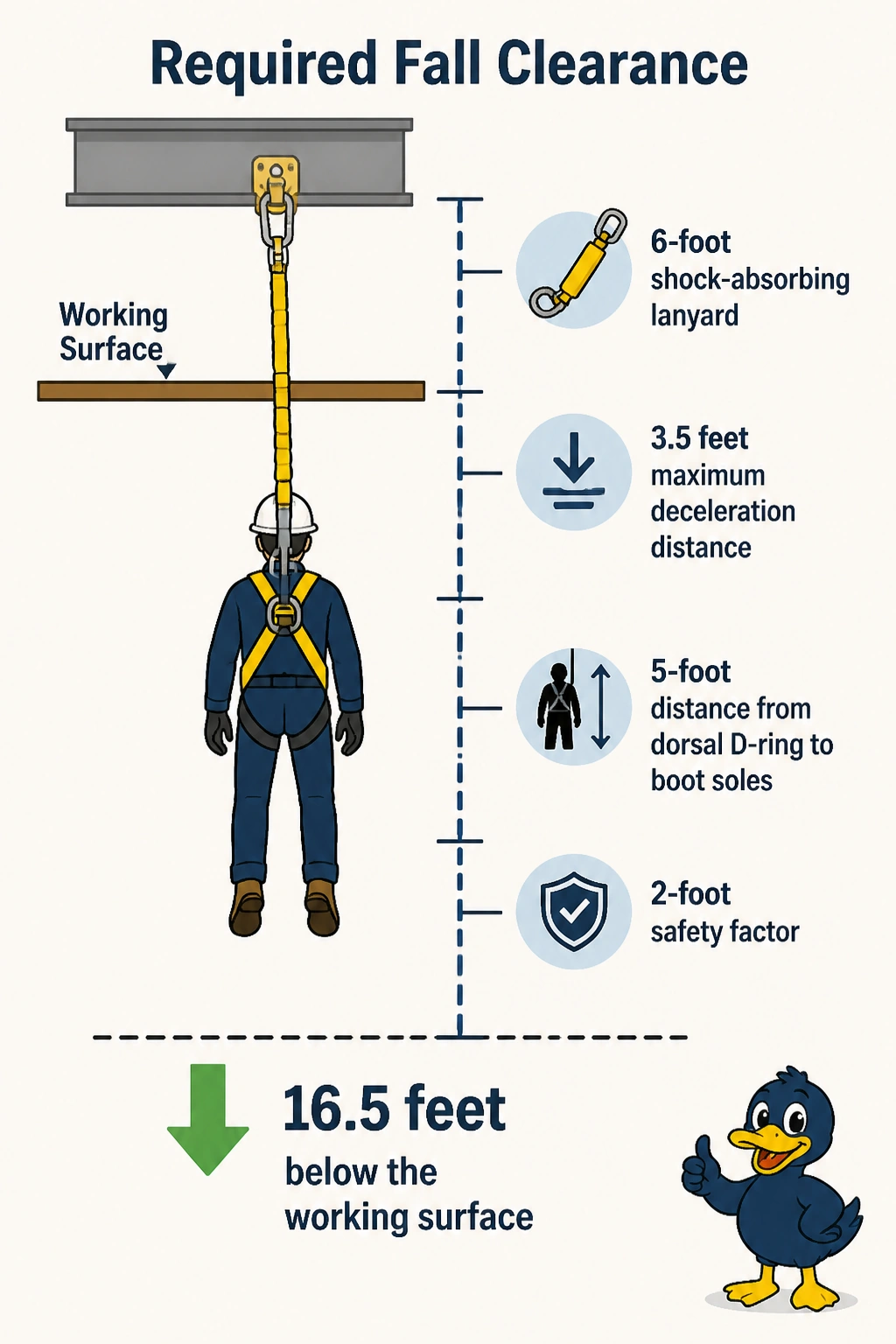
A maintenance technician works on an elevated platform using a personal fall arrest system anchored at foot level with a 6-foot shock-absorbing lanyard. Assuming a maximum deceleration distance of 3.5 feet, a 5-foot distance from the technician's dorsal D-ring to the soles of their boots, and a 2-foot safety factor, what is the minimum required fall clearance below the platform?
Select an answer to reveal the explanation.
Short Explanation
Fall clearance math works like stacking blocks from the anchor down to the ground, and skipping even one block puts your worker at risk. The trap is forgetting the deceleration distance or the worker's own height below the D-ring.
Full Explanation
Calculating total fall clearance for a foot-level anchor requires summing every vertical component, which yields 16.5 feet below the working surface. Adding the 6.0-foot lanyard length, 3.5 feet of shock-absorber deceleration distance, 5.0 feet from the dorsal D-ring to the boot soles, and the 2.0-foot safety factor equals 16.5 feet. Selecting 14.5 feet below the working surface omits the 2.0-foot safety factor, leaving zero margin for harness stretch or platform deflection. Selecting 13.0 feet below the working surface drops the 3.5-foot deceleration distance, which only applies if the energy absorber never deploys. Selecting 11.5 feet below the elevated platform leaves out the 5.0-foot D-ring-to-soles distance, which would allow the worker's feet to strike the lower level before arrest completes. As a caveat, anchoring overhead reduces free-fall distance and total required clearance compared with foot-level tie-off. For an operational check, measure the actual vertical distance from the walking surface to the nearest lower obstruction with a tape measure before authorizing lanyard use, and switch to a self-retracting lifeline if clearance is tight.
Prefer to study offline? Printable PDF study book + test engine ($7.50, unofficial). These questions stay free here.