
An occupational health nurse reviews annual audiograms for stamping-press operators enrolled in a hearing conservation program. Under OSHA's Occupational Noise Exposure standard (29 CFR 1910.95), which finding defines a Standard Threshold Shift (STS)?
Select an answer to reveal the explanation.
Short Explanation
Think of an audiogram like a baseline snapshot—you are looking for a real, sustained change across the speech-and-noise-sensitive frequencies, not a one-off blip. The trap is reacting to a single-frequency dip or an absolute decibel level instead of comparing the three-frequency average against your worker's baseline.
Full Explanation
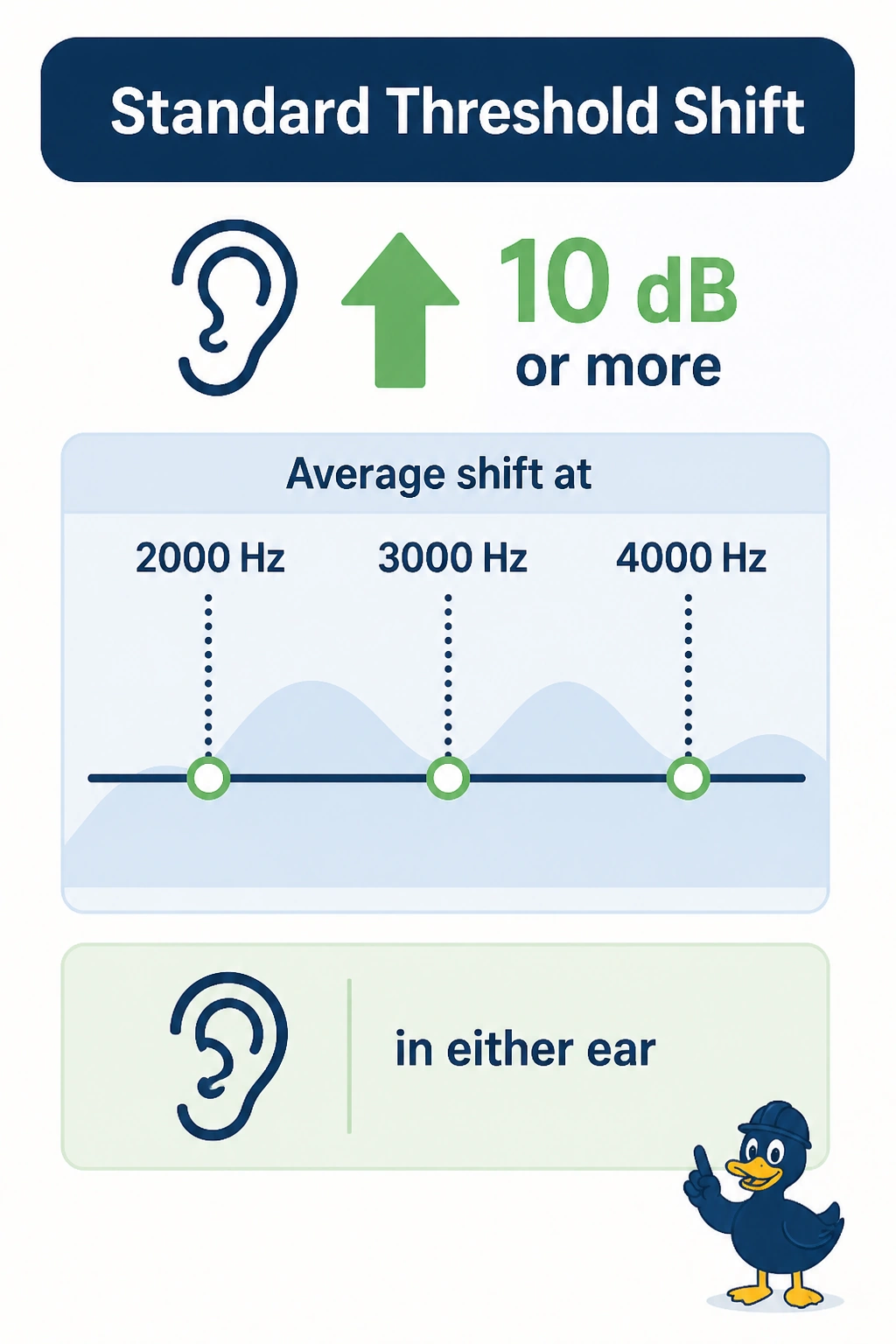
Under OSHA's Occupational Noise Exposure standard (29 CFR 1910.95), a Standard Threshold Shift is defined as a change in hearing threshold relative to the baseline audiogram of an average of 10 dB or more at 2000, 3000, and 4000 Hz in either ear, which makes An average shift of 10 dB or more at 2000, 3000, and 4000 Hz in either ear the correct criterion. Averaging across those three higher frequencies filters out minor test-to-test variation while capturing early noise-induced damage. A single-frequency 5 dB drop at 4000 Hz compared with the worker's prior annual test falls below the 10 dB multi-frequency average threshold and compares to the prior annual test rather than the baseline. Any measured hearing threshold exceeding 25 dB HL at 500 Hz in the worker's dominant ear tests an absolute level at a low speech frequency rather than a shift from baseline. A temporary threshold shift of 10 dB at 1000 Hz that resolves after a 14-hour quiet period reflects transient fatigue outside the 2000-4000 Hz averaging band. As an exam caveat, age-correction tables may be applied when evaluating an STS, though baseline comparison remains mandatory. Operationally, verify that workers have at least 14 hours without workplace noise before baseline audiograms and retest within 30 days if an STS appears.
Prefer to study offline? Printable PDF study book + test engine ($7.50, unofficial). These questions stay free here.