
A laboratory technician handles a sealed alpha-emitting calibration source and asks why the same isotope becomes far more hazardous if accidentally inhaled as dust rather than held near gloved hands. Which statement accurately explains the biological hazard of alpha radiation?
Select an answer to reveal the explanation.
Short Explanation
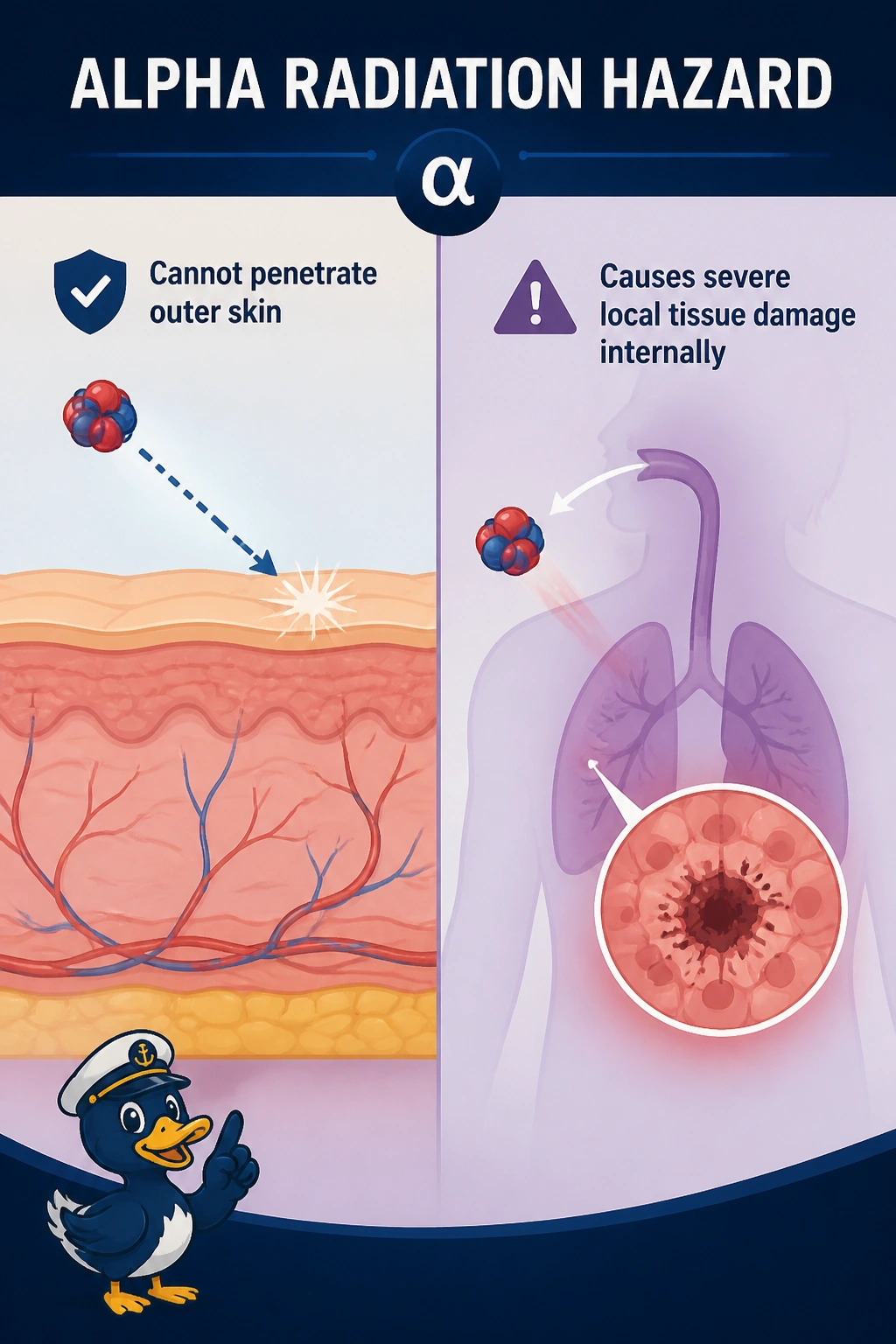
Think of alpha radiation like a bowling ball on bubble wrap: it stops at your outer dead skin, but inside your lungs it wrecks everything it touches. The trap is assuming that because a sheet of paper blocks alpha particles outside the body, the isotope is harmless if breathed in.
Full Explanation
Alpha radiation consists of heavy, doubly charged helium nuclei that lose energy rapidly in matter, which is why alpha particles cannot penetrate outer skin but cause severe local tissue damage internally. Outside the body, the dead outer layer of epidermis blocks alpha particles, yet if an alpha emitter is inhaled or ingested, it sits directly against living alveolar or gastrointestinal cells and deposits intense ionizing energy along a microscopic track. Claiming that alpha particles travel farther through air than gamma rays before losing their kinetic energy is incorrect because alpha particles have a range of only a few centimeters in air, whereas gamma photons travel long distances. Stating that alpha particles pass completely through the body and require thick lead walls for shielding confuses alpha particles with penetrating gamma rays or X-rays; a simple sheet of paper stops alpha particles externally. Arguing that alpha particles convert stable atoms in room air into radioactive isotopes upon brief contact describes neutron activation rather than alpha decay. As a caveat, sealed alpha sources remain low-risk externally only while their encapsulation stays intact. As an operational check, perform routine wipe tests on sealed sources and enforce strict no-eating, no-drinking, and local exhaust controls whenever unsealed alpha powders are handled.
Prefer to study offline? Printable PDF study book + test engine ($7.50, unofficial). These questions stay free here.