
An industrial hygienist evaluates workers exposed simultaneously to two hepatotoxic solvents whose combined toxic effect on the liver is substantially greater than the sum of their individual effects if each occurred alone. Which toxicological interaction describes this combined effect?
Select an answer to reveal the explanation.
Short Explanation
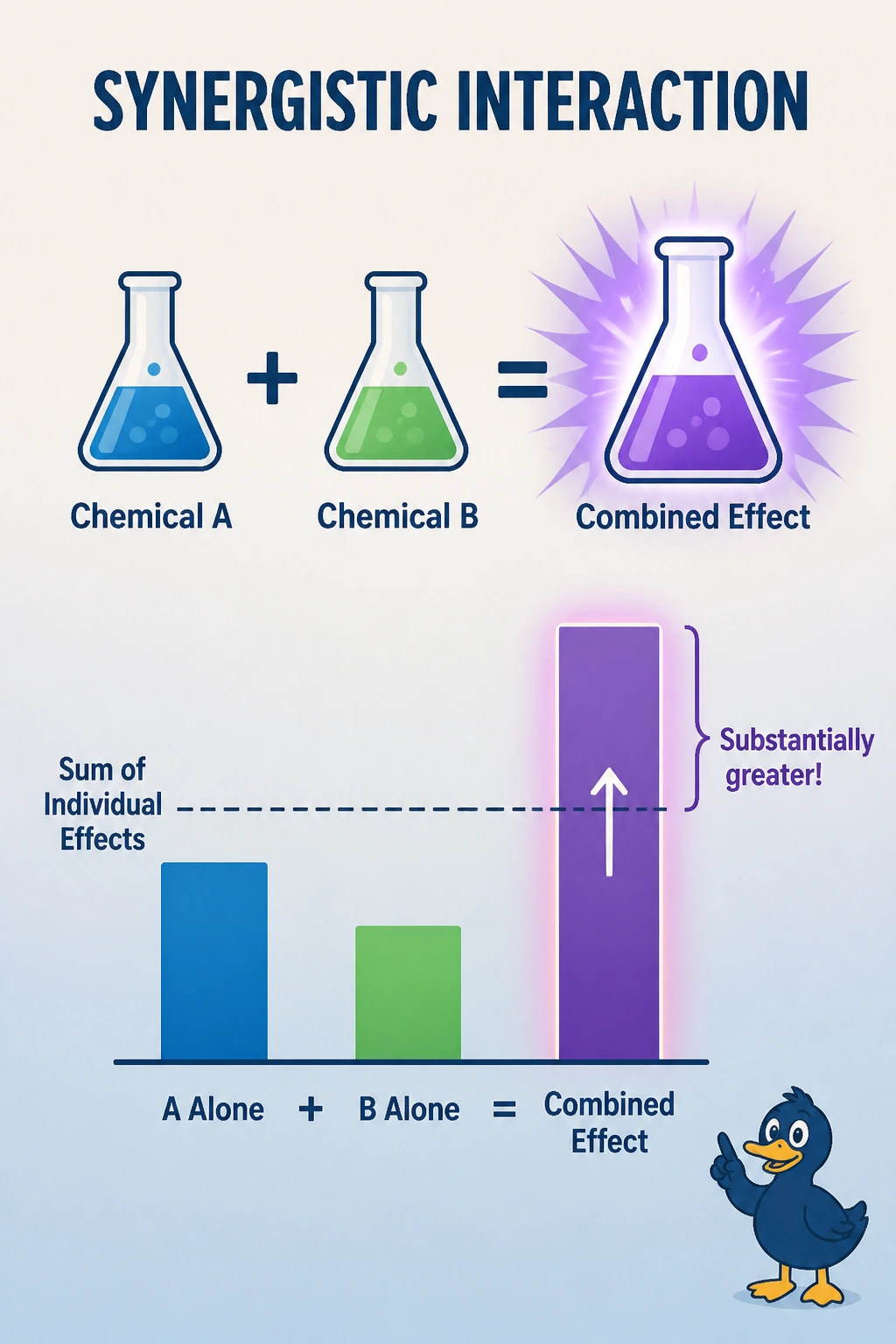
In toxicology, one plus one does not always equal two—sometimes two solvents team up and hit the liver like ten. The trap is mixing up synergism with potentiation or simple addition. When two toxic chemicals together cause far more harm than their sum alone, you are looking at a synergistic interaction.
Full Explanation
When two toxic agents act together to produce a combined biological effect far exceeding the sum of their individual effects, toxicology classifies that response as A synergistic interaction. Recognizing synergism matters because evaluating each solvent separately against its single-substance Permissible Exposure Limit can underestimate actual liver injury. Choosing An antagonistic interaction describes the opposite phenomenon, where two chemicals interfere with each other so the combined effect is weaker than expected from their individual toxicities. Selecting An additive interaction applies when the combined effect simply equals the arithmetic sum of the individual effects, which is the default assumption for OSHA mixture calculations unless evidence shows otherwise. Picking A potentiating interaction refers specifically to a case where a substance that has no toxic effect of its own makes another chemical much more toxic, whereas here both solvents are independently hepatotoxic. As a caveat, many workplace mixtures have limited human interaction data, so industrial hygienists still apply conservative controls when multiple organ-specific toxins coexist. For an operational check, review Safety Data Sheets for target-organ overlap and verify local exhaust controls keep mixed-vapor exposures well below combined limits.
Prefer to study offline? Printable PDF study book + test engine ($7.50, unofficial). These questions stay free here.