
An industrial hygienist needs to determine whether welders moving across several fabrication bays exceed the 8-hour Permissible Exposure Limit for hexavalent chromium. Which air-sampling strategy provides the most accurate compliance data?
Select an answer to reveal the explanation.
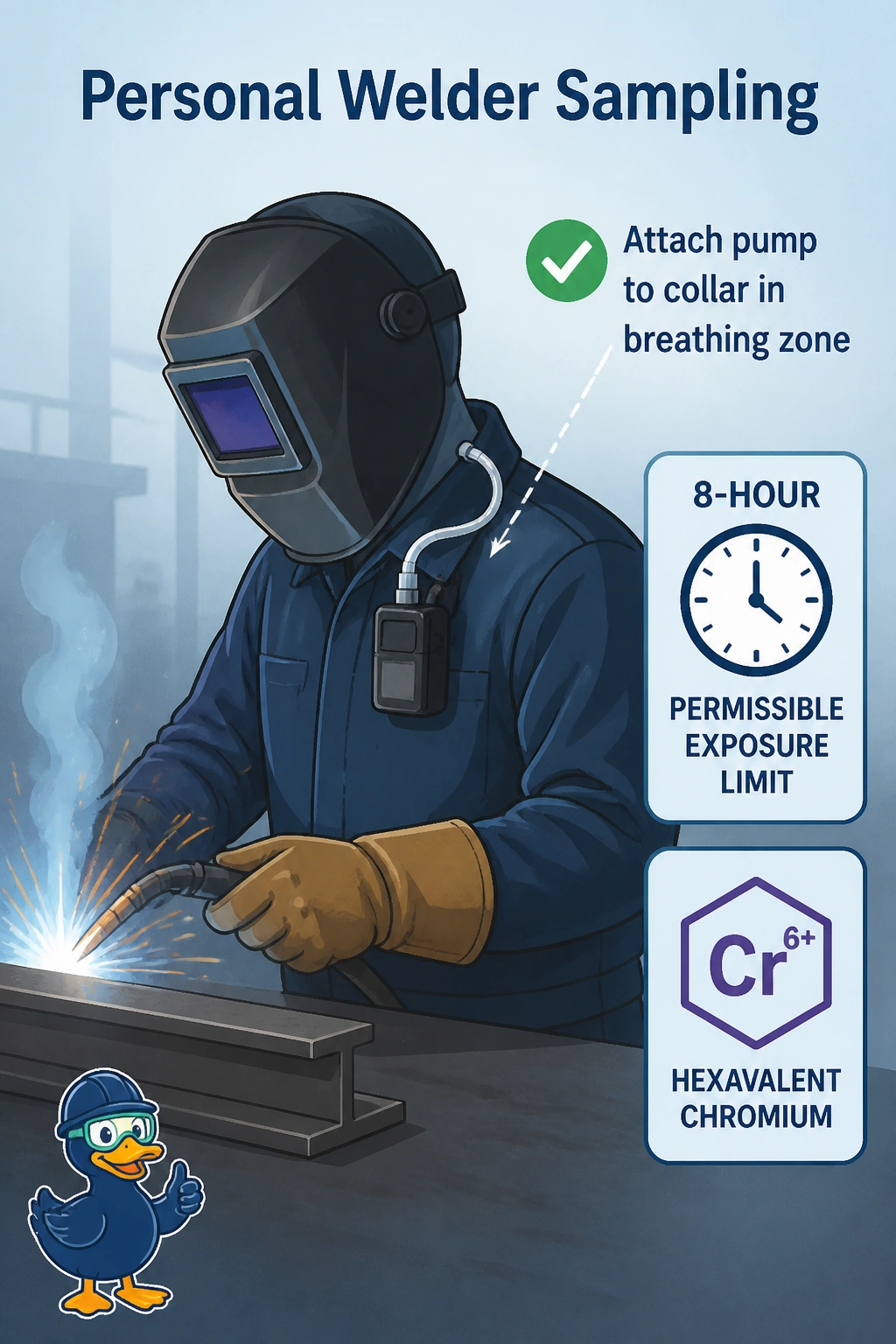
Short Explanation
To know what a mobile welder actually inhales, you have to sample the air right next to their nose and mouth, not across the room on a column. The trap is relying on stationary area monitors or quick grab samples that miss your worker's true full-shift exposure.
Full Explanation
OSHA compliance with an 8-hour Time-Weighted Average Permissible Exposure Limit requires measuring the contaminant concentration actually inhaled by the worker over the full shift. Attaching personal sampling pumps to each welder's collar in the breathing zone places the filter cassette within roughly 6 to 9 inches of the nose and mouth, capturing true exposure as the welder moves between bays. Placing stationary area monitors on roof columns near the central welding bay measures ambient room concentrations rather than the plume rising directly under a welder's helmet. Collecting instantaneous grab samples with colorimetric detector tubes at mid-shift provides only a brief snapshot that cannot represent an 8-hour TWA across changing tasks. Measuring exhaust fan static pressure at the main rooftop dust collector verifies ventilation airflow performance rather than airborne chemical concentration. As a caveat, for welding, position the sampling cassette inside the welding helmet when evaluating true breathing-zone fume exposure per OSHA guidance. Operationally, calibrate each personal pump before and after the shift with a primary flow calibrator and submit field blanks with the laboratory samples.
Prefer to study offline? Printable PDF study book + test engine ($7.50, unofficial). These questions stay free here.