
A plating shop plans to install an overhead canopy hood above an open tank of heated chromic acid where operators lean over the tank rim to dip parts. Why should an industrial hygienist reject a canopy hood for this operation?
Select an answer to reveal the explanation.
Short Explanation
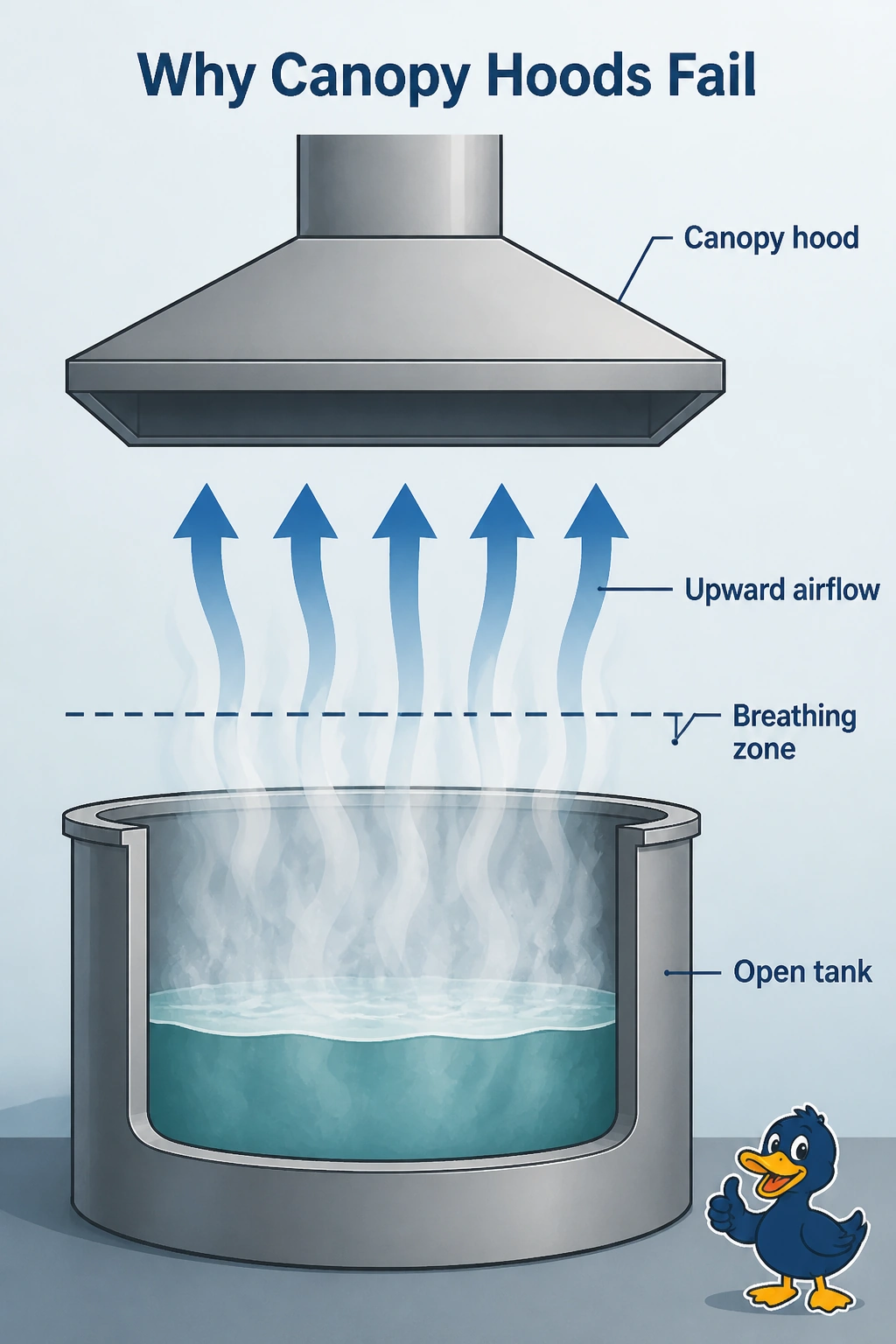
When you picture an operator leaning over a heated acid tank, you can see why a canopy hood is a poor fit: its upward airflow carries mist past the operator’s face. The key hazard is exposure in the breathing zone before the hood captures the mist.
Full Explanation
An industrial hygienist should reject a canopy hood because its upward airflow draws contaminated air directly past the worker’s breathing zone. When an operator leans over an open tank, rising chromic acid mist can pass the face before the hood captures it, increasing inhalation exposure instead of controlling the contaminant before it reaches the worker. The claim that canopy hoods cannot handle heated air plumes from open-surface tanks is incorrect: these hoods can use thermal buoyancy to capture a rising plume when workers are not beneath it. The claim that an overhead hood requires higher static pressure than a full enclosure at the same face velocity also misidentifies the concern; the problem is that capture velocity falls rapidly with distance, not that the hood necessarily has greater resistance. The claim that canopy hoods violate OSHA standards unless exhaust passes through a HEPA stage confuses hood design with air-cleaning requirements: hood geometry alone does not establish that a HEPA filter is required. Exam caveat: a canopy hood can be effective for an automated or enclosed hot process when workers do not lean beneath the plume. Practical check: use smoke tubes at the tank rim during dipping to see whether airflow carries mist across the operator’s face before capture.
Prefer to study offline? Printable PDF study book + test engine ($7.50, unofficial). These questions stay free here.